The Loneliness of Being the Strong One
Need Home Care?
Contact Us Today
Everyone calls you because you handle things.
You are the one who keeps track of the appointments. The one who knows which medications are taken when. The one the siblings call when they need to know how things are going. The one who holds things together when someone else falls apart.
You are the strong one.
And you are more alone than you have ever been in your life.
Not because people are not present. They are, in their way. But the role you inhabit, the one everyone needs you to inhabit, leaves almost no room for anyone to ask how you are doing and really mean it. Because you are the one who handles things. You do not need handling.
This is one of the least discussed and most quietly devastating features of being a primary caregiver.
What the research shows
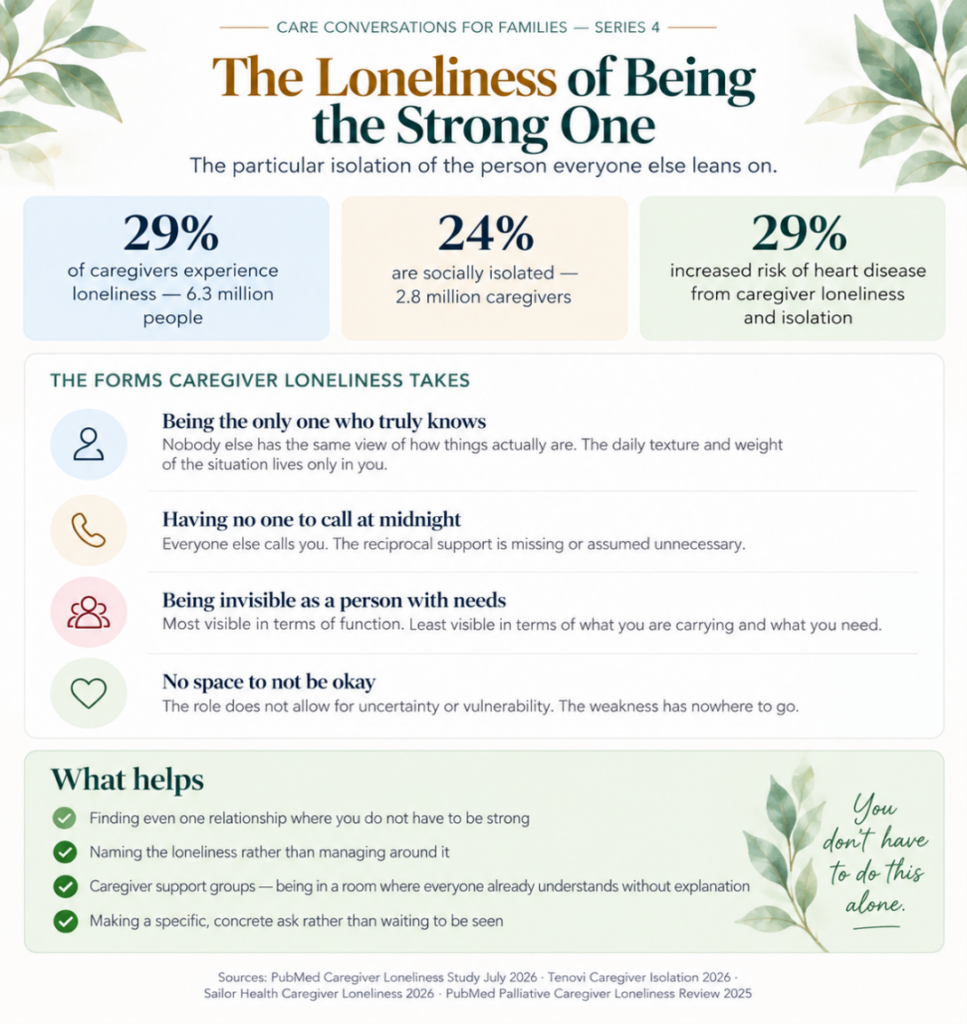
Almost one quarter of caregivers were socially isolated and 29% experienced loneliness. The results estimate that 2.8 million caregivers are socially isolated and 6.3 million caregivers feel lonely. PubMedTenovi
Those numbers deserve a moment to sit with. They are not describing people who are physically alone. They are describing people surrounded by family, by need, by the constant presence of the person they are caring for, who still experience profound loneliness and isolation.
While often used interchangeably, caregiver isolation and caregiver loneliness are distinct experiences. Caregiver isolation refers to the state of being socially disconnected — few social contacts, not participating in community or social activities, or physical separation from others due to caregiving duties. Caregiver loneliness is an emotional experience. Tenovi
The distinction matters. You can be at a family dinner, surrounded by people who love you, and feel completely, utterly alone. Because loneliness is not about the number of people in the room. It is about whether the person you actually are, with everything you are currently carrying, is visible to anyone in it.
The particular loneliness of the strong one
There is a specific form of loneliness that attaches to being the person everyone else leans on.
It is the loneliness of never getting to put your weight down on someone else. Of being the emotional first responder in every situation. Of knowing that if you admitted how tired or frightened or overwhelmed you were, the people around you would not know what to do with that information. Because you are not supposed to be the one who is tired or frightened or overwhelmed.
Many caregivers can feel invisible because they often have a thankless job. They go unnoticed by others despite being their loved one’s nurse, housekeeper, and advocate. Sailorhealth
Invisible is exactly the right word. The strong one is the most visible person in the family system in terms of function. And the most invisible in terms of need.
There is also often an unspoken agreement at the heart of this dynamic. At some point, perhaps long before the caregiving began, you became the person who holds things together. People stopped asking if you were okay not because they do not care, but because the role had become so established that it no longer occurred to them that you might not be. You trained them, without meaning to, by always being fine.
The health cost of carrying it alone
Loneliness among caregivers is not just an emotional experience. Social isolation and loneliness were associated with a 29% increased risk of heart disease. The physical body does not distinguish between emotional isolation and physical danger. Both activate the same stress response systems. Both exact the same physiological toll over time. Tenovi
A systematic review of loneliness and social isolation in caregivers providing palliative care identified three overarching themes in how caregivers experience this: caring is complex, lack of support, and what helps. What emerges from caregivers’ own descriptions of their experience is the layered nature of the isolation. It is not just that they are alone. It is that the nature of what they are doing makes connection harder to maintain, and the role itself makes it harder to ask for what they need.
What the strong one actually needs
The strong one needs, more than almost anything, one relationship in which they do not have to be strong.
One person. One place. One conversation in which the weight can be set down without judgment or anxiety from the person receiving it. That might be a therapist. It might be a caregiver support group where everyone in the room already understands without needing an explanation. It might be a sibling who is genuinely willing to listen rather than just check in. It might be a trusted friend who has the capacity to hold what you are carrying.
Caregiver support groups work not because they solve the logistics of caregiving but because they temporarily dissolve the isolation of it. For an hour, you are not the only one. That changes something.
What does not work, over time, is continuing to absorb everything without release. The loneliness that comes from never being allowed to need anything is a kind of long-term injury. It compounds. And it makes the caregiving itself harder, not because strength is wrong but because strength without replenishment eventually runs out.
On asking for help
The strong one is often the last person to ask for help directly. Partly because asking feels like weakness. Partly because they are not sure anyone else can handle what they would ask them to handle. Partly because self-sufficiency has become so embedded it no longer feels like a habit. It feels like identity.
But asking is a skill. It can be practiced. And the most effective ask tends to be specific. Not “I need more support” but “I need someone to take the Tuesday appointment next week so I can have that afternoon to myself.” Specific asks give people something concrete to say yes to.
Most people who love you are waiting to be asked in a way that tells them exactly what to do.
One thing to do this week
Think of one person in your life who would want to support you if they knew how.
Then tell them one specific thing. Not everything. One honest thing.
Not because you need to unload everything at once. Because the strong one deserves to have someone who knows what they are carrying. And because carrying something alone for too long is not strength. It is just alone.
Next in the series: What Caregiving Does to a Marriage or Partnership. Publishing October 2.
Nobody Told Me It Would Feel Like This is a series from Care Conversations for Families, exploring the interior life of loving someone through illness.

The Most Comprehensive Care In The Industry

Physical Wellness
We make daily life easier as needs change, with support for personal care, mobility, medication reminders, and recovery after a hospital stay.
Learn More
Mental Well-Being
Staying active and connected matters. Our caregivers provide companionship and meaningful engagement to support emotional health and independence.
Learn More
Nutrition & Hydration
Healthy meals and proper hydration are essential. We help with planning, shopping, and preparation to support daily wellness and energy.
Learn More
Active Connections
Strong relationships bring comfort and purpose. We help seniors stay connected through social engagement, technology, and regular check-ins.
Learn More