
The Permission to Rest: Why Caregivers Resist Help and How to Accept It
Need Home Care?
Contact Us Today

Someone offers to help. A family member, a friend, a professional caregiver. The offer is genuine. The need for a break is real. And something in you hesitates.
Not because the offer is unwelcome. But because accepting it means stepping back from a role you have organized your entire life around. It means trusting someone else with something you have been managing alone. And it means, at some level, admitting that you cannot sustain all of this indefinitely without relief.
That admission feels, to many caregivers, like failure.
It is not failure. It is the most accurate assessment of a human situation that exists. And the resistance to accepting help is one of the most well-documented and least-addressed features of family caregiving.
Why do caregivers resist accepting help?
Caregivers resist accepting help for several documented reasons, most of which have more to do with identity and guilt than with practical barriers.
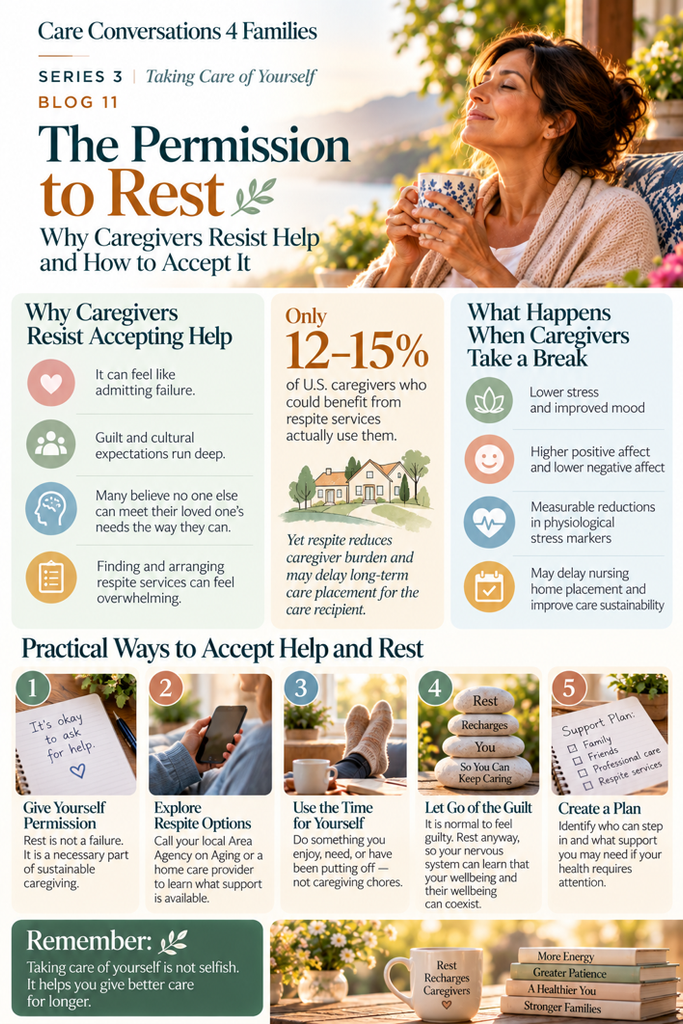
Asking for help can feel like admitting failure. Guilt and cultural expectations run deep, especially in families where caring for a loved one is understood as a duty performed personally, not delegated. This pattern appears consistently across racial and cultural groups, though the specific framing varies.
Beyond guilt, caregivers frequently believe no one else can replicate the knowledge they have developed about their loved one’s needs, preferences, rhythms, and fears. This belief is understandable — and also, in most cases, a barrier to something that would benefit everyone.
The practical friction of accessing professional respite care is also a genuine barrier. Many caregivers do not use available services because identifying them, evaluating them, arranging them, and determining what insurance covers requires effort that caregivers do not have in surplus. The friction itself becomes a reason not to proceed.
Only 12 to 15 percent of US caregivers who could benefit from respite services report actually using them, despite substantial evidence that respite reduces caregiver burden and may delay long-term care placement for the care recipient.
What happens when caregivers do take a break
The evidence on what happens when caregivers accept help is consistent and worth knowing directly.
Regular use of adult day services and respite programs is associated with reduced caregiver stress, improved mood, and measurable reductions in physiological stress markers. Caregivers who use these services report lower negative affect and higher positive affect on the days they do so. Respite use is also associated with delayed nursing home placement, which reflects improved overall care sustainability.
Caregivers who used respite time to do what they had most desired, needed, or planned to do — not to catch up on caregiving logistics, but to do something for themselves — reported the highest levels of wellbeing over time, including lower caregiver burden and fewer depressive symptoms. Permission to use the break for yourself is not incidental to how respite works. It is the mechanism by which respite works.
What to do with the guilt that arrives with the break
Many caregivers who do take a break report that the relief is immediately followed by guilt. They are relaxed. They are not worried, for an hour, about the person at home. And the guilt arrives: how can I be resting when they are not? How can I be okay when they are not?
This guilt is real. It is also not useful information. It does not tell you that you should not be resting. It tells you that you have been in the role long enough that stepping outside of it feels wrong — even when it is necessary and appropriate.
The way through this is not to suppress the guilt. It is to rest anyway, until the nervous system learns that your wellbeing and your loved one’s wellbeing can coexist. That you can be okay and they can be okay, simultaneously, with someone else in the room.
How to find respite and caregiver support services
The Eldercare Locator, available at eldercare.acl.gov or by phone at 1-800-677-1116, connects caregivers to local Area Agencies on Aging, which coordinate respite services, adult day programs, in-home support, and caregiver support groups in most communities. Many services are available on a sliding scale or at no cost.
Home Helpers Home Care provides in-home care that can serve as planned respite, allowing family caregivers a defined break while professional care continues in the home.
Frequently asked questions
Is it okay for a caregiver to take time off?
Yes. Rest is not an indulgence — it is a functional requirement of sustainable caregiving. Research consistently shows that caregivers who take regular breaks provide better care over a longer period than those who do not.
What is respite care and how does it work?
Respite care is temporary, short-term relief for primary caregivers, provided by a trained professional or volunteer either in the home or at an adult day program or short-term facility. It can range from a few hours per week to an extended stay, depending on the caregiver’s and care recipient’s needs.
Why do caregivers feel guilty taking a break?
Caregiver guilt during rest is common and stems from the identity reorganization that long-term caregiving produces. When a caregiver’s sense of purpose becomes organized around availability to the care recipient, being unavailable feels wrong even when it is necessary. The guilt typically diminishes as regular rest becomes a normal part of the caregiving routine.
One thing to do this week
Identify one form of help you have been declining or not pursuing. Then take one step toward accepting it. Call your local Area Agency on Aging. Say yes to an offer that has been sitting on the table. Contact a home care provider about arranging a few hours of weekly respite. Rest is not the opposite of devotion. It is what makes devotion sustainable.
Next in the series: When Caregiving Changes Who You Are. Publishing October 26.
Nobody Told Me It Would Feel Like This is a series from Care Conversations for Families by Home Helpers Home Care, written by Dr. Gunjan Arya. Exploring the interior life of loving someone through illness.
The Most Comprehensive Care In The Industry

Physical Wellness
We make daily life easier as needs change, with support for personal care, mobility, medication reminders, and recovery after a hospital stay.
Learn More
Mental Well-Being
Staying active and connected matters. Our caregivers provide companionship and meaningful engagement to support emotional health and independence.
Learn More
Nutrition & Hydration
Healthy meals and proper hydration are essential. We help with planning, shopping, and preparation to support daily wellness and energy.
Learn More
Active Connections
Strong relationships bring comfort and purpose. We help seniors stay connected through social engagement, technology, and regular check-ins.
Learn More