
It Is Not Too Late to Have THE Conversation
Need Home Care?
Contact Us Today

Over the past eleven weeks, this series has covered a lot of ground together.
We talked about why families avoid these conversations and what that silence costs. We walked through the difference between home care and home health, palliative care and hospice. We covered Medicare and Medicaid, long-term care insurance, and the five ways families pay for senior care. We talked about legal authority and why a power of attorney cannot wait. About the driving conversation and how to have it without destroying the relationship. About what loved ones are afraid of that they have never said out loud.
We talked about forgiveness. About what young people carry in silence when someone they love is seriously ill. About what a good end of life actually looks like and how families can shape it. About the will conversation that tears families apart and the simple steps that prevent it. About how to find trustworthy home care. About where loved ones want to live when living alone is no longer fully safe.
It has been a lot.
Because caring for someone you love through serious illness or decline is a lot. It is one of the most emotionally demanding and practically complex things most families ever navigate. And they navigate it largely without a roadmap.
This series has been an attempt at a roadmap.
And this final post is for everyone who has read any part of it and is still sitting with the same question.
Where do I start?
You have not missed the window
The most common thing people say after reading a series like this is some version of: we are already behind. We should have had these conversations earlier. We missed the window.
Here is what is almost always true. You have not missed the window. You have arrived at the edge of it. Which is a different thing entirely.
There is almost always something left to do. A document that can still be signed. A conversation that can still be had. A wish that can still be expressed and honored. The window is almost never fully closed until the very end.
What changes as time passes is not whether something can be done. It is how many options remain and how much space there is to do things with care rather than urgency.
The family that starts today has more options than the family that starts after the next crisis. And the family that starts now, imperfectly and incompletely, is in a far better position than the family that waits for the perfect moment that never arrives.
What does not have to happen all at once
Reading a series like this one can feel overwhelming, as if there is an enormous checklist of things that should have been done and now must all be done immediately.
That is not how this works.
These conversations and decisions unfold across months and years. They happen in layers, with each conversation making the next one slightly easier. A family that has talked about legal documents finds the money conversation easier to start. A family that has talked about wishes finds the housing conversation less frightening. Each honest exchange builds the capacity for the next one.
Start with one thing. The most natural thing. The thing that is already on your mind.
Maybe it is finding out where the will is. Maybe it is asking your loved one what they are afraid of. Maybe it is calling the Eldercare Locator to understand what resources exist. Maybe it is sitting down with a sibling and saying we need to start talking about this.
Any of those is a beginning. And a beginning is everything.
What families who navigated this well have in common
Looking back across this series, there is a consistent pattern in the families who describe navigating a loved one’s serious illness or decline with the least regret.
They started before they felt ready. They asked questions before they had the answers. They had conversations that were imperfect and incomplete and followed up on them later. They kept the relationship at the center rather than letting the logistics crowd it out.
They were not always prepared. But they were present. They showed up before the crisis forced them to. They said the things that needed to be said while there was still space to say them well.
They were not special. They were just willing to start.
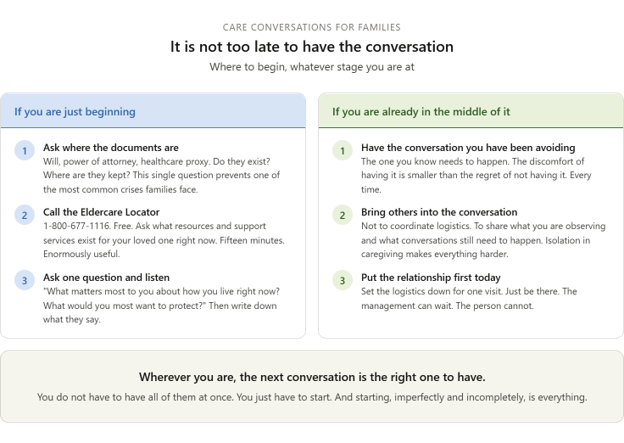
The infographic: where to begin, wherever you are
A final word to everyone who showed up
This series found you for a reason.
Maybe you are in the early stages of noticing something has changed in someone you love. Maybe you are already deep in the middle of caregiving and searching for language you did not have yet. Maybe you found one post through a friend who shared it and stayed for the rest. Maybe you are a professional who works with families and wanted to understand what they are going through.
Wherever you came from, you are here because someone in your life matters to you. And you are trying to do right by them with the resources, the information, and the courage you have.
That willingness, the willingness to look at the hard things while there is still time to act on what you find, is exactly what every conversation in this series has been about.
The families who navigate serious illness and decline with the least regret are not the ones who had everything figured out. They are the ones who stayed curious, stayed honest, and stayed present through the discomfort of not knowing exactly what came next.
They asked the questions. They had the imperfect conversations. They showed up even when showing up was hard.
They did not do it perfectly. They did it with love.
And love, expressed through the willingness to be honest with the people who matter most to you, is exactly what this series has been about from the beginning.
Thank you for being here. Whatever comes next for the people you love, and for you, you are not as alone in it as it sometimes feels.
Care Conversations for Families is published every Monday and Friday. Series 3, What We Wish We’d Said Sooner, concludes with this post. Thank you for reading, sharing, and showing up.
The Most Comprehensive Care In The Industry

Physical Wellness
We make daily life easier as needs change, with support for personal care, mobility, medication reminders, and recovery after a hospital stay.
Learn More
Mental Well-Being
Staying active and connected matters. Our caregivers provide companionship and meaningful engagement to support emotional health and independence.
Learn More
Nutrition & Hydration
Healthy meals and proper hydration are essential. We help with planning, shopping, and preparation to support daily wellness and energy.
Learn More
Active Connections
Strong relationships bring comfort and purpose. We help seniors stay connected through social engagement, technology, and regular check-ins.
Learn More