
From Promotion to Pause: How Caregiving Quietly Disrupts Careers
Need Home Care?
Contact Us Today

Caregiving does not only affect life at home. It can quietly reshape work life too.
For many working adults, caregiving rarely begins with one dramatic moment. It often starts small — a few more phone calls, more appointments to coordinate, more check-ins, and a growing awareness that someone you love now needs more from you than they did before.
At first, it may feel manageable.
You adjust your schedule. You leave work a little early. You answer calls between meetings. You move things around and try to keep everything going.
But over time, what felt temporary can begin to change the rhythm of everyday life.
It often looks manageable from the outside
That is part of what makes caregiving so difficult to name.
From the outside, the person doing it may still be showing up to work, meeting deadlines, attending meetings, and trying to stay dependable.
But internally, something has shifted.
There is more mental load. More emotional weight. More planning. More uncertainty. A workday no longer begins and ends with work. It is layered with reminders, follow-ups, worry, scheduling, and the constant feeling that something important could fall through the cracks.
Caregiving often becomes a second job that no one officially sees.
Career disruption is usually quiet
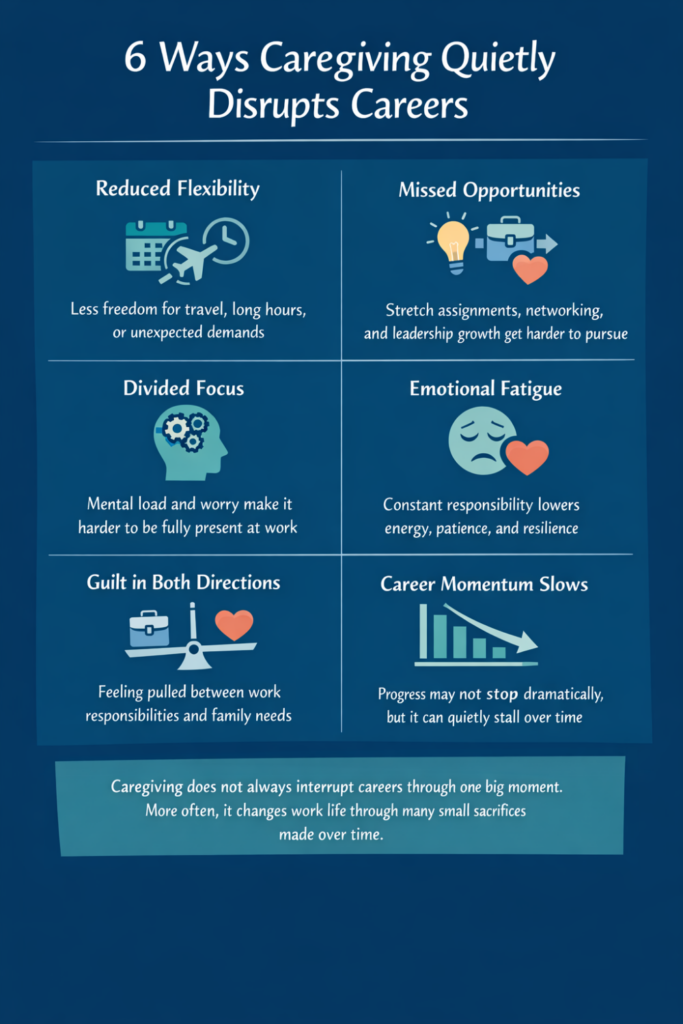
Caregiving does not always interrupt careers through one obvious moment.
More often, it shows up through smaller choices made again and again:
- saying no to travel
- avoiding stretch assignments
- declining leadership opportunities
- stepping back from networking
- using time off for appointments instead of rest
- arriving distracted or leaving early
- trying to perform at the same level while carrying much more behind the scenes
These choices may seem small on their own.
But over time, they can affect growth, visibility, confidence, and momentum.
The guilt is often constant
One of the hardest parts of caregiving is not only the work itself. It is the guilt that comes with it.
Guilt for not doing enough. Guilt for not being more available. Guilt for being at work when a loved one needs help. Guilt for being with a loved one while work is piling up. Guilt for feeling tired, frustrated, or stretched thin. Guilt for even thinking about needing help.
Many caregivers live in a constant tension between responsibility and limitation.
No matter where they are, part of them feels they should be somewhere else.
Why asking for help can feel like letting go
For many family caregivers, bringing in support is not just a practical decision. It is an emotional one.
It can feel like admitting that things have changed. It can feel like acknowledging that love and effort are no longer enough on their own. It can feel like stepping back from a role they have carried with devotion and pride.
Even when help is clearly needed, caregivers may wrestle with thoughts like:
Shouldn’t I be able to do this myself? Am I letting them down if I involve someone else? Does accepting help mean I am stepping back too much?
These feelings are deeply human.
But getting help is not the same as giving up.
It is not abandonment. It is not a lack of love. And it is not failure.
Often, it is one of the most responsible and compassionate choices a family can make.
The emotional strain follows people into work
Caregiving is not just logistical. It is emotional.
There is love in it. Responsibility in it. Sometimes gratitude. Sometimes grief. Often fear.
A caregiver may be thinking:
- Am I doing enough?
- What if something happens while I am at work?
- How long can I keep managing this pace?
- Why does it feel like I am failing in both places?
That emotional strain does not stay at home. It follows people into their workday. It affects focus, patience, creativity, and energy.
And because many caregivers do not want to appear unreliable, they often carry this stress quietly.
Why support matters sooner than people think
Many caregivers wait too long to acknowledge how much their work life is being affected.
They tell themselves it is just a busy season. That things will settle down. That they can push through a little longer.
But often, the strain builds gradually until it starts affecting health, relationships, job performance, or all three.
Support matters because it creates breathing room.
Breathing room to think clearly. Breathing room to rest. Breathing room to show up at work without carrying every responsibility alone. Breathing room to care with more steadiness and less exhaustion.
And perhaps most importantly, breathing room to understand that sharing the load is not the same as letting go of love.
Final thought
Caregiving does not only change schedules.
It can change momentum.
It can affect how people work, what they take on, what they delay, and what they quietly give up to keep someone they love safe and supported.
It can also bring an emotional burden that is harder to talk about: the guilt of not being enough for everyone, and the fear that accepting help somehow means letting go.
But letting others support you is not the same as letting go of your loved one.
Sometimes it is how you continue showing up with more strength, more clarity, and more compassion.
Because sometimes the strongest people are not the ones carrying everything alone.
Sometimes they are the ones willing to admit that the load has become too heavy to carry without help.
The Most Comprehensive Care In The Industry

Physical Wellness
We make daily life easier as needs change, with support for personal care, mobility, medication reminders, and recovery after a hospital stay.
Learn More
Mental Well-Being
Staying active and connected matters. Our caregivers provide companionship and meaningful engagement to support emotional health and independence.
Learn More
Nutrition & Hydration
Healthy meals and proper hydration are essential. We help with planning, shopping, and preparation to support daily wellness and energy.
Learn More
Active Connections
Strong relationships bring comfort and purpose. We help seniors stay connected through social engagement, technology, and regular check-ins.
Learn More