Who Takes Care of the Caregiver?
Need Home Care?
Contact Us Today

Family caregivers in the United States provide an estimated $600 billion in unpaid care annually. They coordinate medications, manage appointments, handle crises, and reorganize their entire lives around someone else’s needs. And in the middle of all of that, most of them are not being taken care of themselves.
Who takes care of the caregiver? In most families, the honest answer is: not enough people, and not enough of the caregiver themselves.
This matters not just for the caregiver’s own wellbeing. It matters for the quality and sustainability of the care they are providing. A caregiver whose health is declining cannot give good care. A caregiver running on empty will eventually break in ways that are costly for everyone, including the person they are trying to protect.
Why caregiver health declines during caregiving
Caregiver health declines primarily because the role crowds out the time, attention, and energy available for the caregiver’s own medical and emotional needs. The process is gradual. Appointments get deferred. Sleep gets disrupted. Social connections narrow. Exercise stops. By the time the decline is noticeable, it has been accumulating for months.
63 million Americans are now family caregivers, a nearly 50 percent increase since 2015. Over 40 percent now provide high-intensity care, performing complex medical tasks like administering injections or managing equipment, yet only 22 percent receive any training to do so. Nearly one in five caregivers rates their own health as fair or poor, directly attributable to caregiving responsibilities. A 2025 umbrella review across dozens of studies put the median prevalence of depression among informal caregivers at roughly 33 percent and anxiety at roughly 35 percent.
The physical toll is equally measurable. Family caregivers experiencing chronic stress have a 23 percent higher risk of developing heart disease compared to non-caregivers their age. Caregiver wounds heal 24 percent more slowly than those of non-caregivers, reflecting impaired immune function. Over 70 percent of family caregivers report that caregiving has negatively affected their sleep.
These are not statistics about a vulnerable minority. They describe the majority experience of long-term family caregiving.
What stops caregivers from prioritizing their own health
The most common reason caregivers give for not attending to their own health is time. A caregiver providing 25 or more hours of care per week alongside employment and other responsibilities has very little surplus available. Something gets sacrificed, and what most easily gets sacrificed is the caregiver’s own maintenance.
There is also a more subtle dynamic. Many caregivers have come to define their value in terms of their availability to the person they care for. Taking time for their own needs feels, at some level, like taking it away from someone who needs it more. This is a thought pattern, not a fact — but it functions like a fact until it is examined directly.
And there is the simple reality that nobody is asking after the caregiver. The medical system asks after the care recipient. The family asks about the care recipient. The caregiver becomes so organized around another person’s needs that their own disappear from the conversation, including their own internal one.
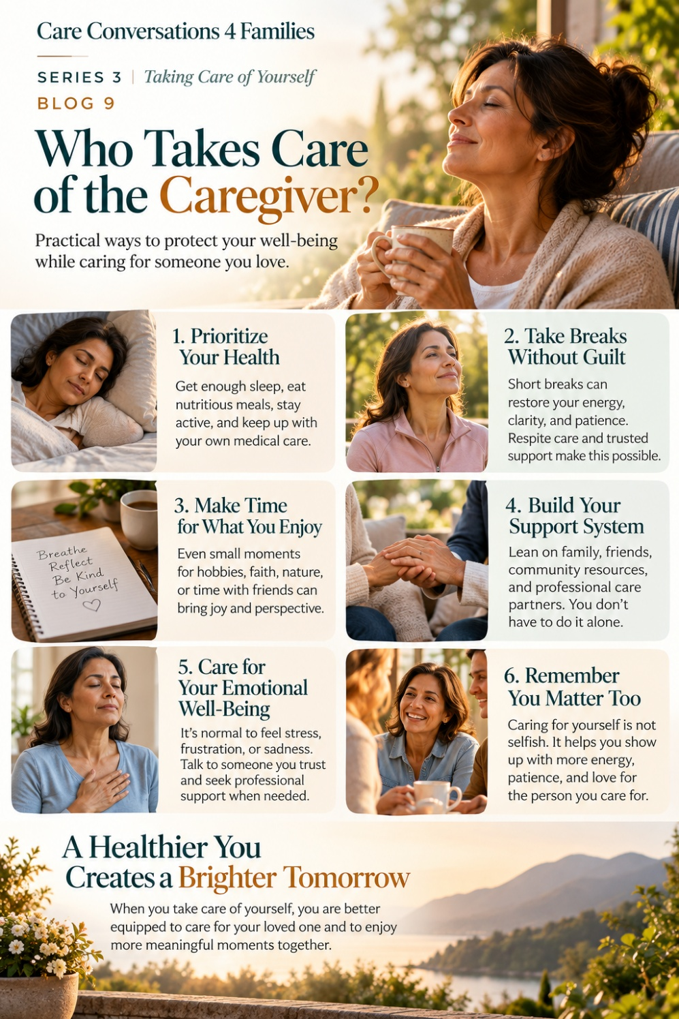
How caregivers who stay healthy actually do it
Caregivers who sustain their own health over the long term are not the ones who sacrifice the most. They are the ones who treat their own needs as a non-negotiable parallel responsibility rather than a secondary one.
In practice, this looks like a few specific behaviors. They schedule and keep medical appointments for themselves, and treat those appointments with the same priority as appointments made for the person they care for. They identify at least one relationship in which they are the one being asked after, rather than the one providing. They tell their own physician explicitly that they are a caregiver, so the full context of their stress load is part of their care.
They also allow other people to take over the care, even briefly, so they can exist as something other than a caregiver for a defined window of time. And they use that time for something restorative rather than catching up on logistics.
What family members and friends can do
If you are not the primary caregiver but someone in your life is, the single most useful thing you can do is not offer help in general. Offer help specifically. Not “let me know if you need anything” but “I am coming over Tuesday afternoon — what can I take off your list?” The caregiver who has to orchestrate their own relief is still the one doing the work.
Asking directly how they are doing — and waiting for a real answer rather than accepting “fine” — matters more than most people realize. The strong one is rarely asked.
Frequently asked questions
What does caregiver health decline actually look like?
Caregiver health decline typically presents as deferred medical care, disrupted sleep, social withdrawal, worsening of pre-existing conditions, and increasing rates of depression and anxiety. It develops gradually rather than through a single crisis, which is why it is often not recognized until it has become significant.
How does caregiver stress affect physical health?
Chronic caregiving stress is associated with a 23 percent higher risk of heart disease, measurably impaired immune function (wounds heal 24 percent more slowly), and sleep disruption in over 70 percent of caregivers. The physiological effects are real and cumulative.
What can caregivers do to protect their own health?
The most effective approaches involve treating personal health maintenance as a scheduled, non-negotiable responsibility rather than something to attend to when time allows. This includes keeping medical appointments, being transparent with a physician about caregiving demands, and using respite time for genuine restoration rather than additional tasks.
One thing to do this week
Schedule one appointment for yourself this week that has nothing to do with the person you care for. A doctor’s visit, a walk with a friend, one hour that belongs to you. Put it in the calendar the way you would put in a medical appointment. And keep it.
Next in the series: When the Caregiver Is Also Managing Their Own Health. Publishing October 19.
Nobody Told Me It Would Feel Like This is a series from Care Conversations for Families by Home Helpers Home Care, written by Dr. Gunjan Arya. Exploring the interior life of loving someone through illness.
The Most Comprehensive Care In The Industry

Physical Wellness
We make daily life easier as needs change, with support for personal care, mobility, medication reminders, and recovery after a hospital stay.
Learn More
Mental Well-Being
Staying active and connected matters. Our caregivers provide companionship and meaningful engagement to support emotional health and independence.
Learn More
Nutrition & Hydration
Healthy meals and proper hydration are essential. We help with planning, shopping, and preparation to support daily wellness and energy.
Learn More
Active Connections
Strong relationships bring comfort and purpose. We help seniors stay connected through social engagement, technology, and regular check-ins.
Learn More