When You Are Caring for Someone You Have a Complicated History With
Need Home Care?
Contact Us Today
Not every caregiving story begins with warmth.
Some begin with a parent who was absent. Or critical. Or unpredictable. Or cruel. Some begin with a sibling who broke something that was never quite repaired. Some begin with a loved one whose drinking, or anger, or pattern of behavior shaped the family in ways that left lasting marks.
And yet here you are. Showing up. Making appointments. Managing medications. Sitting beside someone whose history with you is not simple — and maybe never was.
If you are caring for someone you have a complicated history with, this post is for you.
The caregiving story nobody tells
Nobody writes much about this kind of caregiving. The cultural narrative of care is organized around love: you show up because of love, you sustain it through love, the experience finds its meaning through love.
That narrative is real for many people. And it is incomplete for many others.
There are people caring for parents who hurt them. Caring for siblings who were never kind. Caring for ex-partners to whom they are bound through children. Caring for people whose behavior, across many years, gave them every reason to walk away.
They are doing it anyway. Sometimes out of obligation. Sometimes out of guilt. Sometimes because they cannot find a way not to. Sometimes because they believe it is the right thing to do even when it does not feel like love. Sometimes because somewhere inside, they still hope to find the relationship they always wanted to have.
All of these are real motivations. None of them are shameful.
What makes this kind of caregiving harder
Research on family caregivers consistently finds that the quality of the prior relationship shapes the caregiving experience significantly. When caregivers report a history of conflict, neglect, or abuse, they carry measurably higher rates of emotional distress, depression, and caregiver burden. The caregiving itself is not necessarily harder in a physical sense. But the emotional weight is different in kind.
When the relationship has a complicated history, several things become more difficult at once.
The normal grief of caregiving — watching someone decline, mourning what is being lost — gets tangled up with older grief. You are not just losing the person they are becoming. You may also be losing the hope of getting what you never received from them. The reconciliation that did not happen. The acknowledgment that never came. The apology. The relationship you wished you had always had. There is also the anger that resurfaces. Old wounds do not stay dormant just because someone is sick. You may find yourself in a room with someone who hurt you, caring for them with your own hands, and feeling something that does not look anything like the caregiving the books describe. That anger is not a sign that you are a bad person. It is a sign that you are a whole person, with a real history, doing something very hard.
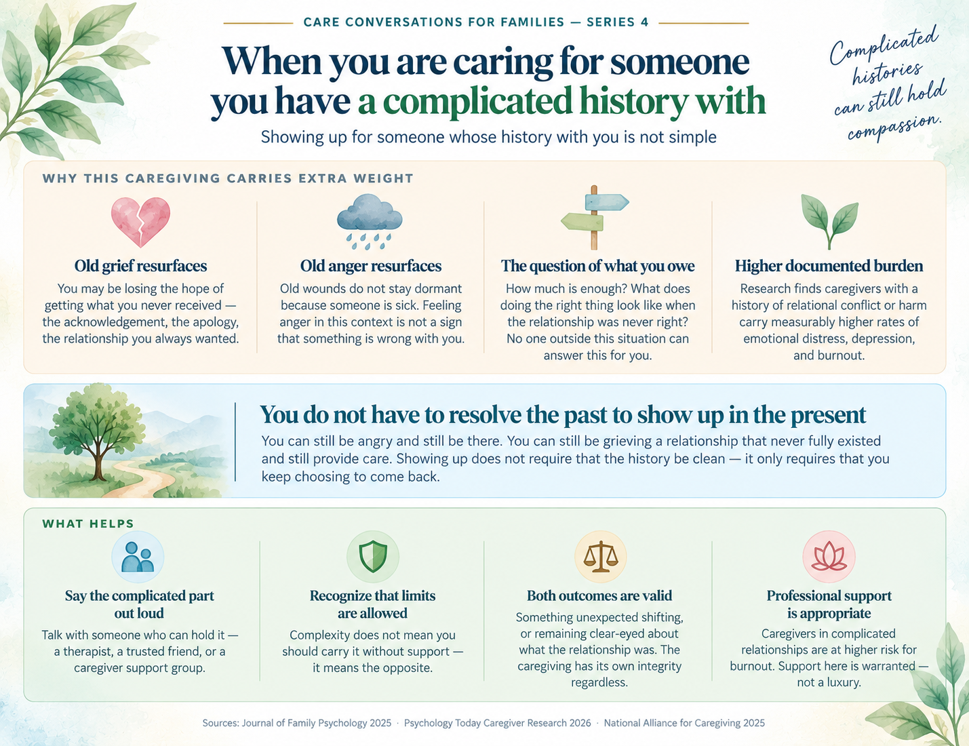
You do not have to resolve the past to show up in the present
One of the most useful things to understand going into complicated caregiving is that you do not have to have worked everything out in order to do the work.
You can still be angry and still be there. You can still be grieving a relationship that never fully existed and still provide care. You can still carry resentment and still be the person who comes when called.
Showing up does not require that the history be clean. It only requires that you keep choosing to come back.
That said, there is a meaningful difference between showing up and dissolving yourself in the process. You are allowed to have limits. You are allowed to get support — a therapist, a counselor, a trusted person who understands the history — so that you are not absorbing the full weight of this alone. The complexity of the relationship does not mean you should carry it without help. It means the opposite.
Caregivers with complicated relational histories are specifically identified in the research as being at higher risk for burnout, depression, and unresolved grief. Professional support for this group is not a luxury. It is appropriate and warranted.
On the possibility of something unexpected
Some people who step into complicated caregiving find that something shifts.
Not reconciliation exactly. Not a full accounting for the past. But a different kind of knowing. They see the person who hurt them as old, or frightened, or diminished — and something in them changes. Not toward erasure of what happened, but toward a kind of freedom from the need for the other person to be different. They stop needing the other person to change in order to be okay themselves.
Others do not find this. They care for someone difficult, get through it, and remain clear-eyed about what the relationship was and was not. Both of these outcomes are valid. The caregiving itself has its own integrity regardless of how the relationship resolves.
One thing to do this week
If you are carrying complicated history alongside caregiving, find one person you can say the complicated part out loud to — not the logistics, but the history, and what it feels like to be in this situation right now.
Therapists who specialize in family relationships or caregiver support are particularly useful here. Caregiver support groups can also be valuable, because complicated feelings are far from unusual in that room.
You do not have to resolve anything. You just need to not carry it entirely alone.
Next in the series: The Caregiver Who Lives Far Away. Publishing October 9.
Nobody Told Me It Would Feel Like This is a series from Care Conversations for Families, exploring the interior life of loving someone through illness.
The Most Comprehensive Care In The Industry

Physical Wellness
We make daily life easier as needs change, with support for personal care, mobility, medication reminders, and recovery after a hospital stay.
Learn More
Mental Well-Being
Staying active and connected matters. Our caregivers provide companionship and meaningful engagement to support emotional health and independence.
Learn More
Nutrition & Hydration
Healthy meals and proper hydration are essential. We help with planning, shopping, and preparation to support daily wellness and energy.
Learn More
Active Connections
Strong relationships bring comfort and purpose. We help seniors stay connected through social engagement, technology, and regular check-ins.
Learn More