
What Families Wish They Knew Before Care Became Urgent
Need Home Care?
Contact Us Today

It usually starts with something small.
A missed medication. A bruise that appeared without explanation. A meal left untouched on the stove. A phone call where your parent sounded just slightly like someone you didn’t quite recognize.
You noticed. You filed it away somewhere in the back of your mind. You told yourself you’d look into it. Then life happened. Work, kids, schedules, the weight of a Tuesday. And the moment passed.
Most families don’t fail their aging loved ones out of neglect or selfishness. They fail them out of timing. The gap between when something changes and when anyone feels ready to talk about it is where the most painful regrets are born. That gap looks quiet and ordinary from the outside. It rarely feels like a turning point while you’re standing in it.
This series was built for that gap.
The thing nobody warns you about
Here is what the research shows, and it may stop you mid-scroll.
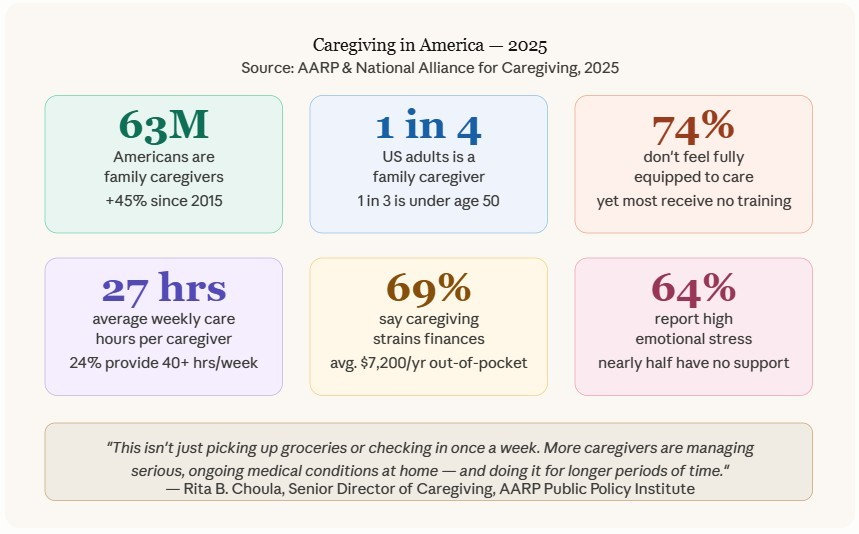
Those numbers are not abstract. They are the collected experience of millions of families who woke up one day and realized that “we’ll figure it out when the time comes” had quietly become “the time came, and we weren’t ready.”
You already know something is changing
If you are reading this, there is a reason. Something has shifted in a parent, a spouse, someone you love. Maybe you can name it clearly. Maybe it is just a feeling you cannot shake.
Either way, the knowledge is already in you. What this series aims to do is help you trust it, act on it, and navigate what comes next before a crisis makes every decision for you.
Here is what most families tell us, in hindsight.
“I knew six months before I was willing to admit it.”
Some version of that sentence appears in conversation after conversation. The family who discovered their mother had been forgetting to eat. The son who noticed his father’s driving had changed but didn’t want to make it a big deal. The daughter who saw the stack of unopened mail and told herself it was just a busy week.
They weren’t wrong to notice. They were waiting for permission to act.
This series is that permission.
Why the moment before the crisis matters more than the crisis itself
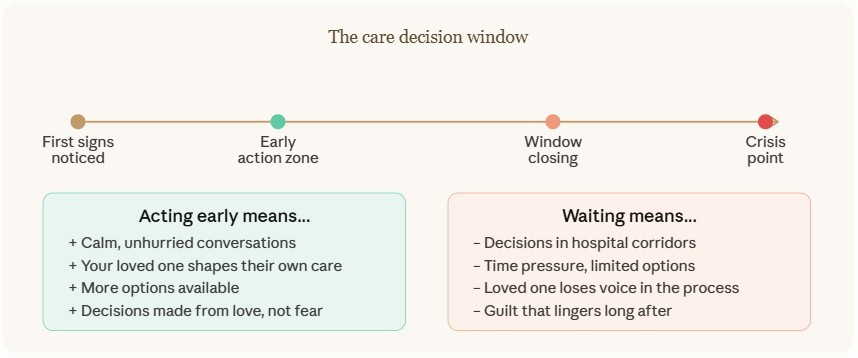
There is a window, sometimes weeks and sometimes months, between the first signs that someone needs more support and the point where the situation becomes urgent. That window is where the most important decisions get made. Or don’t get made.
When families act inside that window, they have time to have calm and honest conversations with their loved one. They can explore options without the pressure of a discharge date or an emergency. Their loved one gets to participate in decisions about their own care. The transition to support feels like a choice rather than a collapse.
When families wait until the window closes, everything changes. Decisions get made in hospital corridors, under time pressure, with limited options and maximum guilt
What families wish someone had told them
We asked. We listened. And across every conversation with adult children, professional caregivers, and seniors themselves, the same themes came up again and again.
They wished they had known that the first conversation doesn’t have to be the hard one. It can simply be a question. “How has your week been, really?” or “Is there anything that’s felt harder lately?” Starting gently isn’t avoidance. It’s access.
They wished they had known that needing help isn’t the same as losing independence. In fact, the right support at the right time is often what makes independence possible for longer. Seniors who resist help are rarely resisting care. They are protecting dignity. Understanding the difference changes everything.
They wished they had known that the system doesn’t do the noticing for you. Doctors see a patient for twelve minutes. Families see a person, their routines, their mood, the small things that add up. That kind of observation is not nothing. It is irreplaceable.
And they wished they had known that waiting for a crisis to prove the need for help is almost always more expensive, financially, emotionally, and in terms of the options still available. Caregivers report losing an estimated $21,000 in income each year on average due to their caregiving responsibilities. Acting early costs less in almost every way that matters.
What this series is going to do
Over the next eight weeks, we are going to walk through the moments that matter most. The ones families don’t always talk about because they don’t quite have the language for them yet.
We’ll talk about the good day and bad day cycle that families misread. About why nights are harder. About the role your mother’s kitchen layout plays in her cognitive health. About the Medicare coverage gaps nobody explains until it’s too late. About what it looks and sounds like when siblings disagree, and how to get back on the same side.
We’ll talk about all of it plainly and honestly, with real data, because you deserve more than reassurance. You deserve useful.
One question before you go
Think of someone you love who is aging. Now ask yourself this.
Is there something I’ve noticed and not yet said out loud?
If the answer is yes, you are exactly where this series begins. You are not late. You are just starting.
And starting is everything.
This blog is part of the Care Conversations for Families series, an ongoing look at the moments, decisions, and truths that shape how families navigate aging together.
The Most Comprehensive Care In The Industry

Physical Wellness
We make daily life easier as needs change, with support for personal care, mobility, medication reminders, and recovery after a hospital stay.
Learn More
Mental Well-Being
Staying active and connected matters. Our caregivers provide companionship and meaningful engagement to support emotional health and independence.
Learn More
Nutrition & Hydration
Healthy meals and proper hydration are essential. We help with planning, shopping, and preparation to support daily wellness and energy.
Learn More
Active Connections
Strong relationships bring comfort and purpose. We help seniors stay connected through social engagement, technology, and regular check-ins.
Learn More