
America’s $1 Trillion Caregiving Reality: The Hidden Cost Families Are Already Paying
Need Home Care?
Contact Us Today

The number is so large, it almost feels abstract.
👉 $1 trillion.
It’s easy to read that and move on.
But behind that number are not systems or institutions.
They are families.
What $1 trillion actually represents
According to AARP — based on a March 2026 report from the AARP Public Policy Institute (Valuing the Invaluable) — family caregivers in the U.S.:
- Provided 49.5 billion hours of care in 2024
- Represented 59 million Americans caring for adults
- Delivered care valued at $1.01 trillion annually if paid
That is not just data.
That is daily life for millions of people.
What this means in simple terms
If caregiving were a company…
👉 It would be one of the largest “industries” in the United States.
Except:
- it’s unpaid
- it’s untracked
- and it’s carried by families
This is what that number looks like in real life
It looks like:
- A daughter rearranging her workday for a doctor’s appointment
- A spouse helping with meals, medications, and routines
- A son managing safety, mobility, and home coordination
- A family adjusting schedules, finances, and priorities
- A caregiver carrying emotional strain that rarely gets acknowledged
This is what makes the trillion-dollar figure so powerful.
It translates something invisible… into something undeniable.

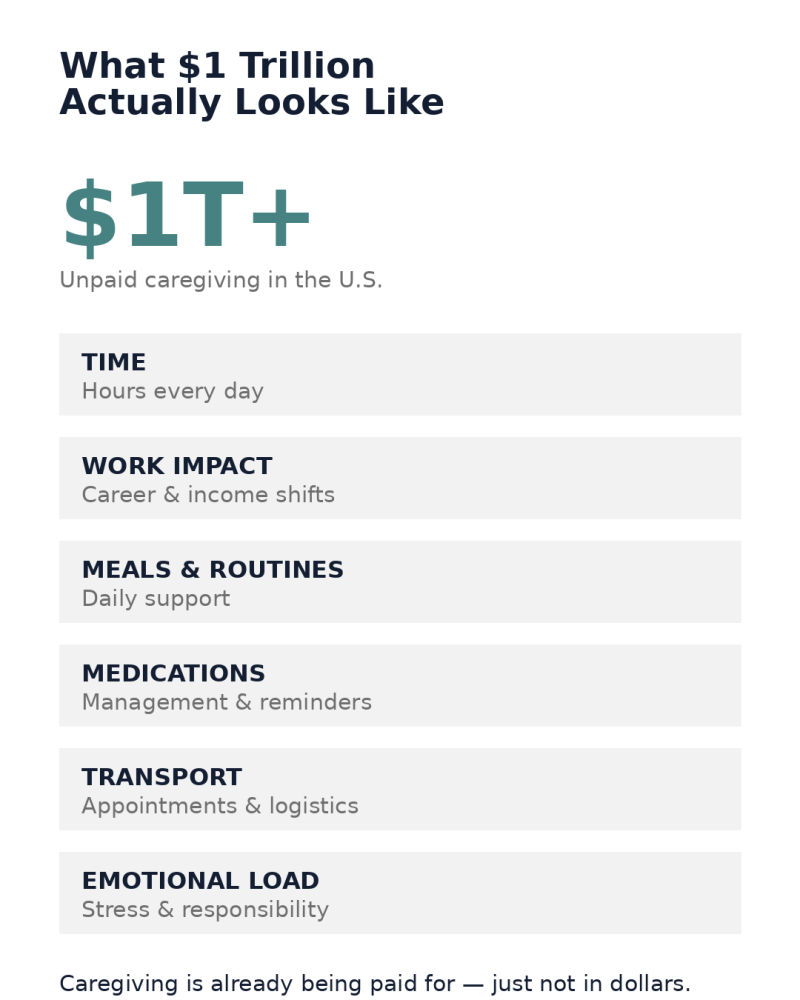
Caregiving isn’t free — it’s just paid differently
Families may not always be paying through formal invoices.
But they are paying in other ways:
- Time — hours taken from work, rest, or personal life
- Career impact — reduced hours, missed opportunities, paused growth
- Financial strain — out-of-pocket costs and long-term income loss
- Energy — constant coordination and responsibility
- Emotional load — worry, fatigue, and quiet stress
👉 Caregiving isn’t free. It’s just paid in ways we don’t measure.
Why this matters more than ever
For years, caregiving has been treated as a private responsibility.
Something families are expected to manage quietly.
But at this scale?
👉 It is no longer just personal. 👉 It is economic, social, and systemic.
It affects:
- households
- workplaces
- healthcare systems
- communities
And yet, much of it still goes unrecognized.
The power of putting a number to it
The trillion-dollar figure does something important.
It gives language to what families already know:
This is not small. This is not temporary. This is not easy.
It validates the experience of millions of caregivers who are doing essential work every single day—often without acknowledgment or support.
A more honest conversation
When we begin to understand the true scale of caregiving, the conversation shifts.
From: 👉 “How are families managing this?”
To: 👉 “How should we be supporting them?”
Because the goal is not just to recognize caregiving.
It is to make it sustainable.

Final thought
Caregiving in America is already a trillion-dollar reality.
Not because families are choosing it as a financial decision.
But because they are showing up for the people they love—every day, in ways that matter.
The question is no longer whether caregiving is valuable.
👉 The question is whether we are doing enough to support the people carrying it.
💬 Let’s make this visible
If this resonates, I’d genuinely like to hear from you:
👉 What has caregiving “cost” you that most people don’t see?
Even one perspective can help make this invisible reality more visible.
The Most Comprehensive Care In The Industry

Physical Wellness
We make daily life easier as needs change, with support for personal care, mobility, medication reminders, and recovery after a hospital stay.
Learn More
Mental Well-Being
Staying active and connected matters. Our caregivers provide companionship and meaningful engagement to support emotional health and independence.
Learn More
Nutrition & Hydration
Healthy meals and proper hydration are essential. We help with planning, shopping, and preparation to support daily wellness and energy.
Learn More
Active Connections
Strong relationships bring comfort and purpose. We help seniors stay connected through social engagement, technology, and regular check-ins.
Learn More