
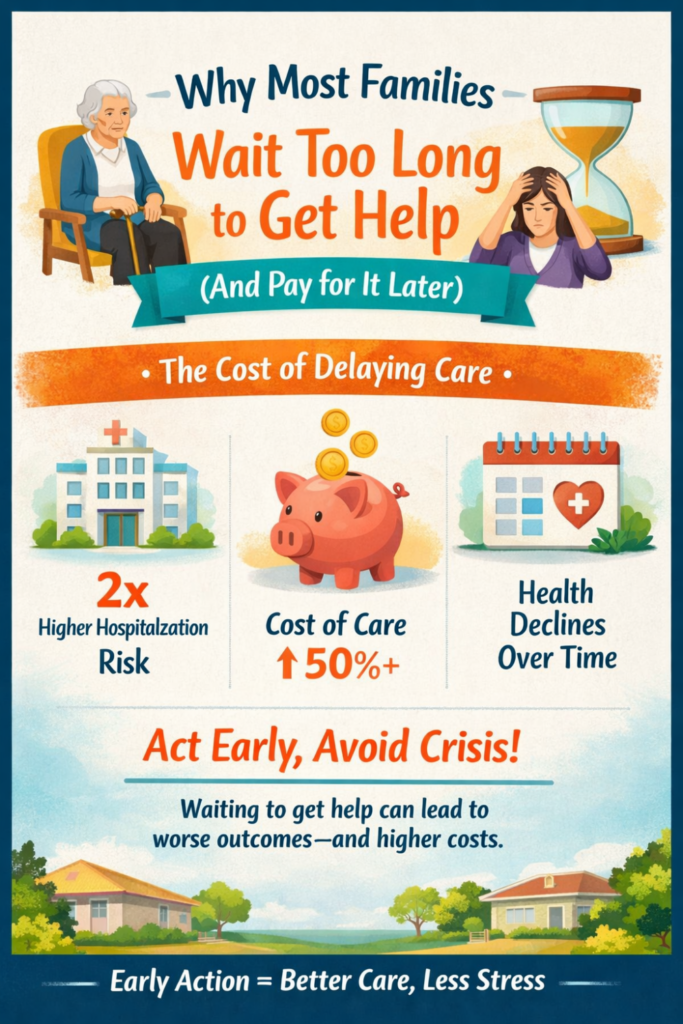
Why Most Families Wait Too Long to Get Help (And Pay for It Later)
Need Home Care?
Contact Us Today

Families rarely ignore care needs because they do not care.
More often, they wait because they care deeply. They want to protect independence. They do not want to upset a loved one. They hope things will improve. They tell themselves they are managing.
And for a while, that may even feel true.
But in senior care, waiting often comes at a cost.
The cost may not show up right away. It may begin quietly: more stress, missed routines, skipped meals, caregiver exhaustion, small safety issues, or growing emotional strain at home. Then one day, what felt manageable no longer does.
A fall happens. A hospitalization follows. A caregiver burns out. A decision that could have been made calmly now has to be made under pressure.
That is why waiting too long to get help often leads to worse outcomes, more stress, and fewer good choices.
Why families delay
Families often wait because:
- the need has grown gradually
- no single incident feels serious enough
- guilt makes asking for help feel like failure
- the older adult resists the idea of care
- the family is trying to “save money”
- everyone is hoping to avoid a difficult conversation
But delay has consequences.
When support comes in too late, families are no longer planning. They are reacting.
6 signs waiting may be costing more than helping
- Daily life feels harder every week Routines are still happening, but with more effort, more stress, and less margin.
- Safety concerns are increasing Maybe there has not been a fall yet, but walking, bathing, and being alone are starting to feel less safe.
- The caregiver is becoming the system One person is doing the scheduling, checking, lifting, reminding, worrying, and holding it all together.
- The loved one is more isolated Even if they are physically safe, they may be lonely, withdrawn, or disconnected.
- Health changes are stacking up Hospital stays, medications, weakness, or memory changes are making home life more complex.
- The family keeps saying “not yet” Sometimes the strongest warning sign is repeated delay itself.

The hidden cost of waiting
Families often think they are avoiding cost by waiting.
But waiting can create:
more caregiver burnout
more risk of emergency events
more lost work time
more family tension
more rushed decisions
more emotional exhaustion
Early support often costs less than crisis response, financially and emotionally.
Final thought
The best time to explore help is not always after something bad happens.
Often, it is when the family first begins to feel stretched.
The earlier families recognize that care is becoming heavier, the more options they usually have.
Sometimes the most costly decision is not getting help. It is waiting too long to consider it.
If this topic resonates with you, please comment, share, and subscribe to Care Conversations 4 Families for more insights on senior care, family caregiving, and aging at home.
The Most Comprehensive Care In The Industry

Physical Wellness
We make daily life easier as needs change, with support for personal care, mobility, medication reminders, and recovery after a hospital stay.
Learn More
Mental Well-Being
Staying active and connected matters. Our caregivers provide companionship and meaningful engagement to support emotional health and independence.
Learn More
Nutrition & Hydration
Healthy meals and proper hydration are essential. We help with planning, shopping, and preparation to support daily wellness and energy.
Learn More
Active Connections
Strong relationships bring comfort and purpose. We help seniors stay connected through social engagement, technology, and regular check-ins.
Learn More