
The Hospital Discharge Gap: Why the First 7 Days at Home Matter

The day a loved one comes home from the hospital often feels like a turning point.
There is relief in finally being back home. Relief that the hospital stay is over. Relief that recovery can now begin in familiar surroundings.
But for many families, the first week at home is not a return to normal. It is the start of a new and often overwhelming phase of care.
An older adult may come home weaker, more tired, less steady, and more dependent than expected. Medications may have changed. Follow-up appointments may need to be scheduled quickly. Everyday tasks like bathing, dressing, walking, preparing meals, or getting to the bathroom may suddenly require much more support.
And while all of this is unfolding, the family caregiver is often still managing daily life too.
Meals still need to be made. Laundry still needs to get done. Work responsibilities do not disappear. Children may still need attention. Errands, appointments, and the rest of the household continue moving forward.
That is what makes the first 7 days after discharge so important and so difficult. Recovery at home does not happen in a quiet vacuum. It happens in the middle of real life.
When relief and worry exist at the same time
For many caregivers, the emotions are mixed.
They are grateful their loved one is home. But they are also watching closely, worried about what could go wrong.
They may be thinking:
What if I miss something important? What if they fall? What if I misunderstand the medications? How am I supposed to manage all of this and everything else too?
These thoughts are not a sign of weakness. They are a sign that the responsibility feels very real.
Coming home from the hospital is not always the same as being ready to recover safely at home.
Why the first week matters so much
The first 7 days after discharge often reveal the gap between what families hoped recovery would look like and what it actually requires.
This is when families may begin to notice:
- more weakness than expected
- difficulty walking or transferring safely
- confusion around medications
- low appetite or dehydration
- increased help needed with personal care
- fatigue, fear, or emotional strain in both the older adult and the caregiver
This is also when caregivers are often trying to hold everything together while quietly feeling overwhelmed.
That is why the first week matters so much. It is often the period when extra support can prevent setbacks before they turn into bigger problems.
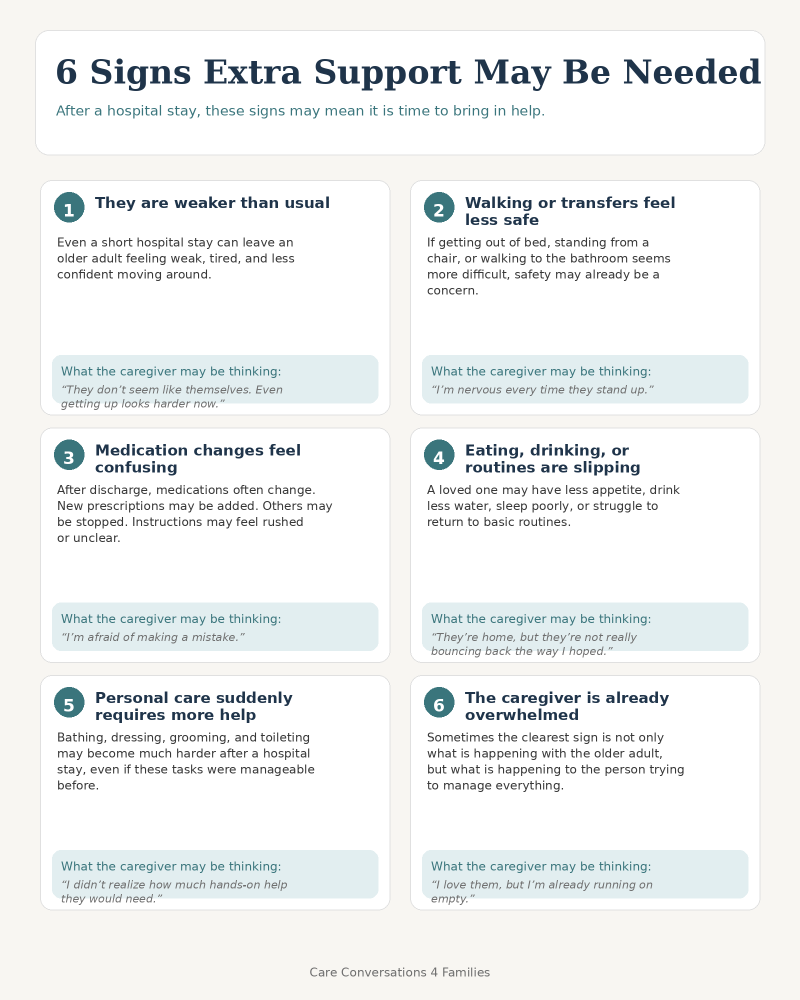
6 signs extra support may be needed
1. They are weaker than usual
Even a short hospital stay can leave an older adult feeling weak, tired, and less confident moving around.
What the caregiver may be noticing: They don’t seem like themselves. Even getting up looks harder now.
2. Walking or transfers feel less safe
If getting out of bed, standing from a chair, or walking to the bathroom seems more difficult, safety may already be a concern.
What the caregiver may be thinking: I’m nervous every time they stand up.
3. Medication changes feel confusing
After discharge, medications often change. New prescriptions may be added. Others may be stopped. Instructions may feel rushed or unclear.
What the caregiver may be thinking: I’m afraid of making a mistake.
4. Eating, drinking, or routines are slipping
A loved one may have less appetite, drink less water, sleep poorly, or struggle to return to basic routines.
What the caregiver may be noticing: They’re home, but they’re not really bouncing back the way I hoped.
5. Personal care suddenly requires more help
Bathing, dressing, grooming, and toileting may become much harder after a hospital stay, even if these tasks were manageable before.
What the caregiver may be thinking: I didn’t realize how much hands-on help they would need.
6. The caregiver is already overwhelmed
Sometimes the clearest sign is not only what is happening with the older adult, but what is happening to the person trying to manage everything.
They may still be cooking, cleaning, handling family responsibilities, working, coordinating appointments, and trying not to let anything fall through the cracks.
What the caregiver may be thinking: I love them, but I’m already running on empty.
What support can look like
Support after discharge does not have to mean something dramatic.
Sometimes it looks like:
- help with meals
- medication reminders
- bathing and dressing support
- mobility assistance
- transportation to follow-up appointments
- companionship and supervision
- respite for the family caregiver
Even a few hours of reliable help can reduce stress, improve safety, and make recovery feel more manageable for everyone.
Why waiting can make recovery harder
Many families take a wait-and-see approach. That is understandable. They want to believe things will settle in a few days.
But if a loved one is already weak, confused, unsteady, or needing more help than expected, waiting can increase the risk of falls, missed medications, dehydration, exhaustion, or even another trip to the hospital.
Support is not a sign that the family is failing.
Very often, it is the support that helps the family succeed.
Final thought
The first 7 days after a hospital stay can be some of the most emotionally and physically demanding days for a family.
Older adults are trying to recover. Caregivers are trying to stay organized, stay calm, and still keep daily life moving.
The goal is not simply to bring someone home.
The goal is to make sure home is ready for recovery, safety, and dignity.
Sometimes the most loving thing a family can do is recognize that love may need support.
If this topic matters to you, please comment, share, and subscribe to Care Conversations 4 Families for more insights on senior care, family caregiving, and aging at home.

The Most Comprehensive Care In The Industry

Physical Wellness
We make daily life easier as needs change, with support for personal care, mobility, medication reminders, and recovery after a hospital stay.
Learn More
Mental Well-Being
Staying active and connected matters. Our caregivers provide companionship and meaningful engagement to support emotional health and independence.
Learn More
Nutrition & Hydration
Healthy meals and proper hydration are essential. We help with planning, shopping, and preparation to support daily wellness and energy.
Learn More
Active Connections
Strong relationships bring comfort and purpose. We help seniors stay connected through social engagement, technology, and regular check-ins.
Learn More