The Guilt of Feeling Resentful Toward Someone You Love
Need Home Care?
Contact Us Today

You were in the middle of something when the phone rang.
Maybe it was the third call that day. Maybe it was the same question you had already answered twice. Maybe it was a need that felt, in that particular moment, like one more thing being taken from a reserve that was already almost empty.
And you felt it. That flash of something dark and uncomfortable. Irritation. Frustration. Something that, if you sat with it long enough, you might have to call resentment.
And then, almost immediately, the guilt arrived.
Because people who love someone do not feel that way. Because they needed you and you resented being needed. Because what kind of person resents someone who is sick, or aging, or losing themselves to an illness they did not choose.
This post is about that feeling. The one you are most ashamed of. The one that is also, research consistently confirms, one of the most common experiences in family caregiving.
How common this actually is
Caregiver resentment is one of the most common and most misunderstood emotional responses to long-term caregiving. Feeling resentful does not mean you do not care. It means the demands of caregiving tasks may be exceeding the emotional, physical, or practical support you receive.
That framing matters. Resentment is not a verdict on your love. It is a signal about your support. It is what happens when the gap between what caregiving demands and what you have available to give it becomes too large for too long.
Many family caregivers feel resentment, anger, or sadness, then judge themselves for having those feelings. This cycle can create constant self-criticism. Guilt is one of the most common emotions experienced by family caregivers, affecting a significant majority of those providing care over a long period. The caregivers who never feel resentful, never feel the friction of perpetual need, are the exception rather than the rule.
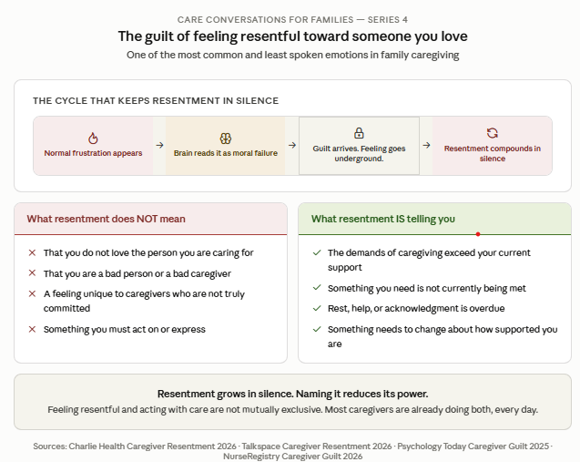
If you feel trapped or resentful or wish things were different, guilt may closely follow behind, making you feel like a bad person for simply having human emotions. That mechanism, normal emotion triggering perceived moral failure triggering guilt, is the cycle that keeps caregivers carrying resentment in silence. The resentment itself is not the problem. The silence is.
Where the resentment comes from
Resentment in caregiving almost never comes from not loving the person. It comes from exhaustion. From the feeling of giving more than is being acknowledged. From watching your own life narrow while the needs around you expand. From the accumulation of small sacrifices that went unnoticed, including by yourself, until they became something heavier.
Caregiver resentment is a feeling of frustration, overwhelm, or emotional exhaustion that develops when the demands of caregiving exceed the support, rest, or resources you have. It does not mean you do not love the person you are caring for. It is a completely normal, human response to the stress, exhaustion, and responsibility of caregiving.
You may begin to experience resentment for time lost caring for your loved one. You may desire to spend your time with other people or completing other tasks, and caregiving takes up your physical and emotional space. That loss of time and space is real. It is not selfishness to notice it.
Caring for a loved one often brings complex emotions. Role reversal, unresolved history, and the weight of sustained responsibility can intensify resentment. This form of resentment often includes deep guilt, making it harder to express or seek help.
Why naming it is not the same as acting on it
There is a distinction that gets lost in the shame around resentment. Feeling something and acting on it are not the same thing. You can feel resentful toward someone you love and still show up with care and dignity every single day. You can feel the irritation and choose not to express it in a way that causes harm. You can acknowledge the feeling without letting it define the relationship.
What you cannot do indefinitely is pretend the feeling is not there. Resentment grows in silence. Caregiver resentment does not resolve through endurance alone. It requires support, boundaries, and honest acknowledgment. Naming resentment reduces its power. It is a signal that something needs to change.
The feeling is information. It is telling you something about what you need that is not currently being met. It might be rest. It might be more help from others. It might be someone to talk to who is not caught up in the same situation. It might be the simple act of having your contribution acknowledged out loud by someone who can see what you are doing.
When resentment is named and understood rather than suppressed and judged, it becomes something that can be worked with. When it is suppressed, it compounds.
The infographic: understanding caregiver resentment
What to do when you notice it
The most important first step is the simplest and hardest one. Acknowledge it without judgment.
Not necessarily to anyone else. To yourself first. The thought “I am feeling resentful right now, and that does not make me a bad person” is the beginning of the cycle breaking rather than completing itself.
When possible, have an honest conversation about your feelings. Use “I” statements, such as “I feel overwhelmed,” rather than language that sounds accusatory. This can help open space for mutual understanding and practical problem-solving.
A therapist or counselor can be useful here, not because you are broken, but because caregiving is genuinely one of the most emotionally complex things a person can do and having a neutral space to process it without judgment changes things. Caregiver support groups exist for the same reason. The relief of being in a room where everyone already understands without needing an explanation is significant.
And it is worth asking, concretely, what change would make a difference. More help from other family members. A few hours to yourself each week. Acknowledgment from someone who can see what you are doing. The specific thing resentment is pointing toward is often more identifiable than it seems when the feeling itself is the only focus.
One thing to do this week
Write down this sentence privately and complete it honestly.
“What I most resent right now is ___________.”
Do not share it yet. Do not judge it. Just let yourself finish the sentence.
What you write is not a verdict on your love. It is information about what you need. And knowing what you need is the beginning of being able to ask for it.
Next in the series: Grieving Someone Who Is Still Alive. Publishing September 25.
Nobody Told Me It Would Feel Like This is a series from Care Conversations for Families, exploring the interior life of loving someone through illness.

The Most Comprehensive Care In The Industry

Physical Wellness
We make daily life easier as needs change, with support for personal care, mobility, medication reminders, and recovery after a hospital stay.
Learn More
Mental Well-Being
Staying active and connected matters. Our caregivers provide companionship and meaningful engagement to support emotional health and independence.
Learn More
Nutrition & Hydration
Healthy meals and proper hydration are essential. We help with planning, shopping, and preparation to support daily wellness and energy.
Learn More
Active Connections
Strong relationships bring comfort and purpose. We help seniors stay connected through social engagement, technology, and regular check-ins.
Learn More