
Where Do You Want to Live When You Cannot Live Alone?
Need Home Care?
Contact Us Today

It is one of the most important questions in a person’s life. And it is almost never asked directly until the answer has already been made by circumstance.
A fall. A hospitalization. A decline that crossed a threshold quietly and then all at once. And suddenly the family is not having a conversation about where their loved one wants to live. They are managing a discharge date and trying to figure out what is available and affordable right now, in this zip code, with these care needs.
The decisions made in that moment are rarely the ones anyone would have chosen. They are the ones that were left.
This post is about asking the question before that moment arrives. Before the options narrow. Before the decision stops being about what your loved one wants and becomes about what the situation allows.
What people actually prefer
Most people, when asked directly, want to stay home. They want to remain in the place where their life has been lived, surrounded by the people, objects, and routines that make them who they are.
Home is not just a preference. For most people, it is an identity. The desire to remain there is not stubbornness or denial about what is realistic. It is a deeply human wish to maintain continuity with the self they have been.
Understanding this is the starting point for having a productive conversation about what comes next.
A conversation that looks different in every family
Before walking through the options, something worth naming directly.
In many families, particularly those from Latino, Asian, African American, South Asian, Caribbean, and other cultures where multigenerational living is a deeply held value, the question of where a loved one will live when they can no longer fully manage alone is not primarily about facilities. It is about how the family will reorganize itself to provide care at home.
For these families, the conversation is not “which community” but “how do we do this together.” That is not a lesser version of the question. In many ways it is a richer one. It involves space, schedules, relationships, and honest acknowledgment of what each family member can and cannot carry over the long term.
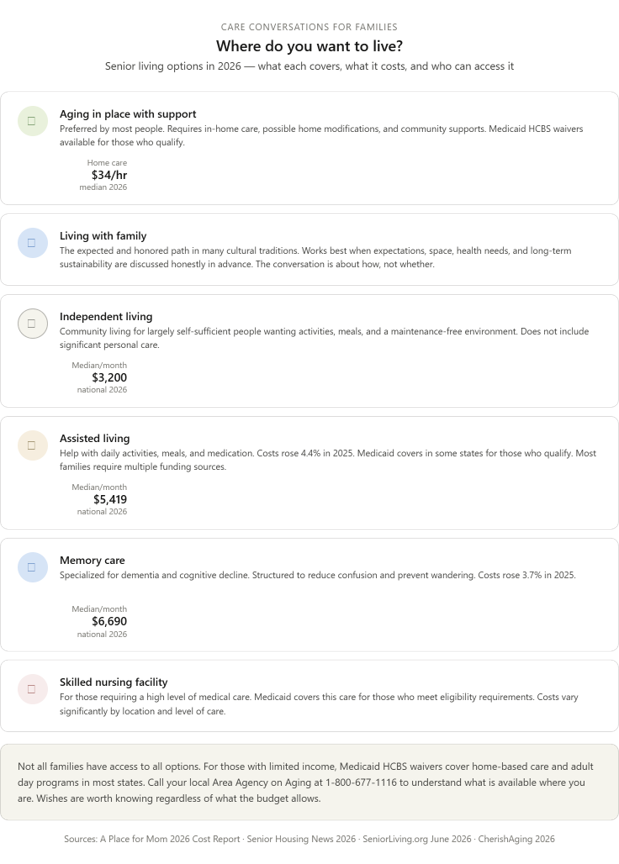
It is also worth acknowledging that not all families have access to the full range of options described below. Assisted living median costs now top $5,419 per month and memory care $6,690. These figures are out of reach for many families without significant savings or insurance. For families with limited income, Medicaid Home and Community Based Services waivers in most states can cover personal care, home support, and adult day programs. Your local Area Agency on Aging at 1-800-677-1116 can explain what your state offers and how to apply. Yahoo Finance
Whatever the resources available, the conversation about what your loved one wants is worth having. Wishes are not contingent on what is affordable. Understanding what matters most guides every decision that follows, even when the options are constrained.
The options families need to understand
Aging in place with support.
This is the starting point for most families because it is what most people prefer. Remaining at home is achievable for many people with the right combination of in-home care, home modifications, and community supports. Most seniors want to stay in their own home. The earlier this conversation happens, the more time families have to put the right support structure in place before a crisis makes it urgent. Caresifter
Home care costs have risen to $34 per hour in 2026, based on national median starting rates. Actual monthly costs depend heavily on the number of hours arranged and the type of care needed. Yahoo Finance
Living with family.
In many cultures this is the expected and honored path. The conversation in these families is less about whether and more about how. What space is needed. What changes to the home. What outside support will make the arrangement sustainable. What happens if care needs increase significantly over time. These conversations, had honestly and in advance, make the difference between an arrangement that works and one that quietly exhausts everyone in it.
Independent living.
Designed for people who are largely self-sufficient but want community, activities, and a maintenance-free environment. The national median monthly cost of independent living is $3,200, making it the most affordable of the residential senior living options. It does not include significant personal care. Yahoo Finance
Assisted living.
For people who need help with daily activities but do not require the level of medical care provided in a nursing facility. The national median annual cost of assisted living was $65,028 in 2025, an increase of 4.4% from 2024, driven by rising resident acuity and operational costs. Even in states with the lowest assisted living costs, families can expect to pay nearly $5,000 a month, which is more than double the average Social Security benefit of $2,071 as of January 2026. For many families, assisted living requires more than one funding source. Senior Housing NewsSeniorLiving.org
Senior living affordability has become the number one concern for families and residents. Families are not just evaluating price but value, and providers that connect pricing to staffing, safety, and quality of care are better positioned to earn trust.
Memory care.
Specifically designed for people living with dementia or other forms of cognitive impairment. Environments are structured to reduce confusion, prevent wandering, and support the specific challenges of cognitive decline. The national median annual cost of memory care was $80,280 in 2025, an increase of 3.7% from 2024. Senior Housing News
Skilled nursing facilities.
For those requiring a high level of medical care. Costs vary significantly by location and level of care. Medicaid covers nursing home care for those who meet eligibility requirements, and this remains one of the primary ways families with limited resources access this level of care.
How to have the conversation
The framing that works best centers on what your loved one wants rather than what the family is worried about. Not “we need to figure out what to do when you cannot manage” but “I want to make sure we understand what matters most to you so we can support that.”
Ask what they love most about where they are right now and what they would want to preserve. Ask what they would most want to avoid. Ask whether they have thought about this at all and what conclusions they have come to.
Then listen without immediately problem-solving or steering them toward what feels most realistic. What they tell you is the foundation that every subsequent practical conversation should be built on.
The practical conversation comes later. The wishes conversation has to come first.
The thing that matters most
The families who look back on this decision with the most peace are almost never the ones who found the objectively optimal arrangement. They are the ones whose loved one’s voice was genuinely part of the decision.
Someone who moved somewhere because the family had a panic after a crisis is in a different emotional position than someone who explored options while they were well, chose something that felt right, and made the move while there was still time to make it a choice rather than a surrender.
The difference is not the outcome. It is the experience of getting there.
And that experience is only available if the conversation happens while there is still time to have it.
One thing to do this week
Ask your loved one one question this week and listen to the full answer.
“If you got to a point where living alone wasn’t fully safe, what would matter most to you about where you were?”
Whatever they say, write it down. It is the beginning of a plan that honors who they are.
Next in the series: It Is Not Too Late to Have the Conversation. The series finale. Publishing September 14.
What We Wish We’d Said Sooner is a series from Care Conversations for Families, exploring the conversations every family needs to have before a crisis makes them urgent.
The Most Comprehensive Care In The Industry

Physical Wellness
We make daily life easier as needs change, with support for personal care, mobility, medication reminders, and recovery after a hospital stay.
Learn More
Mental Well-Being
Staying active and connected matters. Our caregivers provide companionship and meaningful engagement to support emotional health and independence.
Learn More
Nutrition & Hydration
Healthy meals and proper hydration are essential. We help with planning, shopping, and preparation to support daily wellness and energy.
Learn More
Active Connections
Strong relationships bring comfort and purpose. We help seniors stay connected through social engagement, technology, and regular check-ins.
Learn More