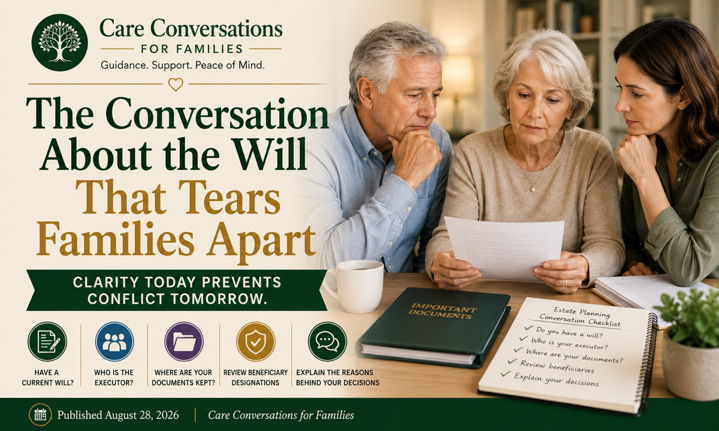
The Conversation About the Will That Tears Families Apart
Need Home Care?
Contact Us Today
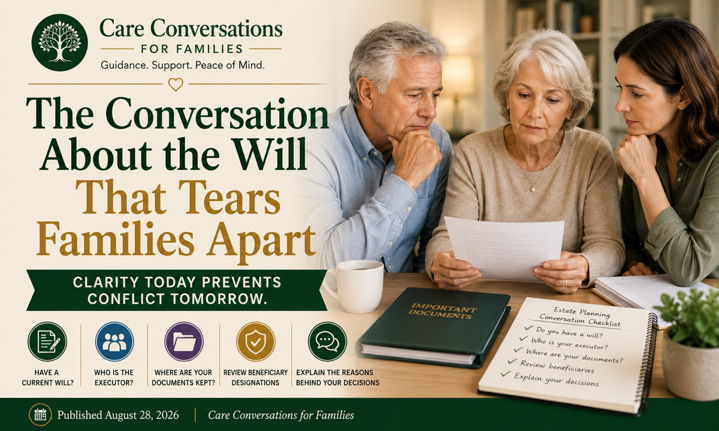
There is a sentence that changes the atmosphere in a room almost instantly.
“We should probably talk about the will.”
People stop making eye contact. Someone changes the subject. Someone jokes that there is nothing worth fighting over anyway. And almost everyone silently hopes the conversation will disappear.
It rarely does.
The conversation simply waits until it arrives under far worse circumstances, after a funeral, when grief and uncertainty are already sitting in the room.
This post is not really about money.
It is about clarity.
Because families rarely fall apart over the size of an inheritance. They fall apart over unmet expectations, unanswered questions, and the belief that someone else knew something they did not.
Why families avoid the conversation
Talking about a will can feel uncomfortable for everyone involved.
Parents worry their children will think they are planning to die. Adult children worry they will sound greedy or insensitive. Siblings assume everyone understands what their parents want without ever checking if that is true.
The result is silence.
Research consistently shows that estate planning conversations are far less common than they should be, even though the vast majority of adults believe having a will is important. Many families discover after a death that important decisions were never documented or communicated, creating confusion and unnecessary conflict.
Avoiding the conversation does not avoid the problem. It simply postpones it until emotions are highest.
What a will actually does
Many people think a will determines everything that happens after someone dies.
It does not.
A will primarily directs how probate assets are distributed, names an executor to carry out those wishes, and, when applicable, names guardians for minor children.
Some assets pass outside of a will entirely. Retirement accounts. Life insurance. Pay-on-death bank accounts. Jointly owned property with rights of survivorship. Those follow beneficiary designations or ownership documents instead.
Understanding that distinction prevents many unpleasant surprises.
The conversations that matter more than the document
The legal document is important. The conversation is often even more important.
Families experience fewer misunderstandings when parents explain the reasoning behind significant decisions before those decisions must be carried out.
Perhaps one child receives the family home because they became the primary caregiver. Perhaps charitable giving reflects deeply held personal values. Perhaps equal does not necessarily mean identical.
People may still disagree. But understanding the why behind a decision often reduces resentment far more than discovering the decision after someone has died.
Fair is not always equal
This may be the hardest concept for families to accept.
Equal distributions are simple. Fair distributions are sometimes different.
One sibling may have provided years of caregiving. Another may have received substantial financial support earlier in life. A family business may only be practical for one child to inherit.
These decisions should never come as surprises. Parents who explain their thinking while everyone can still ask questions often prevent years of misunderstanding later.
A note on access
It is worth saying directly that estate planning has not always been equally accessible to every family.
For families with lower incomes, limited English, or historical reasons to distrust legal systems, creating formal estate documents has not always felt possible or safe. Many families without significant assets have reasonably concluded that a will does not apply to them.
But estate conflict is not only about assets. It is about clarity. And the absence of documented wishes creates ambiguity that affects families at every income level, not just those with significant wealth.
If cost has been a barrier, free and low-cost legal aid resources exist in every state. Your local Area Agency on Aging at 1-800-677-1116 can connect you with estate planning legal aid services. Organizations like FreeWill.com offer accessible tools for getting started at no cost.
The conversation about wishes can happen regardless of whether formal documents are immediately possible.
Common mistakes families make
Waiting until serious illness. Assuming everyone already knows the plan. Never updating beneficiary designations. Keeping estate documents where no one can find them. Believing a verbal promise carries the same legal weight as written documents. Expecting siblings to work it out.
Most family conflict begins long before anyone enters a courtroom. It begins with uncertainty.
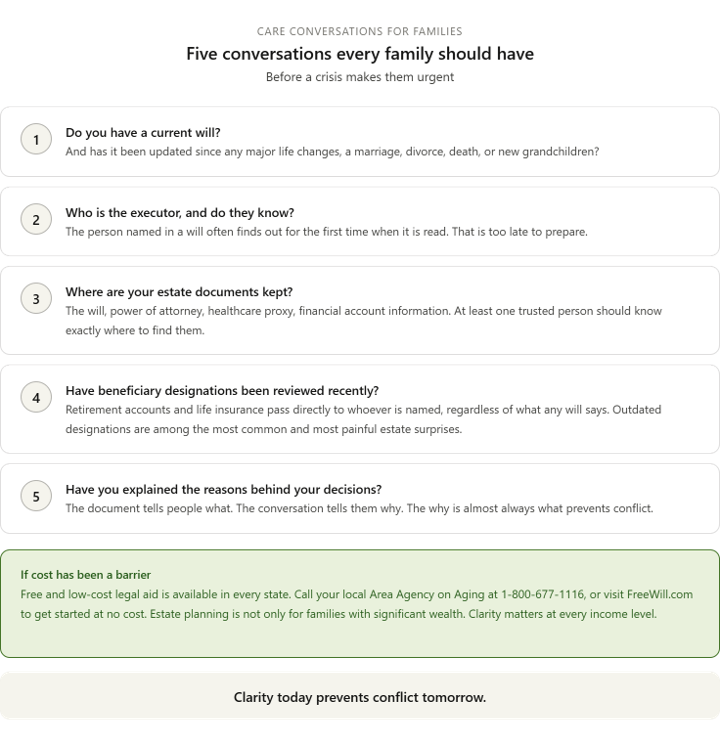
The infographic: estate planning conversation checklist
How to start the conversation
Try something like this.
“I don’t want to know what is in your will. I just want to make sure your wishes are understood and that our family won’t have to make difficult guesses later.”
That shifts the conversation away from inheritance and toward preparation. Most parents appreciate knowing their family wants clarity, not control.
One thing to do this week
Ask your parent one simple question.
“If something happened tomorrow, would we know where your will and other important documents are?”
If the answer is yes, make sure at least one trusted person knows where they are stored. If the answer is no, that conversation has just become one of the most valuable gifts your family can give itself.
And if the documents do not exist yet, that is not a reason to stop. The conversation about what your parent wants can happen today. The paperwork can follow.
Next in the series: What Nobody Asks the Teenagers: The Hidden Caregivers in Every Family. Publishing August 31.
What We Wish We’d Said Sooner is a series from Care Conversations for Families, exploring the conversations every family needs to have before a crisis makes them urgent.
The Most Comprehensive Care In The Industry

Physical Wellness
We make daily life easier as needs change, with support for personal care, mobility, medication reminders, and recovery after a hospital stay.
Learn More
Mental Well-Being
Staying active and connected matters. Our caregivers provide companionship and meaningful engagement to support emotional health and independence.
Learn More
Nutrition & Hydration
Healthy meals and proper hydration are essential. We help with planning, shopping, and preparation to support daily wellness and energy.
Learn More
Active Connections
Strong relationships bring comfort and purpose. We help seniors stay connected through social engagement, technology, and regular check-ins.
Learn More