
What Your Parent Actually Wants at the End of Life (And How to Ask)
Need Home Care?
Contact Us Today

There is a moment many families know well.
Gathered together after a loss, realizing they never asked. Not just what documents were where. But what music she loved. What he wanted people to remember about him. What small wishes went completely unspoken because nobody could find the words to ask.
Most families avoid this conversation out of love, not indifference. Nobody wants to upset a parent. Nobody wants to seem like they are rushing things or counting down. But staying silent carries a cost that only becomes clear when it is too late to do anything about it.
70% of bereaved families experience regret about end-of-life decisions they made on a loved one’s behalf. Not because they made bad choices. Because they were not sure what the person actually wanted. That uncertainty sits with you long after the grief has begun to ease.
What your parent is probably already thinking about
The conversations we are most afraid to have are often the ones people are most relieved to have. Many parents would have told their families what they wanted, if anyone had just asked.
Research found that three-quarters of US adults aged 75 and older have had conversations with their loved ones about their end-of-life wishes. In comparison, just half of those aged 45 to 54 have done so.
The older the person, the more likely they have already thought about these things. What they are waiting for, in many families, is permission. Someone to ask without flinching. Someone who makes it clear that the conversation will not break anything between you.
What the conversation actually covers
End-of-life wishes are not one conversation. They are a series of smaller ones, each building on the last. Breaking them into pieces makes each one more manageable.
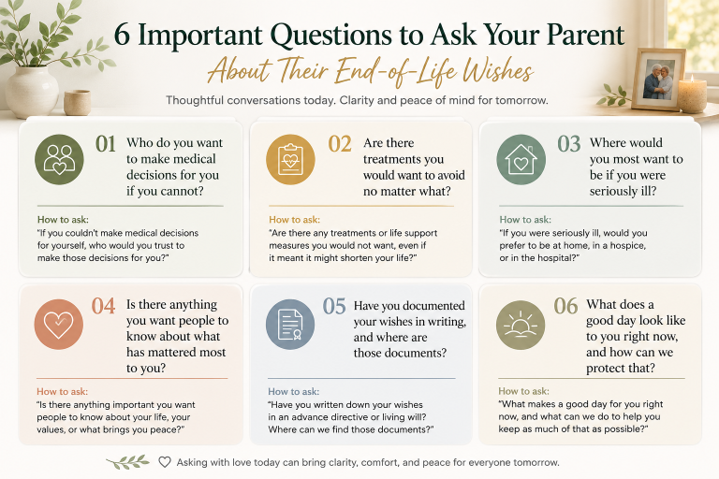
The broad questions come first. What matters most to you as you think about the years ahead? What would a good day look like for you if your health changed significantly?
The care questions follow naturally. If you could not make your own medical decisions, who would you trust to make them? Are there treatments you would want to avoid? Where would you want to be if you were very ill?
The practical questions come later. Have you documented any of this? Do you have an advance directive? Do we know where to find it?
And the personal questions, often the most meaningful of all. Is there anything you want people to know about what you value, what you have loved, how you want to be remembered?
Why this conversation goes better than families expect
Talking about end-of-life wishes preemptively greatly reduces the stress of making decisions about end-of-life care under duress. By preparing in advance, you can avoid some of the uncertainty and anxiety associated with not knowing what your loved ones want.
The conversation may feel uncomfortable for a little while. The clarity it creates can help families for years.
Most parents, given an honest and compassionate opening, are more ready for this conversation than their families assume. They have often been thinking about these things longer than anyone realizes, and carrying the weight of them alone. Being invited to share their wishes can feel less like an intrusion and more like an opportunity to be heard.
A nurse who spent 25 years in end-of-life care wrote this about the moment families finally asked: the conversations we are most afraid to have are often the ones people are most relieved to have.
End-of-life conversations are ultimately conversations about life—what matters, what brings comfort, and what gives a person dignity when circumstances change.
What to do with what you hear
Write it down. Review the notes together afterward to confirm accuracy. Store them somewhere accessible, and share them with the people who need to know.
If your parent expresses wishes that can be formalized, an advance directive or living will allows those preferences to be documented in a way that medical teams can access and follow. Resources like The Conversation Project, Five Wishes, and GoWish Cards can help structure both the conversation and the documentation.
The conversation itself is valuable even without the paperwork. But the paperwork makes the conversation legally meaningful when it matters most.
One thing to try this week
Use this opening, or one close to it, in a calm and private moment with your parent.
“I’ve been thinking about how much you mean to me, and I realized there are things I want to make sure I understand about what matters most to you. Can we talk about some of that?”
Then ask one question. Just one. And listen to the whole answer before you say anything back.
One conversation is enough to start. Starting is everything.
Next in the series: What Does a Good Death Look Like? The question families deserve to answer together. Publishing August 17.What We Wish We’d Said Sooner is a series from Care Conversations for Families, exploring the conversations every family needs to have before a crisis makes them urgent.
The Most Comprehensive Care In The Industry

Physical Wellness
We make daily life easier as needs change, with support for personal care, mobility, medication reminders, and recovery after a hospital stay.
Learn More
Mental Well-Being
Staying active and connected matters. Our caregivers provide companionship and meaningful engagement to support emotional health and independence.
Learn More
Nutrition & Hydration
Healthy meals and proper hydration are essential. We help with planning, shopping, and preparation to support daily wellness and energy.
Learn More
Active Connections
Strong relationships bring comfort and purpose. We help seniors stay connected through social engagement, technology, and regular check-ins.
Learn More