
When Values Shape Treatment Decisions: The Conversation About Treatment Wishes
Need Home Care?
Contact Us Today

It does not come up in most family conversations about care.
Not directly. But it shapes them, quietly and powerfully, in almost every family navigating serious illness.
A parent who believes deeply in the sanctity of life and wants every possible intervention to continue. A sibling who interprets that same faith as a call to trust in a natural dying process. A doctor who recommends withdrawing a treatment the family believes God might still reverse. A family meeting where everyone is speaking from love, and nobody is speaking the same language.
Faith and medicine do not always conflict. In many families, they align beautifully and provide a framework that makes hard decisions more navigable rather than less. But when they do conflict, the conversations can become among the most painful and divisive that families face. And without preparation, they often happen at the worst possible time, in the most pressured circumstances, with the least space for the kind of honest and compassionate dialogue they deserve.
How common this actually is
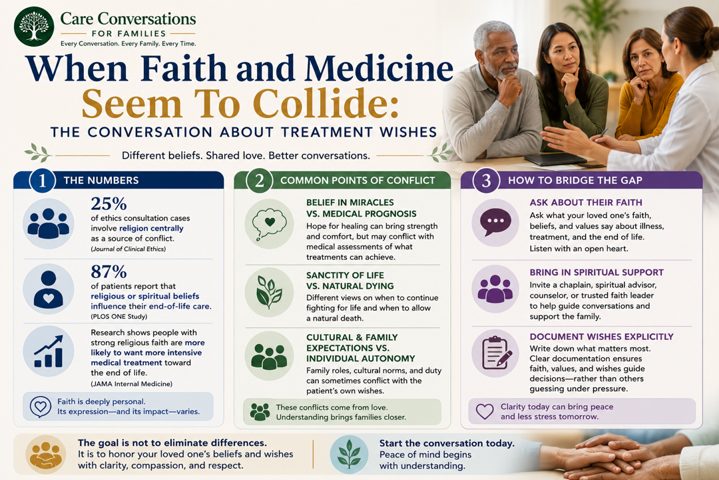
Religion has been found to be central to conflict over life-sustaining treatment decisions in about 25% of ethics consultation cases. These are the formal cases that reach an ethics committee. The informal conflicts, the ones that play out in family meetings and bedside conversations and late-night phone calls, are far more common.
Research shows that people with strong religious faith are more likely to want more intensive medical treatment toward the end of life. Deeply held religious convictions are associated with a preference for interventions at the end of life. This is not irrationality. For many people of faith, the body is sacred, life is a gift from God, and the decision to stop fighting for it requires a level of theological certainty that not everyone can reach. For others, the same faith may lead them to focus on comfort, dignity, and accepting the natural course of life. Faith does not always point people toward the same decisions, even within the same tradition.
At the same time, 87% of patients reported some endorsement of religious beliefs in the context of end-of-life medical care, suggesting that this dimension is nearly universal, even if its expression varies enormously.
The challenge is not that faith shapes these decisions.
That is entirely appropriate. The challenge is when faith is not named explicitly in medical conversations, leaving clinicians to guess, families to assume, and patients to feel unheard on the dimension of their lives that may matter most to them at the end.
What faith communities generally believe
Faith traditions approach end-of-life care differently, and even within traditions there is significant variation based on denomination, cultural context, and individual interpretation.
Most mainstream traditions distinguish between ordinary care, which includes food, water, and pain management, and extraordinary care, which includes mechanical ventilation, artificial nutrition, and aggressive resuscitation.
Many traditions distinguish between treatments that are considered ordinary care and those considered extraordinary or medically disproportionate. Individual beliefs and guidance from trusted faith leaders often shape how those teachings are understood in practice.
Many religious traditions also hold a deep belief in miracles: the possibility that God can heal what medicine cannot. This belief is not irrational. It is an expression of faith. And it can create genuine conflict when medical teams are recommending comfort-focused care while a family is waiting and praying for a different outcome.
Spiritual and religious beliefs can guide decision-making during illness and at the end of life. Many patients share that spirituality helps them find meaning in their illness. Spiritual care is not secondary to medical care. For many patients, spiritual care is not separate from medical care. It is part of how they understand suffering, hope, healing, and the decisions they make throughout serious illness.
How to bring faith into the conversation directly
The mistake most families make is treating faith as a background variable rather than a central one. It gets discussed in the car after the appointment rather than in the room during it.
Clinicians often do not discuss religious beliefs in family meetings, even when they are an important concern of the family.
The remedy is straightforward. Say it out loud, in the room, with the medical team present.
“Our family’s faith is an important part of how we approach these decisions. Can we talk about how that fits with what you’re recommending?”
Or, when speaking with your parent directly: “I know your faith has always guided you. Has it helped you think about what you would want if things got much more serious?”
These are not difficult questions to ask once you have decided to ask them. The difficulty is only in the deciding.
When the family disagrees within the faith
Some of the most painful end-of-life conflicts are not between families and medical teams but within families, between siblings or spouses who share a faith tradition but interpret its guidance differently.
One person hears “sanctity of life” as a mandate to pursue every available treatment. Another hears it as a call to respect the natural completion of a life. Both interpretations come from genuine faith. Neither is simply wrong.
A hospital chaplain or pastoral counselor can be an invaluable resource here. Not to resolve the theological question, but to help the family articulate what their parent’s own faith actually says and to hold the conversation with enough care that it does not become another fracture in an already strained family system.
The goal is not to decide whose faith is stronger. It is to understand how your parent interpreted and lived their own faith throughout their life.
One thing to do this week
If faith is a significant dimension of your parent’s life, ask them one question this week.
“Has your faith given you any guidance about what you would want if you were very ill and couldn’t speak for yourself?”
Then write down what they say. Because what they tell you in that conversation may be the most important guidance you ever have for the decisions that come later.
Next in the series: The Phone Numbers and Organizations Every Caregiving Family Should Have Saved. Publishing August 24.What We Wish We’d Said Sooner is a series from Care Conversations for Families, exploring the conversations every family needs to have before a crisis makes them urgent.
The Most Comprehensive Care In The Industry

Physical Wellness
We make daily life easier as needs change, with support for personal care, mobility, medication reminders, and recovery after a hospital stay.
Learn More
Mental Well-Being
Staying active and connected matters. Our caregivers provide companionship and meaningful engagement to support emotional health and independence.
Learn More
Nutrition & Hydration
Healthy meals and proper hydration are essential. We help with planning, shopping, and preparation to support daily wellness and energy.
Learn More
Active Connections
Strong relationships bring comfort and purpose. We help seniors stay connected through social engagement, technology, and regular check-ins.
Learn More