Grieving Someone Who Is Still Alive
Need Home Care?
Contact Us Today

There is a particular moment that many caregivers describe the same way.
You are sitting with your loved one. Maybe across a dinner table. Maybe in a care facility. Maybe in the same living room where you have spent years together.
They are right there. Physically present, breathing, warm.
And you miss them.
Not a future version of missing. The missing is happening right now, in real time, in the same room as the person you are missing. They are there and they are gone. Both at once. And there is no word in ordinary language for what that feels like.
The people who study this have a word for it. Ambiguous loss. And understanding it, even just having a name for it, changes something about how possible it becomes to carry.
What ambiguous loss actually is
The concept of ambiguous loss was developed by researcher Pauline Boss, who described it as one of the most difficult forms of grief precisely because it lacks resolution.
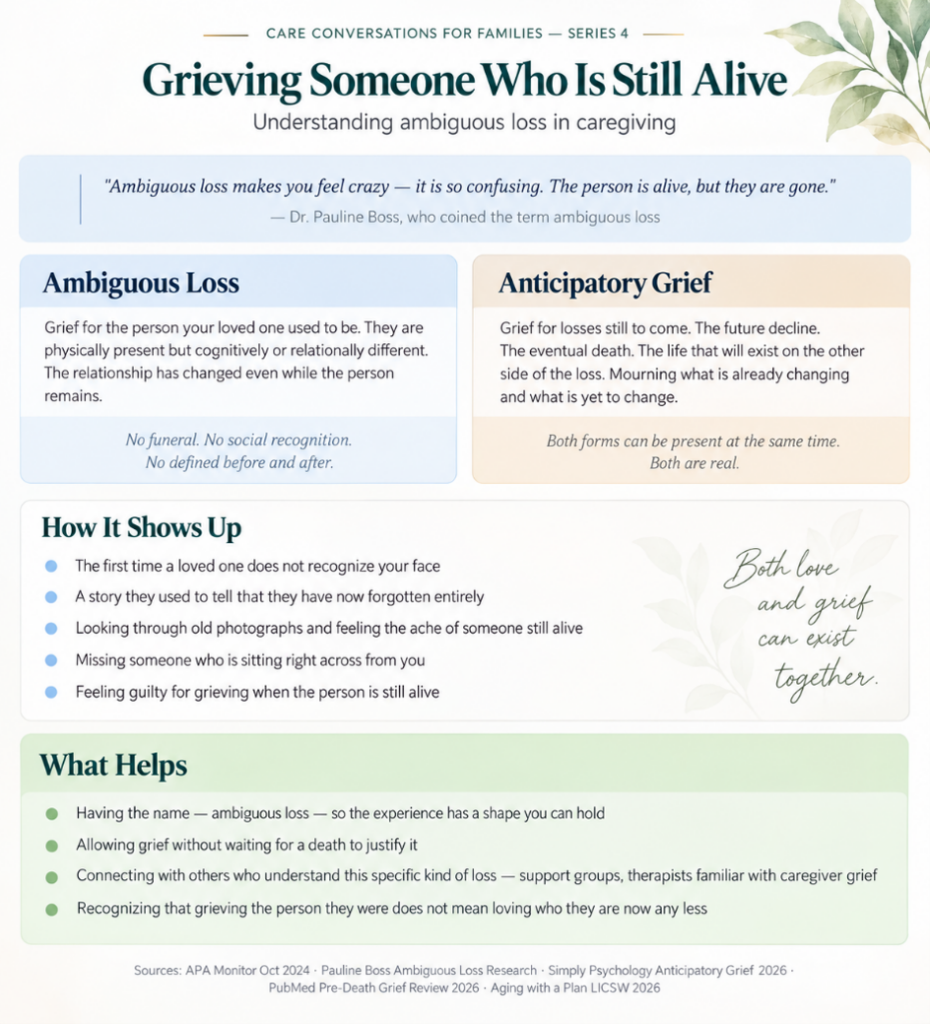
Ambiguous loss is the grief of the person your loved one used to be. They are physically here, but cognitively and relationally different. This type of ambiguous loss, with the loved one still physically present but cognitively or psychologically absent, is one of the most difficult forms of loss, as there is no resolution.
As dementia progresses, caregivers may also struggle with the sense of feeling forgotten once the loved one no longer recognizes them. Prior to ongoing research into this experience, there had been no qualitative research on the effects of being forgotten. What researchers found, when they began interviewing caregivers directly, was a grief that was profound, ongoing, and almost entirely invisible to the people around the caregiver.
Ambiguous loss makes you feel crazy. It is so confusing. The person is alive, but they are gone.
That phrase matters. Not because anything is wrong with you but because the situation itself defies the categories grief is supposed to follow. There is no funeral. No defined before and after. No socially sanctioned period of mourning. Life continues, caregiving continues, and alongside all of it, you are grieving someone who is still in the room.
Two forms of grief that often arrive together
Researchers who study dementia and serious illness caregiving have identified two forms of grief that frequently coexist.
Ambiguous loss is the grief of the person your loved one used to be. The relationship you had. The way they knew you. The stories they told. The specific way they laughed or asked after you or remembered things about your life together. That version of the person is changing or gone, and the loss of it is real even while the person remains.
Anticipatory grief is the fear of losses still to come. The future decline. The eventual death. The life that will exist on the other side of the loss. Anticipatory grief is the process of mourning losses that are happening now or that you know will happen in the future. It involves the ongoing demands of caregiving, the distress of witnessing suffering, the sustained uncertainty about timing and circumstances, and the grief that comes from anticipating your own changed life after the loss.
Both forms can be present at the same time. Both are real. Neither requires a death to have begun.
Why this grief is invisible to everyone else
When someone dies, people know how to respond. They show up. They bring food. They say they are sorry. They check in weeks later. The social infrastructure of grief, imperfect as it is, activates.
When someone is changing because of dementia or serious illness, that infrastructure does not activate. The person is still alive. The grief does not have a name that the people around you recognize. You do not get the time off. You do not get the follow-up calls.
My mother was still physically there, but I had already started grieving the person she used to be. That experience, described by caregivers across every kind of serious illness and cognitive decline, is one of the most universal and least acknowledged features of caregiving.
These grief narratives serve a companionship function and provide solidarity. This pattern aligns with the literature on ambiguous loss, which characterizes dementia caregiving as an ongoing and unresolved form of loss in which a loved one remains physically present while becoming psychologically or relationally less accessible.
Understanding ambiguous loss can help caregivers give themselves permission to grieve without guilt, and to recognize that their grief does not mean they love the person less or wish them dead.
What helps
The single most important thing, according to both caregivers who have navigated this and the researchers who study it, is having a name for it.
The word ambiguous helped me understand what was going on. The ambiguity is exactly how I feel.
When the experience has a name, it becomes something that can be talked about, processed, and supported rather than something that lives in the wordless space between grief and guilt. Finding others who understand the specific texture of this kind of loss, through a support group, a therapist familiar with caregiver grief, or even a trusted person who has been through something similar, changes what is possible to carry.
Grief does not require a death to begin. Allowing yourself to grieve the person your loved one was, while still showing up for who they are now, is not betrayal. It is the most honest possible response to an honest situation.
Anticipatory grief does not mean you have given up. Ambiguous loss does not mean you love them less. It means you loved them fully, and something has changed, and that change is real and worth naming.
One thing to do this week
Allow yourself five minutes this week to think about who your loved one was before illness or decline changed them.
Not with guilt. Not with pressure to find a lesson. Just with honest acknowledgment that you loved that person, that something has changed, and that the grief of that change is real and deserves space.
If you have someone you trust enough to share that with, share it. If not, write it down somewhere private.
The grief does not disappear when it is acknowledged. But it gets a little easier to carry.
Next in the series: The Loneliness of Being the Strong One. Publishing September 28.Nobody Told Me It Would Feel Like This is a series from Care Conversations for Families, exploring the interior life of loving someone through illness.
The Most Comprehensive Care In The Industry

Physical Wellness
We make daily life easier as needs change, with support for personal care, mobility, medication reminders, and recovery after a hospital stay.
Learn More
Mental Well-Being
Staying active and connected matters. Our caregivers provide companionship and meaningful engagement to support emotional health and independence.
Learn More
Nutrition & Hydration
Healthy meals and proper hydration are essential. We help with planning, shopping, and preparation to support daily wellness and energy.
Learn More
Active Connections
Strong relationships bring comfort and purpose. We help seniors stay connected through social engagement, technology, and regular check-ins.
Learn More