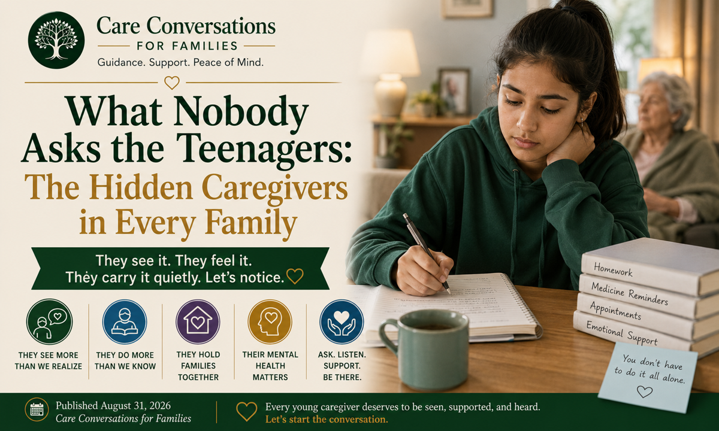
What Nobody Asks the Teenagers: The Hidden Caregivers in Every Family
Need Home Care?
Contact Us Today
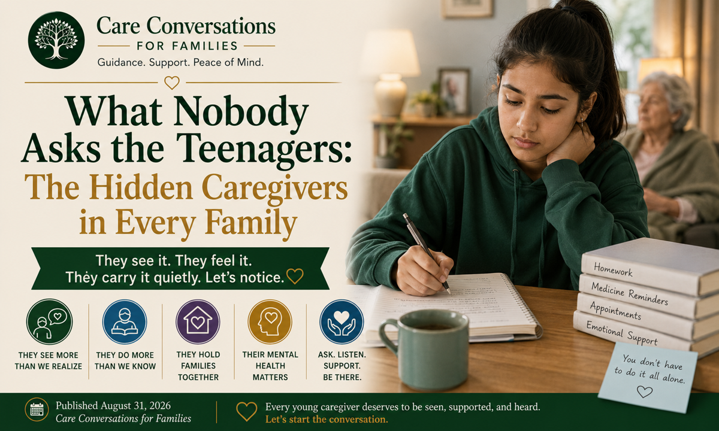
Everyone in the house is focused on getting through today.
Maybe a loved one is no longer recognizing the people around them. Maybe someone the family adores is in the middle of treatment, too exhausted to be fully present. Maybe a beloved family member’s personality has been quietly shifting in ways that nobody has named yet because naming it feels like too much.
Whatever the situation, the adults are managing. Appointments. Medications. Phone calls. Difficult conversations. The logistics of a household reorganizing itself around serious illness.
And somewhere in that same house, there is a young person watching all of it.
Nobody has asked how they are doing. Not really. There have been check-ins, brief ones, between other things. They said they were fine. And everyone was relieved to hear it, because there is simply no bandwidth for anything else right now.
But they are not fine. They are carrying something they do not have words for yet. And the fact that nobody has given them words for it does not mean they are not carrying it.
This post is for that young person. And for every family so consumed by caregiving that they have not had a chance to notice what it is doing to the young people living inside it.
The hidden caregivers nobody counts
Young carers are people of any age who regularly help care for a family member or loved one living with serious illness, cognitive impairment, disability, mental illness, addiction, or other significant health conditions. They often look like ordinary young people rushing through homework, sports practice, or a part-time job. What many adults never see is what happens after they get home. The medication reminder. The redirecting of a loved one who has become confused. The quiet monitoring of someone changed by illness. The emotional labor of holding the household together while pretending at school that everything is normal.
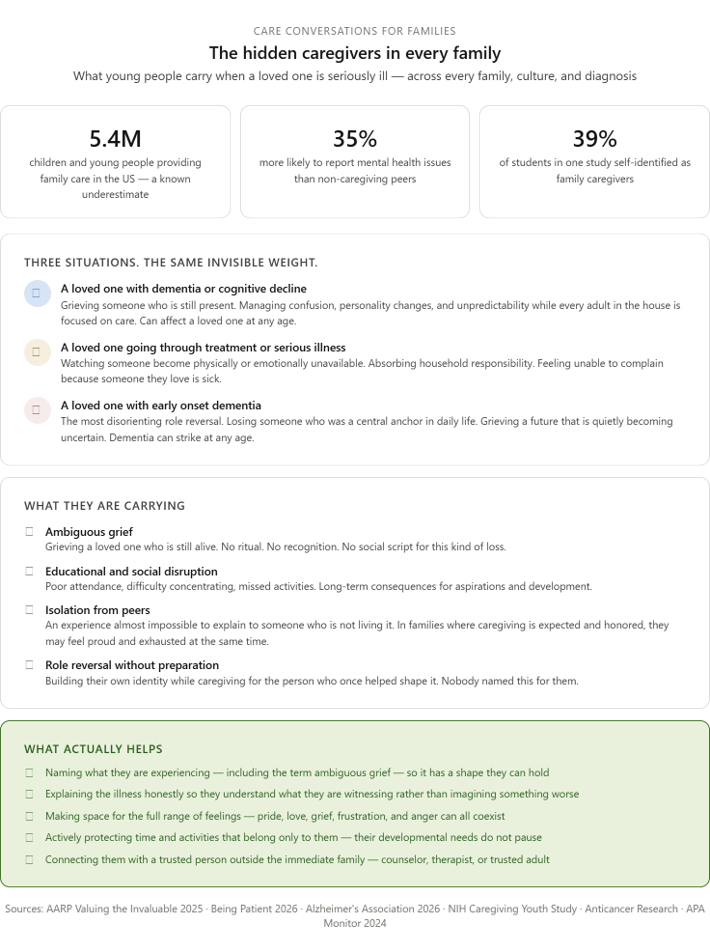
An estimated 5.4 million children and adolescents in the United States are providing this kind of care. That number is considered a significant underestimate because it only counts those living with adult caregivers, missing households where a young person is the primary or sole support.
The experience cuts across every family structure, culture, and income level. In many communities, including Latino, Asian, African American, South Asian, and multigenerational immigrant families, having a seriously ill or aging family member in the home is not unusual. It is the norm. And in those families, young people may carry caregiving responsibilities that feel entirely unremarkable from the outside but are quietly shaping their interior lives in ways nobody has ever named for them.
What they may be living through
A young person in a caregiving role may be supporting a loved one with Alzheimer’s or another form of dementia. They may be helping someone they love navigate cancer treatment. They may be adjusting to a loved one whose personality and presence have shifted in ways that are hard to explain to anyone who is not in the house every day.
Early onset dementia presents particular challenges because individuals are often still employed, financially active, and raising or living with young people when symptoms begin. A loved one can receive a dementia diagnosis at almost any age. When that happens, a young person in the household is not just watching a loved one age. They are watching someone who may have been a central figure in their daily life become someone who needs care. The role reversal is profound. The fear about the future is immediate and personal in a way that is almost impossible to explain to a peer.
The same is true when a loved one is going through cancer treatment. Adolescents experience the impact of a loved one’s illness acutely, including the parent or family member no longer being able to drive them to school, attend events, or be emotionally present. Young people frequently absorb more household responsibility while also managing their own developmental needs.
Whatever the diagnosis, the experience of loving and living with someone who is seriously ill or cognitively changing is one of the most demanding things a young person can face. And it is happening, quietly, in millions of households right now.
Ambiguous grief: the loss that has no funeral
There is a name for what young people carry when a loved one has dementia or is changed by serious illness. Researchers call it ambiguous loss.
Ambiguous loss occurs when a loved one is physically present but cognitively or psychologically absent. This type of loss is one of the most difficult forms of grief because there is no resolution. The person is alive, but they are gone in some essential way.
The loved one who told certain stories, remembered important things, showed up in a particular way, is fading or changing while still breathing. There is no funeral for this kind of loss. No one brings casseroles. No one checks in. Ambiguous grief can complicate bereavement after death, leading to delayed, muted, or intensified grief responses. For young people, who already lack frameworks for processing grief, this kind of unresolvable loss is particularly hard to carry alone.
For a young person whose loved one is going through cancer treatment or another serious illness, the loss is different but equally disorienting. Children experience heightened levels of worry and distress that is often persistent and intrusive. They can feel disconnected and unable to fully express themselves, with worries about the unknown. The person who was a constant, reliable presence is suddenly less available, physically or emotionally. And the young person absorbs that absence quietly because complaining feels selfish when someone is sick.
What the research shows about the real cost
Research shows young carers are 35% more likely to report mental health issues than their non-caregiving peers, including depression, anxiety, and burnout. Young carers remain largely invisible, with minimal recognition or support.
In a study of high school students, 39% self-identified as family caregivers. Compared to their non-caregiving peers, caregiving youth had higher scores on mental health screeners and were more likely to endorse clinically significant levels of depression.
Key challenges for young carers include poor attendance, tiredness, inability to participate in extracurricular activities, problems with concentration and completing homework, anxiety, and behavioral difficulties.
Caregiving responsibilities were found to hinder educational and career aspirations, leading to social isolation and strained relationships. The support received from family, friends, and teachers was often inconsistent and inadequate.
None of this means that caregiving cannot also build resilience, empathy, and a depth of love that many young people never develop so young. Research does show that some young caregivers, particularly those supporting loved ones in multigenerational homes, also experience meaningful positive outcomes including stronger family bonds and a sense of purpose. Both things can be true. What matters is that the weight is acknowledged, not just the strength.
The infographic: what young caregivers carry
What young caregivers actually need from the adults around them
An explanation of what is happening, in plain language. Many young people living with a seriously ill loved one have never had the illness explained to them honestly. They know something is wrong. They may have invented explanations more frightening than the truth. A straightforward, honest conversation about what the illness is, what it does, and what to expect, changes how they process everything they are witnessing. This can look different depending on the family’s cultural background, faith tradition, and the young person’s own temperament. The form matters less than the honesty.
Young people themselves have expressed clearly that they want to be involved in open dialogue and encouraged to seek support if necessary. They want to be included, not protected from the truth.
Permission to have complicated feelings. Young caregivers feel love and grief and frustration and guilt and sometimes anger, all toward the same situation in the same week. In families where caregiving is a deeply held cultural value, there may be an additional layer of guilt about having any negative feelings at all. Releasing that expectation, making explicit space for the full range of what they are experiencing, is one of the most relieving things an adult in the home can do. Both the weight and the love are real. They do not cancel each other out.
Their life protected. Both children and adolescents have increased personal responsibilities when a loved one is ill, resulting in a decrease in social activity and a subsequent loss of childhood at a time when peer groups are essential for social development. Their developmental needs do not pause because a family is in a caregiving season. Whatever can be done to protect their access to their own life, their friendships, their activities, and their own sense of who they are becoming, should be done deliberately and consistently. Anticancer Research
Someone to talk to who is not part of the immediate situation. Adults close to the situation are often too exhausted by it to be the neutral ear a young person needs. A school counselor, a therapist, a trusted person outside the immediate family can offer something the household genuinely cannot right now. Encouraging that relationship is not a sign of family failure. It is one of the wisest things a caregiving family can do.
The question worth asking today
Not at dinner. Not in passing. In a quiet moment when you have their full attention and they know they have yours.
“I know things have been really different at home lately. I have been so caught up in everything that I have not asked you how you are really doing with all of it. I want to know. And I have time.”
Then wait. Let the silence be there. Do not fill it.
What comes next may be the most important conversation you have had with them in a long time.
Next in the series: The Conversation About Forgiveness That Aging Makes Urgent. Publishing September 4.
What We Wish We’d Said Sooner is a series from Care Conversations for Families, exploring the conversations every family needs to have before a crisis makes them urgent.
The Most Comprehensive Care In The Industry

Physical Wellness
We make daily life easier as needs change, with support for personal care, mobility, medication reminders, and recovery after a hospital stay.
Learn More
Mental Well-Being
Staying active and connected matters. Our caregivers provide companionship and meaningful engagement to support emotional health and independence.
Learn More
Nutrition & Hydration
Healthy meals and proper hydration are essential. We help with planning, shopping, and preparation to support daily wellness and energy.
Learn More
Active Connections
Strong relationships bring comfort and purpose. We help seniors stay connected through social engagement, technology, and regular check-ins.
Learn More