
Nobody Told Me It Would Feel Like This
Need Home Care?
Contact Us Today

Before you became a caregiver, you had an image of what it would look like.
You would show up. You would help. You would be the person your loved one needed. It would be hard, yes. You knew it would be hard. But you also imagined something resembling grace. A kind of love made visible in action. The version of yourself you might be most proud of.
Then caregiving actually began. And it looked nothing like that.
It looked like exhaustion so deep you forgot what rested felt like. It looked like showing up again and again for someone who sometimes could not recognize the sacrifice. It looked like skipping your own doctor’s appointments, forgetting to return calls from friends, eating whatever was available because there was no time for anything else. It looked like lying awake at 2am running through logistics. It looked like grief in a form you did not have a name for, because the person you were grieving was still alive.
And underneath all of it, it looked like feelings you were not expecting. Feelings you were ashamed of. Feelings that did not match the image of what a loving caregiver was supposed to be.
Nobody told you it would feel like this.
This series is the thing nobody told you.
The gap between the image and the reality
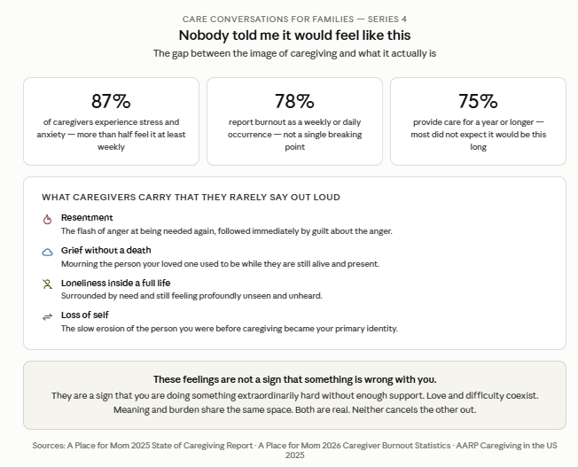
Stress and anxiety are the most prevalent emotions reported by caregivers, experienced by 87% at some point and at least weekly by more than half. Those numbers are significant on their own. But what they do not capture is the texture of what that stress actually feels like from the inside. The way it is not one large wave but a thousand small ones. The way it accumulates in the body before it reaches conscious thought. The way it changes not just how you feel but who you are, quietly, over months and years of sustained pressure. The Mountain-Ear
78% of caregivers report experiencing feelings of burnout, with many describing burnout as a weekly or even daily occurrence. Burnout is not a single breaking point. It is a condition. It is what happens when the demands of a role consistently exceed what a person has available to give it, over a long enough period of time. InsideNova
And the period of time is longer than most people anticipate. On average, family caregivers provide nearly 23 hours of care per week, and 75% provide care for a year or longer. Most people, when they first stepped into this role, imagined something finite. A season of difficulty with a visible end. What caregiving often turns out to be is a long road with no clear horizon, during which ordinary life continues happening alongside it.
Burnout frequently overlaps with other forms of strain. Caregivers who report burnout also commonly experience emotional stress, disrupted sleep, changes in social connection, and financial pressure, underscoring that stress often spans multiple areas of daily life at once. InsideNova
That word simultaneously is the one that matters. These experiences do not take turns. They coexist. The meaning and the burden are in the same room at the same time. The love and the exhaustion are in the same body. And most caregivers have nowhere to put the parts that do not fit the image of devoted, selfless love they believe they are supposed to embody.
What caregivers carry that they rarely say out loud
The feelings caregivers are most reluctant to name are not the expected ones. Exhaustion is acceptable. Sadness is acceptable. Even fear is acceptable. What caregivers carry most silently are the feelings that seem to contradict the love they know they feel.
Resentment toward someone they are devoted to. The grief of losing a person who is still alive. The loneliness of being surrounded by need and still feeling profoundly unseen. The slow erosion of a sense of self that happened so gradually they did not notice until they looked for themselves and could not quite find what they were looking for.
These feelings are not a sign that something is wrong with you. They are a sign that you are a human being doing something extraordinarily hard without enough support. And they are far more common than the silence around them suggests.
This series names them one by one. Not to make caregiving feel heavier than it is. But because naming something is the first step toward carrying it differently.
What this series is
This is the fourth series in Care Conversations for Families.
The first three series covered the practical and relational landscape of caregiving. How to recognize when someone needs help. How to navigate Medicare and Medicaid, hospice and palliative care, legal authority and housing decisions. How to have the conversations that families avoid until a crisis forces them. How to find trustworthy home care. How to talk about the will, about driving, about what comes at the end.
This series goes somewhere different.
It goes inside.
It is about what caregiving actually feels like from the inside. The feelings nobody prepared you for. The ones you carry quietly because there is no space for them in the version of caregiving the world recognizes and honors. The ones that sit alongside the love and make it complicated and do not diminish it.
Over the coming weeks, this series will name those feelings one by one. Resentment toward someone you love. Grief for someone still alive. The loneliness of being the strong one. What caregiving does to your closest relationships. The guilt of not being nearby. The weight of carrying everything alone. What happens to your sense of self when caregiving becomes your primary identity. What comes after, when it ends.
None of this will tell you that caregiving is too hard or that you are doing it wrong. It will tell you that what you are feeling is real, that you are not alone in it, and that naming it is the first step toward carrying it differently.
One thing to do this week
Find one person, just one, who you trust enough to tell the truth to about how caregiving is actually going for you. Not the logistical truth. The emotional truth.
You do not have to say everything. You just have to say something honest. Something you have not said yet because there was no space for it.
That conversation, small and imperfect as it might be, is the beginning of something that matters.
Next in the series: The Guilt of Feeling Resentful Toward Someone You Love. Publishing September 21.
Nobody Told Me It Would Feel Like This is a new series from Care Conversations for Families, exploring the interior life of loving someone through illness.
The Most Comprehensive Care In The Industry

Physical Wellness
We make daily life easier as needs change, with support for personal care, mobility, medication reminders, and recovery after a hospital stay.
Learn More
Mental Well-Being
Staying active and connected matters. Our caregivers provide companionship and meaningful engagement to support emotional health and independence.
Learn More
Nutrition & Hydration
Healthy meals and proper hydration are essential. We help with planning, shopping, and preparation to support daily wellness and energy.
Learn More
Active Connections
Strong relationships bring comfort and purpose. We help seniors stay connected through social engagement, technology, and regular check-ins.
Learn More