
What Caregiving Does to a Marriage or Partnership
Need Home Care?
Contact Us Today

There is a version of your partnership you remember from before.
Before the diagnosis. Before the care schedule. Before one of you became primarily responsible for something enormous and the other one did not quite know how to help.
You are still together. The love has not disappeared. But something has shifted, and you are not entirely sure what to name it or how to talk about it without starting a fight.
This is one of the quietest things caregiving does to a marriage. It does not announce itself. It moves in gradually. And by the time you notice it, it has been there for a while.
What the research shows
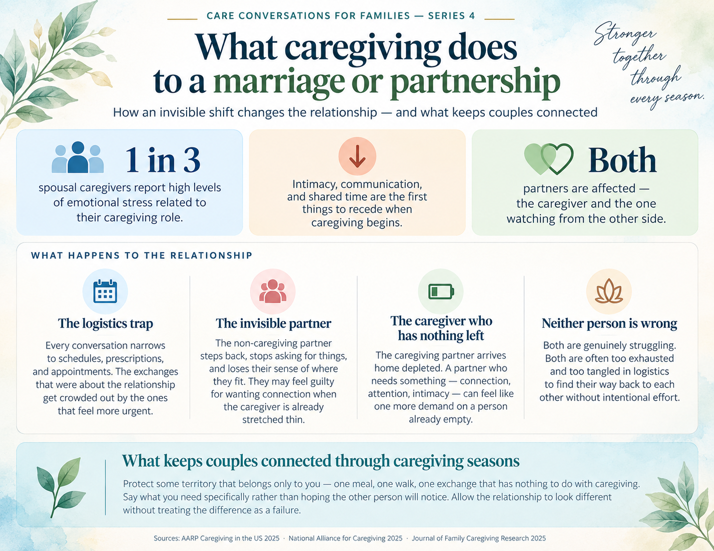
Caregiving places significant and documented strain on intimate partnerships. Spouses who provide care for a partner carry some of the heaviest caregiving burdens of any group. They tend to provide more hours of care, report higher rates of emotional stress, and have fewer social supports than other caregivers. AARP research consistently finds that spousal caregivers are among those most at risk for depression and anxiety.
But the strain does not only fall on the caregiving spouse. It falls equally on the partners of adult caregivers — the people watching their spouse disappear into a role that leaves very little remaining for them. Research on couples navigating caregiving seasons surfaces the same themes repeatedly: reduced intimacy, role confusion, communication breakdown, and a persistent sense of distance that neither person knows how to close.
A partner who steps back because the situation seems to demand it is not disengaging out of selfishness. They are responding to the unspoken reorganization that caregiving imposes on the household. And that reorganization, handled silently, is what creates the distance.
The logistics trap
One of the most common descriptions caregivers and their partners give of their relationship is that they have stopped being partners and become logistics coordinators.
The conversations are about the schedule. Who is picking up the prescription. Whether the appointment needs to be rescheduled. Who will be home when the aide arrives. These conversations are necessary. But they crowd out the ones that used to exist. The ones about something other than the caregiving. The ones about you, as people, as a couple, as two people who chose each other.
When every conversation is functional, something quietly starves. This is not a failure of love. It is a failure of bandwidth. Caregiving consumes cognitive and emotional space, and what gets sacrificed first tends to be exactly the things that feel optional when they are actually foundational.
The invisible partner
The partner who is not the primary caregiver often feels invisible in a particular way. Their needs have receded — not because anyone decided they did not matter, but because the situation made it seem obvious that they should step back. The person being cared for has the most urgent needs. The caregiver is stretched thin. So the partner quietly adapts, stops asking for things, and over time loses their own sense of where they fit in this new configuration.
They may feel guilty for wanting attention, for missing the relationship they used to have, for needing connection when connection feels like one more demand on someone already empty. They may say nothing because what is there to say — that they miss their spouse while their spouse is caring for a sick parent? It feels like a small and selfish thing to admit.
It is not a small thing. And it is not selfish. It is what happens when a relationship is asked to absorb a weight it was not designed to carry alone.
The caregiver who has nothing left
The caregiver, meanwhile, may feel something almost opposite. They are giving everything they have to the caregiving role. They come home depleted. They need their partner to understand without explanation, to help without being asked, to not need things from them right now. And if the partner does need something — connection, attention, conversation, intimacy — it can feel like one more demand on a person who is already empty.
Neither person is wrong. Both are genuinely struggling. And both are often too exhausted and too tangled in the logistics to find their way back to each other.
What keeps relationships intact
Couples who maintain connection through caregiving seasons tend to do a few things consistently. They find ways to preserve some territory that belongs only to them — a shared meal, a brief walk, a ritual that exists outside the caregiving context. They say what they need in specific terms rather than hoping the other person will notice. They extend each other deliberate grace, naming out loud that they know this is hard on both of them, not just one of them.
And perhaps most importantly, they allow the relationship to change without treating the change as failure. The partnership you have during a caregiving season will not look like the one you had before it. Expecting it to can break something that could otherwise survive.
The couples who get through it are not the ones who felt nothing. They are the ones who kept reaching for each other, even when reaching was hard.
One thing to do this week
Have one conversation with your partner this week that has nothing to do with caregiving.
Not a long conversation. Not a heavy one. Just one exchange about something else entirely — something you noticed, something that made you think of them. Fifteen minutes of being two people in a relationship, not two people managing a situation.
The logistics will still be there after.
Next in the series: When You Are Caring for Someone You Have a Complicated History With. Publishing October 5.
Nobody Told Me It Would Feel Like This is a series from Care Conversations for Families, exploring the interior life of loving someone through illness.
The Most Comprehensive Care In The Industry

Physical Wellness
We make daily life easier as needs change, with support for personal care, mobility, medication reminders, and recovery after a hospital stay.
Learn More
Mental Well-Being
Staying active and connected matters. Our caregivers provide companionship and meaningful engagement to support emotional health and independence.
Learn More
Nutrition & Hydration
Healthy meals and proper hydration are essential. We help with planning, shopping, and preparation to support daily wellness and energy.
Learn More
Active Connections
Strong relationships bring comfort and purpose. We help seniors stay connected through social engagement, technology, and regular check-ins.
Learn More