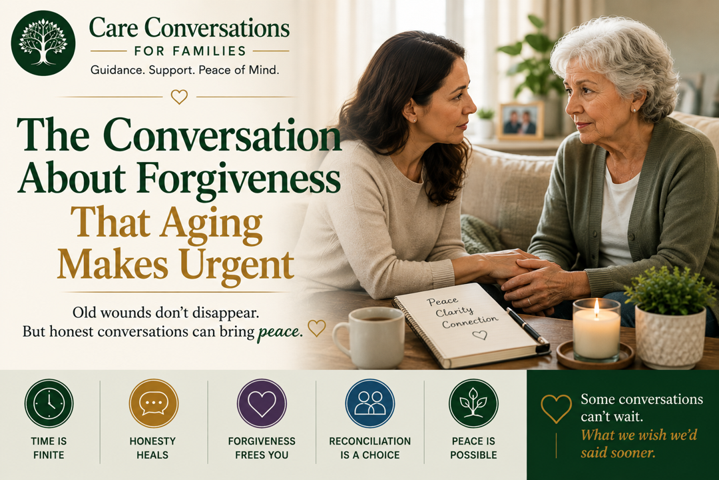
The Conversation About Forgiveness That Aging Makes Urgent
Need Home Care?
Contact Us Today
You have been carrying it for a long time.
Maybe it is something a loved one did years ago that shaped you in ways you are still untangling. Maybe it is something that happened more recently. A decision that felt like a betrayal. A time when you needed something and it was not given. Maybe it is smaller than that. A pattern of behavior that accumulated over decades into something too heavy to simply set down.
You have managed it. Built a life around it. Showed up and maintained a functional relationship and told yourself, reasonably, that some things do not need to be resolved.
But the person you are carrying this about is aging. Or ill. Or changing in ways that make the future feel less certain than it once did. And something about that fact is changing the weight of what you have been carrying.
This post is about what happens to old wounds when time starts to feel finite. Not dramatically or suddenly, in most cases. But visibly. Undeniably. In the small daily changes that tell you the window for certain conversations is not permanently open.
Before we go further, one important note. This post is written for people navigating unresolved hurt within relationships that are fundamentally intact. For those who have experienced serious harm, abuse, or trauma, the question of whether to initiate contact is a different one entirely, and one best navigated with professional support. If that is your situation, what follows is not intended to pressure you toward any particular choice. Forgiveness without contact is entirely valid. So is choosing distance for your own safety and wellbeing.
How common this actually is
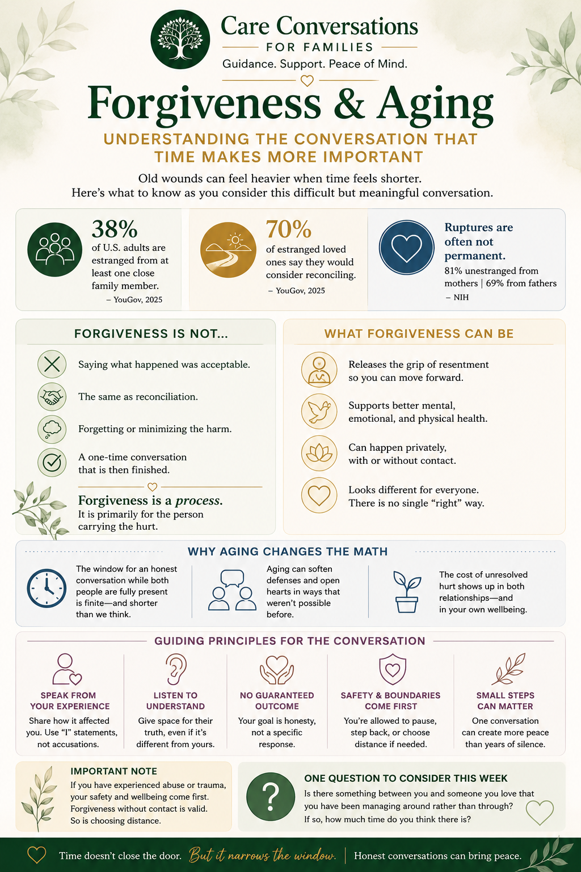
A 2025 YouGov poll found that 38% of US adults were estranged from at least one close family member, including 16% who were estranged from a family member and 10% from another. Fox News
These are the formal estrangements, the ones that have been named and acknowledged. But there is a much larger number of people navigating something quieter. The relationship that is technically intact but carries unspoken damage. The family members who speak regularly but never touch the thing between them. The relationship that manages proximity without ever achieving real closeness.
What is striking is how fluid estrangement actually is. The majority of estranged adult children become unestranged from their loved ones in subsequent waves — 81% from mothers and 69% from fathers. These ruptures are rarely permanent, even when they feel that way from inside them. nih
And yet even in relationships that technically continue, unresolved wounds shape everything. They determine what can be said and what cannot. They narrow the territory of honest conversation. They accumulate quietly until something, illness, a diagnosis, the visible slowing of someone’s step, makes the narrowing impossible to ignore.
Why a loved one’s aging changes the math
When someone we have a complicated history with is young and healthy, it is easy to tell yourself that the conversation can wait. There is time. The urgency is not real yet.
When that same person is visibly aging or seriously ill, that reasoning begins to feel less reliable. The window for having an honest conversation while both people are fully present, while both can actually hear and respond and engage, is finite. And it is shorter than most people want to acknowledge.
Research on estrangement among older adults found that being cut off from someone they love was associated with poorer wellbeing, a reduced sense of purpose, and greater depressive symptoms. The cost of unresolved rupture accumulates on both sides of the relationship. Fox News
What aging introduces is not a deadline for forgiveness. It is a narrowing window for the conversation that might make it more possible. And sometimes, counterintuitively, the approach of that window is what finally opens the door.
What forgiveness actually is and is not
This is worth being precise about, because the word carries weight that makes people resist it. It also carries different meaning across different cultural and faith traditions. The version offered here is a psychological one, not a spiritual or religious prescription. For some people, forgiveness is a spiritual act guided by their faith tradition. For others, it is a psychological process. For some, what is possible is not full forgiveness but a kind of peace with what happened. All of these are valid paths.
Forgiveness is not saying that what happened was acceptable. It is not reconciliation, which is a separate thing that requires two people and may not always be possible or appropriate. It is not forgetting. And it is not something that happens in a single conversation and is then finished.
People understand forgiveness mainly as the absence of negative emotions and as moving forward. The main motivation for forgiving is often exhaustion from negative feelings. ScienceDirect
In psychological terms, forgiveness is a process by which a person releases the ongoing grip that resentment has on their interior life. Forgiveness interventions result in more changes in depression, stress, and anger than no intervention conditions. Forgiveness treatment also enhances positive states including satisfaction with life, subjective happiness, and psychological wellbeing. DOI
It is not a gift given to the person who caused the harm. It is something done primarily for the person carrying the harm. And it does not require a conversation with that person. Forgiveness without contact is real and legitimate and sometimes the most honest path available.
What aging introduces is a narrowing of a different window. Not the window for forgiveness, which remains open regardless of circumstances. But the window for the conversation that might make forgiveness more possible. The conversation where both people are fully present. Where what needs to be said can actually be heard.
The infographic: forgiveness and aging
The conversation that aging makes available
Here is something counterintuitive that people who have had this conversation often describe.
A loved one who is aging and knows it is often more open to honesty than they were at any earlier point. The defenses that were so firmly in place earlier can be more porous later. The need to be right, which drove so many conflicts in earlier decades, softens when there is less future left to be right in.
Among estranged loved ones, 70% say they would consider reconciling. That number is higher than most people on the other side of the estrangement would guess. Many people are carrying their own version of regret. Their own awareness that something between you was never resolved. Their own wish that things had gone differently.
Reconciliation rarely survives an attempt to litigate the past. It depends almost entirely on both sides being willing to move toward something rather than backward into it. The conversation that works is not the one that relitigates every grievance. It is the one that says something honest about where you are now and leaves space for the other person to respond from where they are.
The conversation does not always go well. Sometimes it opens something that cannot be neatly closed again. But the people who describe their greatest peace after a loss are frequently the ones who had it anyway.
How to begin when you do not know how to begin
There is no single right way to open this conversation. But there are approaches that tend to be more survivable than others.
Starting with your own experience rather than a catalogue of grievances gives the conversation somewhere to go that is not immediately defensive. “There is something I have been carrying that I would like to talk about” is different from “there is something you did that I have never forgiven.”
Going in without requiring a particular outcome changes the entire character of the conversation. If the goal is to say the thing that needs to be said rather than to receive a specific response, the conversation can succeed even when the response is imperfect or incomplete.
A therapist, counselor, or trusted person in your community can be invaluable if the weight of what needs to be said feels too heavy to carry into a conversation alone. Different people will find different kinds of support meaningful here. What matters is that the support exists and is used.
What happens when the conversation never comes
The people who carry the most complicated grief after a loss are often the ones for whom the conversation never happened. Not because they did not want it to. Because they ran out of time.
The thing about a loved one’s aging or illness is that the window does not announce its closing. It just, one day, is.
The regret of not having the conversation is almost always heavier than the discomfort of having it. For those where the conversation itself is not safe or appropriate, that regret takes a different form. Not regret about silence, but about circumstances that made honesty impossible. That grief deserves its own space too.
One thing to consider this week
You do not have to act this week. But you might consider sitting with one question.
Is there something between you and someone you love that you have been managing around rather than through? Something you have been hoping would resolve itself without ever being spoken?
If the answer is yes, and if a conversation feels possible and safe, the only question that matters is this: how much time do you think there is?
Next in the series: How to Find Trustworthy Home Care: What to Ask and What to Watch For. Publishing September 7.
What We Wish We’d Said Sooner is a series from Care Conversations for Families, exploring the conversations every family needs to have before a crisis makes them urgent.
The Most Comprehensive Care In The Industry

Physical Wellness
We make daily life easier as needs change, with support for personal care, mobility, medication reminders, and recovery after a hospital stay.
Learn More
Mental Well-Being
Staying active and connected matters. Our caregivers provide companionship and meaningful engagement to support emotional health and independence.
Learn More
Nutrition & Hydration
Healthy meals and proper hydration are essential. We help with planning, shopping, and preparation to support daily wellness and energy.
Learn More
Active Connections
Strong relationships bring comfort and purpose. We help seniors stay connected through social engagement, technology, and regular check-ins.
Learn More