
The Driving Conversation: How to Bring It Up Without Destroying the Relationship
Need Home Care?
Contact Us Today

You have been noticing it for a while.
The dent on the passenger side that appeared without explanation. The story about taking a wrong turn on a road your father has driven for thirty years. The way he grips the wheel a little tighter now, or drives a little slower, or comes home from errands looking more worn out than the trip should warrant.
You have been noticing. And you have been saying nothing.
Because you know what this conversation is. You know how it is likely to land. And you know that once you say it out loud, something shifts between you that cannot easily be unshifted.
This is one of the most avoided conversations in family caregiving. It is also one of the most necessary. And how you have it matters enormously, not just for safety, but for everything that comes after.
Why this conversation is uniquely hard
Most difficult conversations between adult children and aging parents are hard because of the topic. The driving conversation is hard because of what driving means.
Driving is closely connected to independence. Many older adults worry that stopping driving means losing freedom, losing access to friends and community, becoming a burden, and losing a key part of their identity.
For many seniors, the car keys represent something they have held onto since they were sixteen years old. The ability to go where they want, when they want, without asking anyone for anything. It is one of the last remaining symbols of complete autonomy in a season of life where autonomy is already under pressure from multiple directions.
When family members suddenly suggest giving up the car keys, parents may feel defensive, angry, or deeply saddened. Some view the conversation as an attack on their independence rather than a discussion about safety.
Understanding that is the starting point for having a conversation that actually works. This is not a conversation about a practical problem. It is a conversation about identity. And it requires a different kind of care.
The statistics families need to know
Before having this conversation, it helps to understand the actual risk landscape, because the picture is more nuanced than most families assume.
As of 2024, almost 540 older adult drivers are injured and more than 20 are killed in auto accidents in the United States each day. Those are real numbers that carry real weight. But the picture is not simply that older drivers are dangerous. Farrin
Aging itself does not automatically make someone an unsafe driver. However, normal age-related changes can affect driving performance. Vision changes, slower reaction times, joint stiffness, medication side effects, and cognitive changes all affect driving in ways that vary enormously from person to person. Many older adults continue driving safely well into their eighties. Others develop conditions in their sixties that make driving genuinely risky much earlier.
The goal is not to have this conversation at a certain age. The goal is to have it when you start noticing things, before a near miss or an accident forces it at the worst possible moment.
If your parents are still driving safely, make a plan for down the road. Talk to them now about how they would like you to handle a situation should they develop an illness that impairs their driving ability. That conversation, had early when there is no urgency, is infinitely easier than the one had in the emergency room. Caring Senior Service
What to notice before you say anything
Has your aging parent been driving slower than normal? Have you noticed that they are having trouble seeing or hearing recently? Is it getting to the point that it is affecting their driving? Where You Live Matters
Specific observations carry more weight than general concern. Before the conversation, it helps to have a clear sense of what you have actually witnessed rather than a vague worry you cannot articulate.
Warning signs worth noting include getting lost on familiar routes, difficulty staying in the correct lane, unexplained new dents or scrapes, running stop signs or red lights, difficulty judging speed or distance, becoming confused or anxious while driving, and arriving home significantly later than expected from short trips.
One warning sign does not necessarily warrant an immediate conversation. A consistent pattern does. Tracking what you notice over several weeks gives you something specific and honest to bring to the conversation rather than a general fear that is easy to dismiss.
Who should have the conversation
Seniors are nearly twice as likely to listen to driving concerns from their spouses versus their adult children, according to research by The Harford Center for Mature Market Excellence and MIT AgeLab. Dr Zara Mulla
This is worth taking seriously. If your parent is married, their spouse may be the most effective person to initiate the conversation. If the concern is coming from adult children, the sibling with the closest and most trusted relationship is usually the right choice to lead.
If your parents are frustrated, hostile, or denying that driving is unsafe, do your best to remain calm and do not let your emotions get the best of you. Having a plan for who speaks and a clear sense of what you want to communicate before the conversation begins makes the difference between a dialogue and a confrontation. Where You Live Matters
The infographic: how to have the conversation
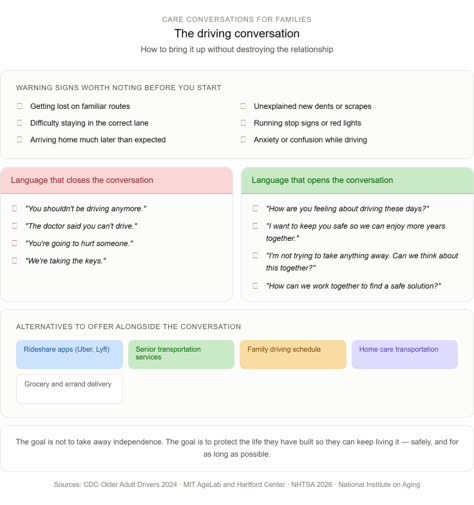
The language that makes this conversation possible
The framing of this conversation determines almost everything about how it goes.
Opening the conversation with a question like “How are you feeling about driving?” allows the parent to reveal unspoken concerns of their own. Many seniors are already aware that something has changed. They are just waiting for someone to open the door without making them feel humiliated or dismissed.
By contrast, leading with an accusation or a verdict, even a gentle one, activates defensiveness before the conversation has a chance to go anywhere useful. Remind your parent that it is about their safety, not about taking away their independence. Remind them that you still care about their social wellness and are not trying to take anything away from them.
The most effective framing separates the car from the life. Losing the car does not have to mean losing access to the things the car made possible. Keeping that distinction clear, and backing it up with real alternatives, changes what the conversation is asking of your parent. It is no longer asking them to give something up. It is asking them to solve a problem together.
When your parent will not budge
Some parents refuse to hear this conversation, no matter how it is approached. They become angry. They deny there is a problem. They make it clear that the subject is closed.
When that happens, there are still options.
A doctor’s perspective often carries more weight than a family member’s. Asking your parent’s physician to raise driving safety as part of a routine appointment, or requesting a formal driving evaluation conducted by an occupational therapist, introduces an objective third party that is harder to dismiss than a worried child.
Some states allow family members to report concerns about an older driver to the DMV, which can trigger a required vision or road test. This is a last resort in most families because of the relational cost it carries. But when safety is genuinely at stake and every other path has been tried, it is worth knowing the option exists.
And if your parent continues driving despite real safety concerns, making sure their insurance is current and that your own liability is understood becomes a practical necessity, however painful that reality is.
What this conversation is really about
The families who navigate this best are the ones who never lose sight of what is underneath it.
Your parent is not fighting about a car. They are fighting for the version of themselves that has been capable and independent and in control of their own life. The car is just the last clear symbol of that.
When you approach the conversation understanding that, everything shifts. You are not trying to win. You are trying to help someone grieve something that matters, while also keeping them safe. Those two things can coexist. But only if the conversation makes room for both.
One thing to do this week
If you have been noticing changes and saying nothing, start a note on your phone after your parent’s next drive or visit. Write down one specific thing you observed.
Not to use as evidence in the conversation. Just to begin the process of seeing clearly, so that when the time comes to say something, you have something honest and specific to say.
The conversation does not have to happen this week. But the noticing should have already started.
Next in the series: Hospice: What It Actually Is, Who Qualifies, and What Families Wish They Had Known Sooner. Publishing August 10.
What We Wish We’d Said Sooner is a series from Care Conversations for Families, exploring the conversations every family needs to have before a crisis makes them urgent.
The Most Comprehensive Care In The Industry

Physical Wellness
We make daily life easier as needs change, with support for personal care, mobility, medication reminders, and recovery after a hospital stay.
Learn More
Mental Well-Being
Staying active and connected matters. Our caregivers provide companionship and meaningful engagement to support emotional health and independence.
Learn More
Nutrition & Hydration
Healthy meals and proper hydration are essential. We help with planning, shopping, and preparation to support daily wellness and energy.
Learn More
Active Connections
Strong relationships bring comfort and purpose. We help seniors stay connected through social engagement, technology, and regular check-ins.
Learn More