What Palliative Care Actually Is (And Why It Is Not the Same as Giving Up)
Need Home Care?
Contact Us Today
Your father has been living with heart failure for two years.
He is still in treatment. His cardiologist sees him regularly. Medications are adjusted, tests are ordered, follow-up appointments are scheduled. He is not giving up. Nobody is giving up.
And yet when someone mentioned palliative care at his last appointment, the room went quiet. Your mother looked frightened. Your father changed the subject. On the drive home, your sister said she did not want to think about that yet.
Nobody explained what palliative care actually is. Nobody needed to. The word alone carried enough weight to shut the conversation down before it opened.
This post is about what that word actually means, and why the fear surrounding it is costing families something real.
The misconception that causes the most harm
Only about 14% of people who need palliative care worldwide actually receive it. The gap is enormous. And the single biggest driver of that gap is a misconception so widespread that it operates even in hospital rooms staffed by trained professionals.
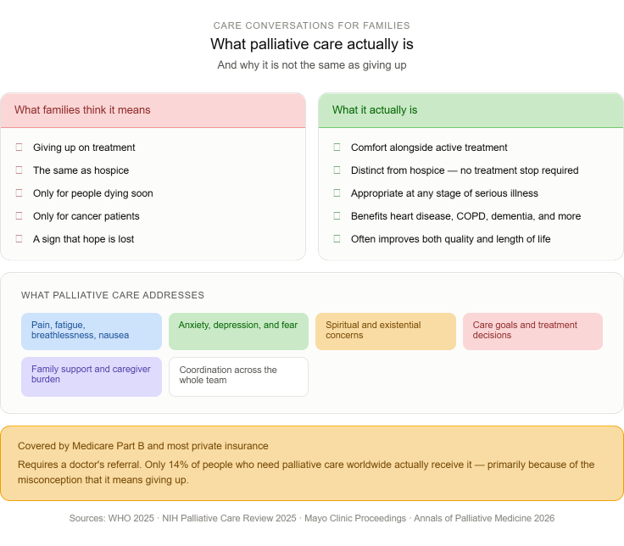
Most people believe palliative care means stopping treatment. Many think it is the same as hospice. Many believe it is only for people who are dying imminently.
This common misconception, combined with the misconception that palliative care is equivalent to end-of-life care, denies patients and families access to palliative care until late in the illness trajectory. nih
Late. Or never. Because by the time people understand what palliative care actually is, they have often already spent months managing avoidable suffering without it.
What palliative care actually is
Palliative care is specialized medical support focused on providing relief from the symptoms and stress of a serious illness. The goal is to improve quality of life for both the patient and the family.
It addresses pain, fatigue, breathlessness, nausea, anxiety, depression, and the emotional and spiritual dimensions of living with serious illness. It involves a team that typically includes doctors, nurses, social workers, and chaplains working alongside the primary medical team.
The most important word in understanding palliative care is alongside.
Palliative care is not about abandoning curative treatments. It is about improving life quality for those with serious illnesses. Palliative care can be given alongside treatments that aim to cure. PubMed
A person receiving chemotherapy can receive palliative care. A person managing congestive heart failure can receive palliative care. A person with early-stage dementia can receive palliative care. None of those situations require stopping treatment. Palliative care is the layer of support that makes the rest of the treatment more bearable.
When palliative care begins
This is one of the most important things families do not know: palliative care does not have a minimum threshold of illness severity. It does not require a terminal diagnosis. It does not require any particular prognosis.
Palliative care is still frequently associated solely with imminent death or limited to oncology patients. Awareness remains insufficient among both healthcare professionals and the general public that individuals with other chronic, life-limiting conditions may also significantly benefit from palliative care. nih
Heart disease, COPD, kidney disease, Parkinson’s, Alzheimer’s, multiple sclerosis: all of these are conditions for which palliative care is appropriate and beneficial, often from the time of diagnosis rather than only at the end of life.
Research has consistently found that patients who receive palliative care alongside standard treatment often live as long as or longer than patients who do not, and with meaningfully better quality of life during that time. This is not a tradeoff between comfort and survival. It is often both.
The infographic: what palliative care is and is not
Why asking for palliative care is not giving up
Here is the clearest way to hold this distinction.
Hospice is a choice to stop pursuing curative treatment and focus entirely on comfort. It requires a prognosis of six months or less. It is a profound and legitimate choice that families often come to too late.
Palliative care is not that choice. Palliative care says: we are still pursuing treatment, and we are also going to address every source of suffering that treatment is creating or that the illness has introduced. It adds a team. It adds support. It does not remove anything.
When physicians discuss end-of-life concerns proactively, many patients choose care more aligned with their values and goals. Palliative care creates the space for those conversations. It does not predetermine their outcome.
Refusing palliative care out of fear that it means giving up is like refusing physical therapy after a surgery because it feels like an admission that something went wrong. The therapy is not about the surgery failing. It is about recovering as fully and comfortably as possible while the healing happens.
How to ask for it
Palliative care requires a referral from a doctor. The conversation is straightforward.
“I’ve been reading about palliative care and what it covers. Given what we’re managing right now, would a palliative care consultation make sense for us?”
That is it. That question opens a door that most families never knew to knock on.
One thing to do this week
If your parent is managing a serious illness of any kind, call their primary care physician or specialist and ask one question: “Would my parent benefit from a palliative care referral?”
The answer, and the conversation that follows, may change the entire experience of the illness. Not by changing the illness. By changing what happens around it.
Next in the series: Hospice: What It Actually Is, Who Qualifies, and What Families Wish They Had Known Sooner. Publishing August 10.
What We Wish We’d Said Sooner is a series from Care Conversations for Families, exploring the conversations every family needs to have before a crisis makes them urgent.
The Most Comprehensive Care In The Industry

Physical Wellness
We make daily life easier as needs change, with support for personal care, mobility, medication reminders, and recovery after a hospital stay.
Learn More
Mental Well-Being
Staying active and connected matters. Our caregivers provide companionship and meaningful engagement to support emotional health and independence.
Learn More
Nutrition & Hydration
Healthy meals and proper hydration are essential. We help with planning, shopping, and preparation to support daily wellness and energy.
Learn More
Active Connections
Strong relationships bring comfort and purpose. We help seniors stay connected through social engagement, technology, and regular check-ins.
Learn More