Home Safety
Need Home Care?
Contact Us Today
Home Safety
HOME SAFE HOME – TIPS FOR A SAFE LIVING ENVIRONMENT AT EVERY AGE
Did you know unintentional injuries are a leading cause of visits to hospital emergency departments (ED), and are often attributed to disability and even death?
Of the 130 million ED visits in 2010, approximately 29.3 million were attributed to unintentional injuries, according to a 2013 report released by the Centers for Disease Control and Prevention (CDC). Included in the number were fractures, sprains and strains, open wounds, contusions, burns, suffocation, choking, drowning, poisoning and other types of trauma and complications.
Of notable concern is that injuries due to falls account for approximately one-third of the 29.3 million injuries. And while people age 15 and younger are more likely to visit an ED (25.5 million) than people age 65 and older (19.5 million), falls pose an especially serious health risk to older people.
Treatment can be quite expensive and adversely affect an older person’s quality of life by drastically reducing their independence. In 2010, about 21,700 older adults died from unintentional fall injuries.1
As one of the nation’s leading providers of home care services, Home Helpers & Direct Link recognize the importance of a safe living environment and offer a suite of medical alert systems via Direct Link.
Clinical studies indicate that use of monitored Personal Emergency Response Systems (PERS), such as the Direct Link PERS, reduce mortality rates by nearly four times, reduce hospital utilization by 59 percent, and yield a positive benefit-to-cost ratio of over seven to one (every dollar spent on PERS results in $7.19 in home care cost savings).2
“Though specific safety measures may vary based on a person’s age, there are many similarities between creating a safe living environment for young kids and older adults.”
Many precautionary measures to enhance safety and help prevent injuries are inexpensive and simple to take. In this edition of Compassionate Care, we share information and insight to help you and your loved ones enhance safety in and around the home.
HOME SAFETY CONSIDERATIONS
Regardless of whether people in your home are toddlers, elderly or somewhere in between, we suggest the following:
- Prevent slips and trips (e.g., carpets, curbs/steps, uneven surfaces, door thresholds, obstructions).
- Secure furniture that may accidentally tip over if grabbed or used to catch your balance.
- Ensure medications are properly stored, dosed and taken (e.g., Direct Link automated medication dispenser).
- Avoid injury in the kitchen and bathroom.
OTHER SAFETY CONSIDERATIONS INCLUDE:
- Do not overload extension cords or create a fire hazard by using a light duty cord for a heavy duty appliance (e.g., air conditioning unit, humidifier, space heater).
- Use a step-stool or ladder with extra care so as not to lose balance.
- Limit the weight of things you pick-up or carry so as not to strain or injure yourself.
- Allow time for your vision to adjust when going from light to dark and vice versa.
- Wait a few seconds before walking when standing up to reduce the chance of losing your balance.
- Have adequate lighting, especially near an entryway and stairs.
- Keep firearms and potentially harmful chemicals/cleaners in a secure location.
- Install smoke alarms and carbon monoxide (CO) detectors and change the batteries in the spring and fall.
- Be careful with candles, lighters/matches and cigarettes.
- Have an escape plan in the event of an emergency.
- Use caller ID/answering machine to screen calls. People calling to solicit or scam are unlikely to leave a message.
PREVENTION IS KEY
Safety experts suggest that 90% of accidents are preventable. Being that most people are accustomed to their home, it may be helpful to have someone who is unfamiliar with your living environment, such as a Home Helper caregiver, walk around your house to identify potential hazards you may have overlooked. Additional resources are listed below:
- AARP
- Centers for Disease Control and Prevention
- Consumer Product Safety Council
- U.S. Fire Administration
1 Centers for Disease Control and Prevention, National Center for Injury Prevention and Control. Web–based Injury Statistics Query and Reporting System (WISQARS) [online]. Accessed August 15, 2013.
2 “Low-tech” personal emergency response systems reduce costs and improve outcomes. Bernstein M. Manag Care Q 2000;8:38-43. [PubMed]
$80 – $100 ValueYOUR INITIAL 4 HOURS OF CARE ARE FREE!Each office is independently owned and operated. Participating locations only.
Your Questions, Answered
Home Helpers Home Care offers a wide range of in-home care services, including personal care, companionship, nutrition support, wellness monitoring, and specialized care for chronic conditions, dementia, and recovery.
Our services are designed for seniors, individuals with disabilities, those recovering from illness or surgery, and anyone who needs extra support to live safely and comfortably at home.
Yes, every care plan is fully personalized based on each client’s unique needs, preferences, and schedule, whether they require a few hours of support or 24/7 care.
Yes, our caregivers are carefully screened, trained, and insured to provide compassionate, high-quality care you can trust.
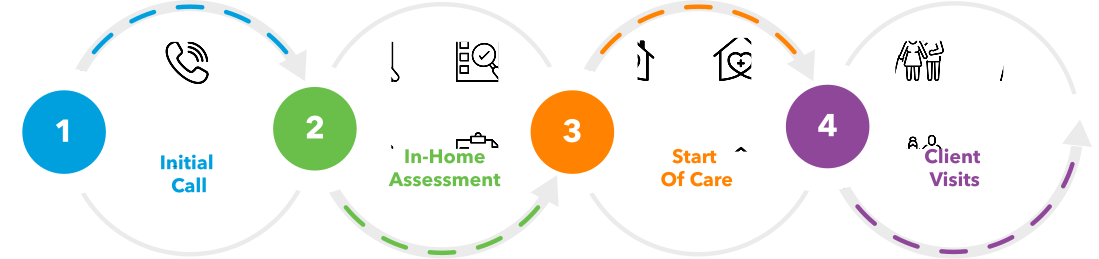
Getting started is easy—simply contact your local Home Helpers location to schedule a free in-home assessment and create a care plan tailored to your needs.