Using Long-Term Care Insurance for Home Care in Cincinnati and Northern Kentucky
Need Home Care?
Contact Us Today
If your family has a long-term care insurance policy, it will very likely pay for in-home care — and Home Helpers of Greater Cincinnati & NKY files the claim for you. We complete the carrier’s forms, supply the plan of care and the visit documentation they require, and deal with the insurance company directly, at no additional charge. Families are not left to fight the paperwork alone, which is the single most common reason a policy someone paid into for twenty years never gets used.
By Kristin Worthington, co-owner, Home Helpers Home Care of Greater Cincinnati & NKY
Call (513) 712-0736 or schedule your free in-home assessment, and bring the policy. We will read it with you.
Long-Term Care Claim Support: What We Actually Do
Most agencies will tell you they accept long-term care insurance. What that usually means is that they will accept the money once you have extracted it from the carrier yourself. The gap between those two things is where policies go to die.
Here is what we handle once care begins:
- We complete the provider sections of the carrier’s claim forms.
- We supply the plan of care the policy requires, drawn from the in-home assessment your Care Manager performs.
- We provide the visit records, caregiver documentation and invoices in the format the carrier asks for — which varies by company and is a frequent reason claims stall.
- We respond to the carrier’s requests for additional information, so those letters do not land on your kitchen table.
- We keep submitting for as long as care continues, not just at the start.
What we do not do is sell insurance, recommend policies, or tell you what your policy means as a legal matter. We are a home care agency, not an insurance advisor, and the carrier makes every coverage decision. What we can do is make sure they are never waiting on us.
What a Long-Term Care Claim Requires
Policies differ, but almost all of them ask for the same four things. Knowing this in advance is most of the battle.
| What the carrier wants | What it means | Who provides it |
| Benefit trigger | Proof that your loved one needs help with a set number of activities of daily living — typically bathing, dressing, eating, toileting, transferring, continence — or has a cognitive impairment | A licensed health care practitioner, supported by our assessment documentation |
| Plan of care | A written plan describing the care to be delivered and how often | Us, from your Care Manager’s assessment |
| A qualified provider | Most policies require a licensed home care agency and will ask for the state license and a federal tax ID | Us, on request |
| Ongoing documentation | Visit records and invoices, submitted on the carrier’s schedule for as long as care continues | Us |
The Elimination Period — and Why Waiting Does Not Save Money
Nearly every long-term care policy has an elimination period: a waiting stretch, commonly 30, 60 or 90 days, that has to pass before the carrier starts paying. During it, the family pays.
Here is the part that costs families real money. On many policies the elimination period is counted in service days — days on which care is actually delivered — not in calendar days from the diagnosis. So a family that delays starting care to conserve cash is not shortening the wait. They are postponing the day the clock starts, and with it the day benefits begin, while going without help in the meantime.
Read your policy’s definition, because this varies and it matters. If it counts service days, starting sooner is usually the better financial decision as well as the better care decision. If you are not sure how yours is written, bring it to the assessment and we will look at it together.
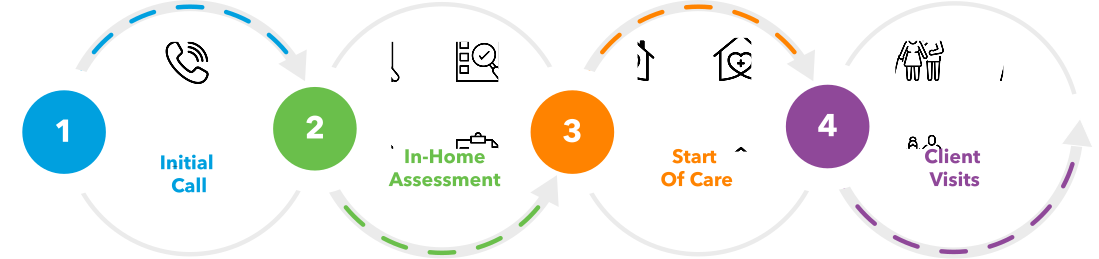
How It Works, Start to Finish
- Call us at (513) 712-0736 and mention the policy. Have the carrier name and policy number if you can find them; if the policy itself is lost, the carrier can usually locate it by name and Social Security number.
- We schedule a free in-home assessment. Your Care Manager meets your loved one at home, and we read the policy with you — benefit trigger, elimination period, daily or monthly maximum, and whether home care is covered at the same rate as facility care.
- You open the claim with the carrier. This step is the policyholder’s to take; most carriers will not speak to us until you have authorized it.
- We complete our portion. Plan of care, provider documentation, licensing and tax details, and the provider sections of the claim forms.
- Care begins. If there is an elimination period, this is when the clock starts on most policies.
- We bill and keep billing. Visit records and invoices go to the carrier on their schedule, and we handle their follow-up requests, for as long as care continues.
What Long-Term Care Insurance Typically Covers
Most policies written in the last twenty-five years cover exactly the care we provide: help with bathing, dressing, meals, medication reminders, mobility and supervision, delivered at home by a licensed agency. That includes 24-hour home care staffed in shifts and it includes memory care at home, which is where a large share of claims are ultimately made. It also includes care after a hospital or rehab stay. Read our blog to learn more about what Medicare does and does not cover.
Older policies — roughly pre-2000 — are more likely to be facility-only or to reimburse home care at a reduced rate. It is still worth checking rather than assuming; we have seen families surprised in both directions.
Two other things worth knowing. Most policies pay a daily or monthly maximum rather than a percentage, so if the benefit does not cover the full schedule, families commonly combine it with private pay — see what home care actually costs to work out the gap. And a policy is not the only route: if your loved one is a veteran, the VA Community Care Network may cover care at no cost to the family, and it is worth checking which is the better path before you open a claim.
Common Questions
Do you bill the insurance company directly, or do I pay and get reimbursed?
It depends on the policy. Some carriers pay the provider directly; others reimburse the policyholder. Either way we produce and submit the documentation the carrier needs, so the paperwork is not yours to manage. We will tell you which arrangement your policy uses when we read it with you.
Do you charge for handling the claim?
No. It is part of the service for our clients, at no additional charge. We think the claim work is a normal part of caring for a family, not an add-on.
Can you help me figure out whether my policy covers anything before I commit to care?
Yes — that is part of the free in-home assessment. Bring the policy and we will go through the benefit trigger, the elimination period and the daily maximum with you. There is no cost and no obligation to start care afterward.
What if the carrier denies the claim?
Denials happen, most often over the benefit trigger or missing documentation. We cannot overturn a carrier’s decision — nobody in home care can promise you that — but we can make sure the documentation on our side is complete and resubmit what they ask for. If the issue is the medical certification, that generally goes back to the physician.
My parent has a policy but has not needed care yet. Should we do anything now?
Find the policy and read two lines: the elimination period and the daily benefit amount. Knowing those before there is a crisis makes every later decision faster. Keep the carrier’s claims phone number somewhere you can find it at 9 p.m. on a Sunday.
Do you work with all carriers?
We work with the major long-term care carriers and have not yet met a policy we could not document for. Requirements vary by company, which is exactly why we handle it rather than leaving it to families.
Trusted care starts with a conversation. Call (513) 712-0736 or schedule your free in-home assessment — and bring the policy.

Your Questions, Answered
Home Helpers Home Care offers a wide range of in-home care services, including personal care, companionship, nutrition support, wellness monitoring, and specialized care for chronic conditions, dementia, and recovery.
Our services are designed for seniors, individuals with disabilities, those recovering from illness or surgery, and anyone who needs extra support to live safely and comfortably at home.
Yes, every care plan is fully personalized based on each client’s unique needs, preferences, and schedule, whether they require a few hours of support or 24/7 care.
Yes, our caregivers are carefully screened, trained, and insured to provide compassionate, high-quality care you can trust.
Getting started is easy—simply contact your local Home Helpers location to schedule a free in-home assessment and create a care plan tailored to your needs.