
When You Are the Only One Showing Up
Need Home Care?
Contact Us Today

There is a specific kind of exhaustion that comes not just from caregiving, but from doing it while watching other people not do it.
Your siblings who are too busy. The family members who appear for the major moments and disappear into their own lives for everything in between. The people who offer to help in general terms and never in particular ones.
You are the one who comes every week, or every day, or every time. You are the one who knows what medications they are on, which doctor they see, and what they are afraid of. You are the one who has rearranged your life, your career, your relationships around a responsibility that other people have quietly passed to you.
This is not unusual. Research consistently shows that caregiving falls disproportionately on one family member — most often, though not exclusively, a daughter or daughter-in-law who lives closest, is seen as most available, or was simply the one who stepped up first and never stopped.
If that person is you, this is about what that actually costs and what you can actually do.
Why the weight falls unevenly
Caregiving rarely gets distributed equitably within families, and it is rarely the result of anyone making a deliberate decision.
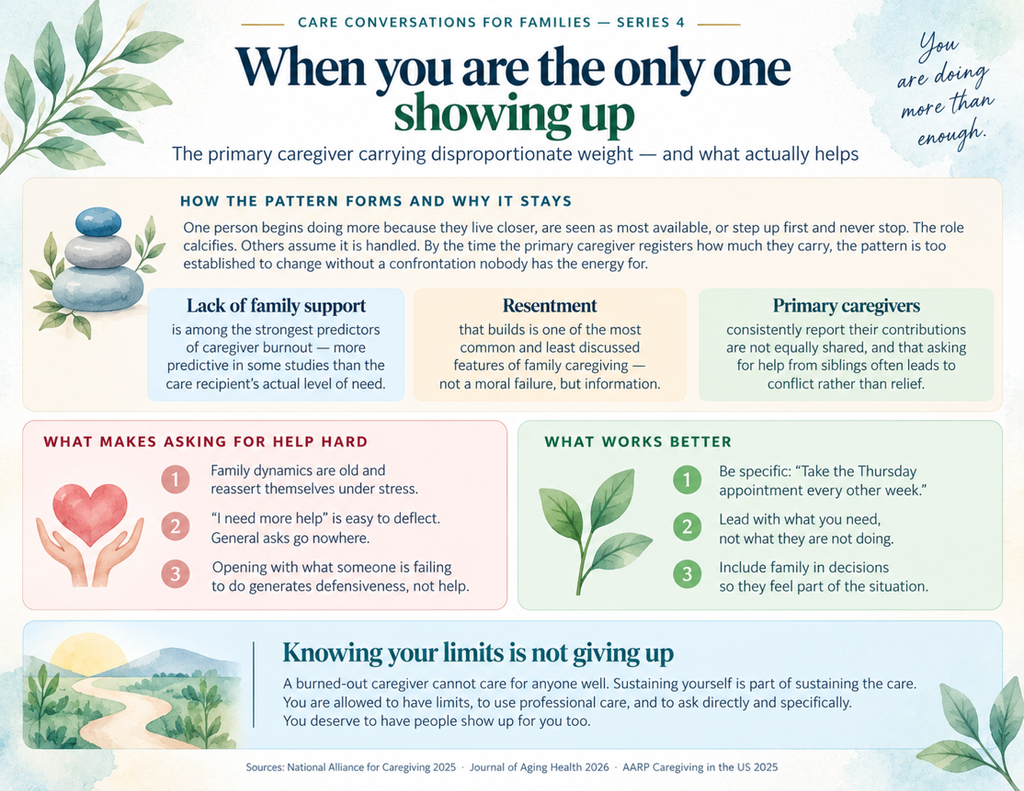
It tends to happen gradually. One person begins to do more because they live closer, or have a more flexible schedule, or are the one who gets called first. As they do more, they become the default. Others assume they have it handled. The role calcifies. By the time the primary caregiver realizes how much they are carrying, the pattern has been established long enough that changing it feels like a confrontation — and confrontation, in a family already under stress, feels like something no one has the energy for.
Research on family caregiving consistently finds that primary caregivers feel their contributions are not equitably shared, and that asking for help from siblings often leads to conflict rather than relief. The primary caregiver keeps absorbing the weight. And the resentment builds quietly alongside the love.
The resentment nobody names
The resentment of the primary caregiver toward absent family members is one of the most common and least discussed features of family caregiving. It is also one of the most difficult to talk about because it sits beside other feelings that seem more socially acceptable — love for the person being cared for, commitment to doing right by them.
But resentment is information. It is telling you something accurate: that the situation is not equitable, that you are carrying more than your share, and that other people who could contribute are not. It is not a moral failure to feel it. It is a signal worth paying attention to.
Many primary caregivers describe the resentment as intensifying not in moments of hardship but in moments of contrast. When a sibling visits briefly and is praised for showing up. When a family member comments on how well the caregiving is going without any awareness of what it is actually taking. When you realize that everyone else has simply assumed you will handle it indefinitely, without being asked and without being thanked.
The infographic: sharing the load — what primary caregivers carry
Having the conversation
Asking for help within families is genuinely difficult. The dynamics are old and they tend to reassert themselves under stress. But there are ways to approach it that are more likely to produce something useful.
Specific asks work better than general ones. “I need help” is easy to deflect. “I need you to take the Thursday appointment every other week” is harder to say no to. Specific asks give people something concrete to commit to.
Leading with what you need rather than what the other person is failing to do tends to generate more possibility. A conversation that opens with what someone is not doing tends to produce defensiveness. A conversation that opens with what you need tends to produce engagement.
And where possible, including other family members in decisions — about care arrangements, upcoming medical conversations, what the next six months might look like — helps. People engage more with situations they feel part of.
None of this is a guarantee. Some family members will not step up regardless of how the conversation is framed. And accepting that, while being clear about your own limits, is its own hard work.
Knowing your limits
The primary caregiver who is doing everything cannot do everything indefinitely.
Caregiver burnout is not a character flaw. It is what happens when a person provides high levels of care without adequate support for long enough. Research on caregiver burnout consistently finds that lack of assistance from other family members is among the strongest predictors of burnout in primary caregivers — more predictive, in some studies, than the care recipient’s level of need.
Knowing your limits means being honest with yourself about what you can sustainably provide, and being willing to say so. It means allowing professional care to supplement or replace what you are doing when that is the right call, without interpreting it as failure. Your wellbeing is not separate from the quality of care your loved one receives. A burned-out caregiver cannot care for anyone well, and sustaining yourself is part of sustaining the care.
One thing to do this week
Name the one caregiving task someone else could do, and identify one person who could do it.
Then ask them directly. A specific task, a specific timeframe. Not “whenever you have time.” A real ask.
You deserve to have people show up for you too.
Next in the series: Who Takes Care of the Caregiver. Publishing October 16.
Nobody Told Me It Would Feel Like This is a series from Care Conversations for Families, exploring the interior life of loving someone through illness.
The Most Comprehensive Care In The Industry

Physical Wellness
We make daily life easier as needs change, with support for personal care, mobility, medication reminders, and recovery after a hospital stay.
Learn More
Mental Well-Being
Staying active and connected matters. Our caregivers provide companionship and meaningful engagement to support emotional health and independence.
Learn More
Nutrition & Hydration
Healthy meals and proper hydration are essential. We help with planning, shopping, and preparation to support daily wellness and energy.
Learn More
Active Connections
Strong relationships bring comfort and purpose. We help seniors stay connected through social engagement, technology, and regular check-ins.
Learn More