When It’s Time for Mom or Dad to Stop Driving: A Gentle Guide for Michigan Families
Need Home Care?
Contact Us Today
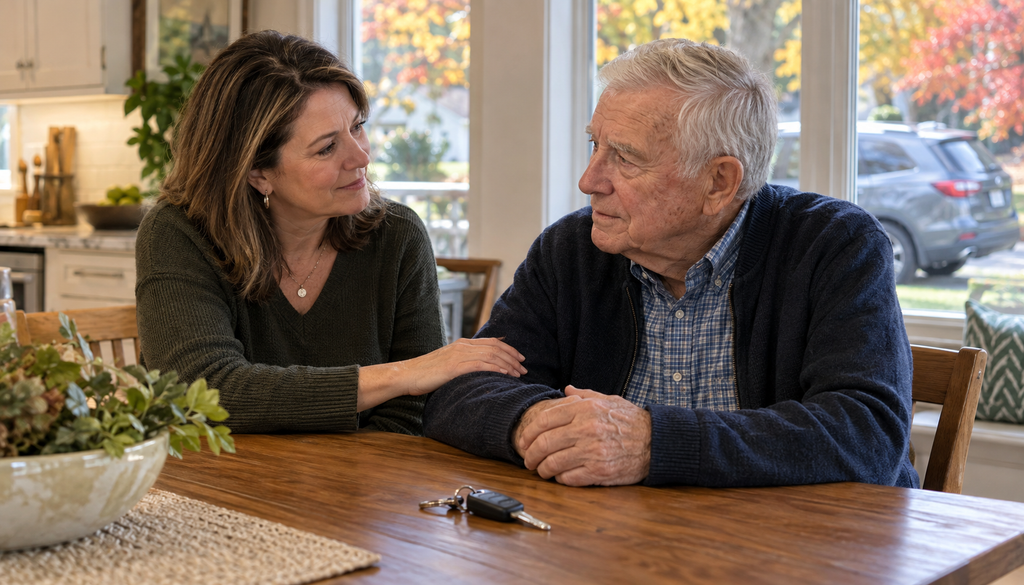
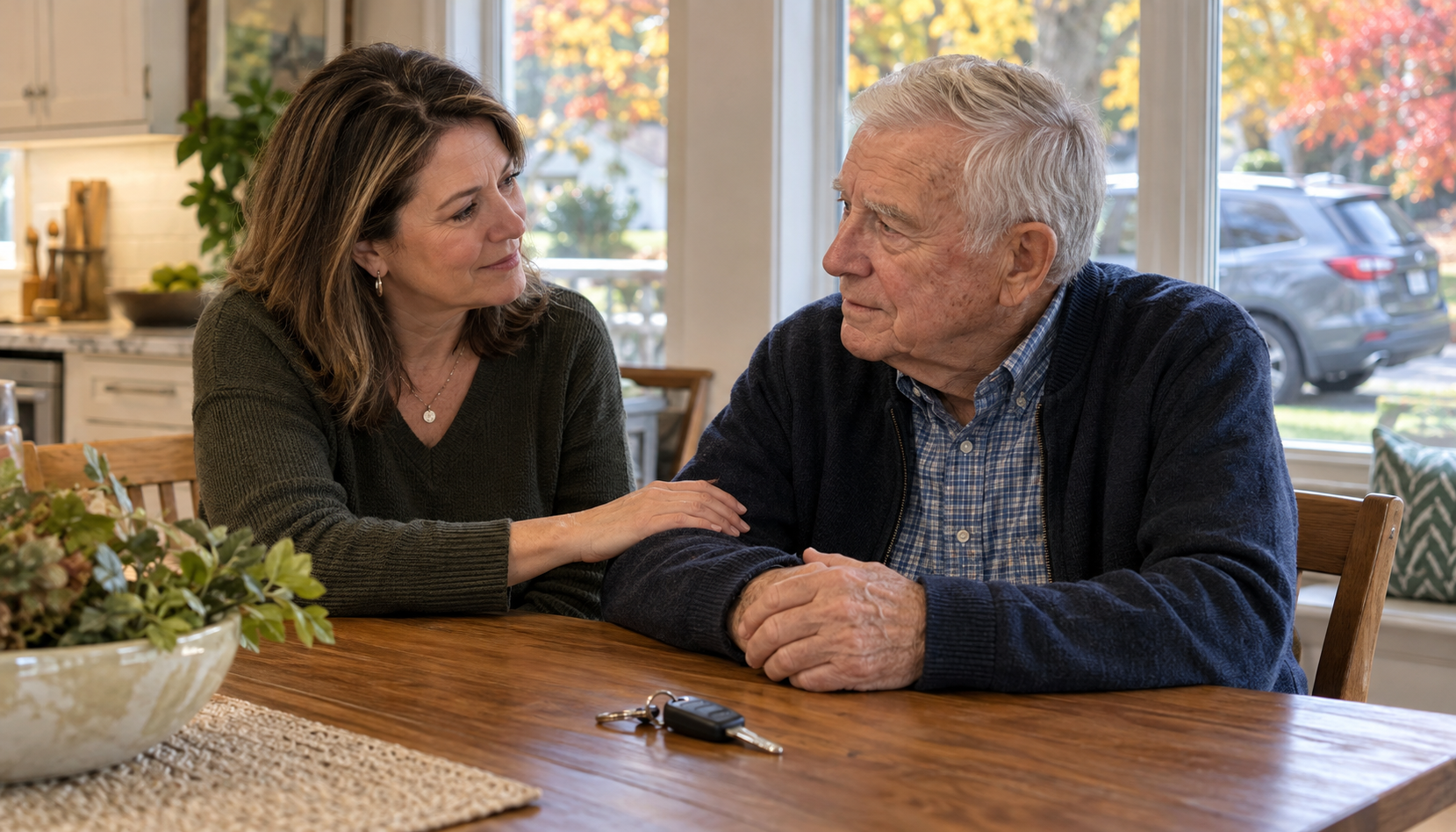
Of all the conversations families bring to me, this is one of the hardest to begin. A daughter calls about her father’s memory, or her mother’s balance, and near the end of the call, almost as an afterthought, she says, and I’m not sure she should still be driving. Then she goes quiet, because she knows what the car means.
In Michigan, the car is how a person gets to church, to the pharmacy, to the grandkids’ games, to lunch with the same three friends on the same Wednesday for twenty years. For many of our parents, driving is the last visible proof that they are still running their own lives. Asking them to give it up can feel like asking them to give up themselves, and they often hear it that way.
I want to offer a gentler path through this, one that starts long before anyone asks for the keys. It is the same progression I have walked with many families, and it tends to go better than the alternatives: a crisis, an accident, or a daughter who takes the keys off the hook one night and does not sleep for a week afterward.
Why this is so hard to raise
Most older drivers feel quite sure of themselves behind the wheel. The University of Michigan’s National Poll on Healthy Aging asked Michigan drivers 65 and older about this in early 2025, and 90% said they were very confident in their current driving. Only 39% had any plan for the day they could no longer drive, and just 6% had ever talked about their driving with a doctor or other health care provider.
Those numbers describe something I see in families all the time. The person driving feels fine, and the people riding along are frightened, and nobody has a plan. The conversation gets put off because there is no good moment for it, until one day there is a bad moment that forces it.
Some of this is ordinary human hope. Some of it is denial, and I say that with a great deal of tenderness. I often tell families that denial is a very effective coping tool. It is not where we want to be, and it is not a healthy coping tool over the long run, but it works for a while, and your parent is using it because the alternative is frightening. Knowing that can give you a little more patience for them, and for the sibling who keeps saying Dad’s fine.
Signs worth paying attention to
Driving rarely changes all at once. What families usually notice is a slow accumulation, and it helps to watch for a few weeks before you say anything, so you are speaking from what you have seen rather than from a single scary afternoon.
Things to look out for might include:
- New dents or scrapes on the car, the mailbox, or the garage door frame that nobody mentions
- Getting lost or turned around on routes your parent has driven for years
- Drifting between lanes, riding the brake, or stopping in places that make no sense
- Other drivers honking, passing quickly, or pulling around your parent
- Trouble judging the gap for a left turn, or hesitation at four-way stops
- A new habit of avoiding driving at night, on the highway, or in the rain
- Warnings or tickets from police, or small fender-benders that get explained away
- Coming home tired or shaken from a short, familiar drive
If you can, ride along once or twice without announcing why. You will learn more in fifteen minutes in the passenger seat than in any conversation. Our piece on the signs that it may be time for in-home care covers driving alongside the other early changes families tend to notice first.
Health changes matter here too. Vision problems, new medications, a recent fall, arthritis in the neck that makes it hard to look over a shoulder, and any diagnosis involving memory or thinking can all affect driving long before anyone has an accident.
The conversation, in the order that tends to work
When families ask me how to begin, I tell them it depends on how gracefully they want it to go, and that there are many ways it can sound. The progression I use has four steps, and it starts with questions.
1. Start with questions
Before you share a single concern, ask your parent how driving has felt lately. Questions give them the dignity of assessing themselves first.
You might ask whether they have felt a little dizzy while driving in the past month, or whether it has seemed hard to see everything around the car. You might ask whether it feels like everyone on the road is going faster than they are, and whether that has been a little scary. You might ask whether stopping quickly has been harder than it used to be.
Then listen, and see where their own assessment lands. Many older drivers already know something has changed, and some will tell you so if you give them room. A parent who says I don’t love driving after dark anymore has just opened a door you did not have to force.
2. Share what you have observed
If their self-assessment and yours are far apart, the next step is to gently share what you have seen. Keep it specific and keep it in the first person.
When I’m driving with you, this is what I’m noticing, and this is what gives me concern for your safety.
Talk about the particular left turn, the drifting on Jackson Road, the dent in the fender. Avoid words like always and never, and leave out anything that sounds like a verdict about who they are. You are describing moments, and your worry for them, and nothing more than that.
3. Talk about safety, and try some limits first
Stopping completely is rarely the first step. Many families do well with a season of parameters before anyone talks about giving up the car.
You might agree that for now your parent drives only when someone is riding along, or only during daylight, for example between ten in the morning and one in the afternoon. You might agree to no highway driving, no driving in snow, or no driving to unfamiliar places. Parameters like these protect your parent while letting them keep much of what the car means to them, and they give everyone time to see how things go.
This is also a good time to suggest an outside opinion, which I will describe below. It can take a great deal of pressure off a family when a professional is the one making the call.
4. When it is time to stop, plan how they will stay independent
If the concerns continue, the day may come when you need to say plainly that driving is no longer safe. When that day comes, I encourage families to spend most of the conversation on the future.
Let’s talk about how you’re going to stay independent. Let’s talk about how you can get around when one of us isn’t here to take you.
Then get specific. There may be a friend who has agreed to take her anywhere she wants to go on Wednesdays. There may be a church or synagogue with a transportation ministry. You might set up a ride-share account connected to a family member’s phone, so the rides are paid for and someone can see where she is. There are good local programs, listed below, that many families never hear about.
The goal is for your parent to hear two things at once: you really can’t drive anymore, it isn’t safe, and we are going to make sure you can still get where you want to go.
If you are weighing whether a caregiver might help with rides, errands and appointments, you can schedule a free in-home assessment and we will talk it through. There’s no cost and no pressure to decide that day. Transportation to appointments and errands is part of what our caregivers do every week.
Getting an outside opinion in Michigan
Families often feel that everything rests on them. It does not have to. There are two good ways to bring in someone neutral.
A driving evaluation
An occupational therapist trained in driver rehabilitation can assess vision, reaction time, thinking skills and physical ability, and some programs include time behind the wheel. The Michigan Department of State keeps a list of rehabilitation agencies that offer this kind of service. On its current list, the options nearest to Ann Arbor include:
- University of Michigan Med Rehab at Briarwood, 355 Briarwood Circle, Building 4, Ann Arbor, (734) 998-7888, which offers pre-driving screening
- St. Joseph Mercy Hospital Rehabilitation Services, 5301 McAuley Drive, Ypsilanti, (734) 712-3456, which offers pre-driving screening
- Chelsea Community Hospital Outpatient Occupational Therapy, 14800 Old U.S. 12, Chelsea, (734) 593-5600, which offers pre-driving screening
Services, costs and referral requirements vary, so call ahead and ask what a screening includes and whether a doctor’s order is needed. Your parent’s primary care doctor is also a good person to bring into the conversation, and many parents will accept advice from their doctor that they would not accept from their children.
The state’s Safe Drivers Smart Options site (michigan.gov/agingdriver) has self-screening tools and guides for families, including an online screening where a family member rates a driver on dozens of specific driving skills.
A request for driver evaluation from the Secretary of State
If you have serious concerns and your parent will not consider any of the steps above, Michigan allows family members, friends and others to ask the Department of State to review a driver. The form is called a Request for Driver Evaluation (you may see it listed as OC-88 or DA-88). You describe the concern, the incident or the pattern of behavior you have seen.
A few things are worth knowing before you file:
- The Department does not accept anonymous requests. Your name goes on the form, though the state says it keeps the submitter’s information confidential to the extent the law allows.
- The driver may be asked to come in for a reexamination, which can include a vision screening, a knowledge test and a road test, along with a conversation about the concerns and their driving record.
- The outcome can be a restricted license that allows driving only under certain conditions, a suspension, or a revocation.
I think of this as a last resort, and I say that with care. It can protect your parent and everyone else on the road, and sometimes it is the right thing to do. It can also cost a great deal of trust if it comes as a surprise. When families do go this route, it usually goes better when the parent has already heard, lovingly and more than once, how worried everyone is.
Getting around without the car in Washtenaw County
A plan for rides deserves as much attention as the conversation itself. Programs change, so call to confirm the details, but these are the places I would start.
Free rides for adults 60 and older. Washtenaw County’s Older Persons Millage, approved by voters in 2024, funds free rides for residents 60 and older through three providers, with a focus on medical appointments, grocery shopping and government services. On the eastern side of the county the providers are Jewish Family Services and People’s Express, and on the western side it is WAVE.
- WAVE (Western-Washtenaw Area Value Express) serves Chelsea, Dexter and western Washtenaw County: (734) 475-9494
- People’s Express serves Northfield Township, Saline and much of the county beyond the bus routes, with door-to-door rides booked in advance: (877) 214-6073
- Jewish Family Services of Washtenaw County offers transportation for its clients: (734) 769-0209
TheRide in Ann Arbor and Ypsilanti. With a GoldRide ID, adults 65 and older ride TheRide’s regular fixed-route buses for free. GoldRide also offers a premium shared-ride service near the bus routes in Ann Arbor, Ypsilanti and the surrounding townships, booked through the FlexRide app or by phone. TheRide’s GroceryRide runs weekly trips from senior housing to grocery stores, and A-Ride provides door-to-door accessible service for people who qualify. TheRide’s customer line is (734) 973-6500.
Your parent’s own circle. Friends, neighbors and congregations are still some of the best transportation in the county, and many people are glad to be asked. A standing Wednesday ride with a friend often means more to a parent than any program could.
A caregiver. For some families, the right answer is a caregiver who comes a few times a week, drives your parent to appointments and errands, and stays with them while they are there. That keeps the outings going and puts another set of eyes on how your parent is doing.
Why now, before winter
In Michigan, the calendar makes this conversation more pressing every fall. Clocks fall back on Sunday, November 1, and the drive home from an afternoon appointment is suddenly in the dark. Then come the first icy mornings and the snow. A parent who is managing well in September can struggle in December, and it is much kinder to have the conversation, try some limits, and line up rides now than to have it on the shoulder of a snowy road.
If your parent’s winter is part of what worries you, our guide to Michigan winter safety for seniors walks through the rest of the season.
Frequently asked questions
At what age should someone stop driving?
There is no single age. Many people drive safely well into their eighties, and others need to stop much earlier because of a health change. The better question is how your parent is driving now, which is why watching for specific signs, riding along, and getting a professional evaluation all matter more than a birthday.
Can I report an unsafe elderly driver in Michigan?
Yes. Family members, friends and others can submit a Request for Driver Evaluation to the Michigan Department of State. Anonymous requests are not accepted. The driver may be called in for a reexamination that can include vision, knowledge and road tests, and the result can range from no change to a restricted license, a suspension or a revocation.
Where can my parent get a driving evaluation near Ann Arbor?
The Michigan Department of State’s list of rehabilitation agencies includes pre-driving screening at University of Michigan Med Rehab at Briarwood in Ann Arbor, St. Joseph Mercy Hospital Rehabilitation Services in Ypsilanti, and Chelsea Community Hospital Outpatient Occupational Therapy. Call ahead to ask what the screening involves, what it costs, and whether a doctor’s referral is needed.
What if my parent has dementia?
A dementia diagnosis does not always mean driving must stop the same day, but driving skills usually decline as the disease progresses, and people living with dementia are often not able to judge their own driving accurately. Bring your parent’s doctor in early, consider a formal evaluation, and plan for the transition sooner rather than later. Our guide to dementia care at home in Ann Arbor covers what to expect at each stage.
How can my parent get around after they stop driving?
In Washtenaw County, adults 60 and older can get free rides for medical appointments, groceries and errands through WAVE, People’s Express and Jewish Family Services, funded by the county’s Older Persons Millage. Adults 65 and older can ride TheRide’s fixed-route buses free with a GoldRide ID. Friends, congregations, ride-share accounts managed by family, and an in-home caregiver who provides transportation can fill in the rest.
What if my parent refuses to stop?
Slow down, go back to questions and observations, and try limits before stopping altogether. Involve their doctor, and consider a professional driving evaluation, which moves the decision away from the family. If there is real, immediate danger, a Request for Driver Evaluation to the Secretary of State is available. Through all of it, keep returning to the plan for how they will stay independent, because that is usually what they are most afraid of losing.
A closing word
If you are dreading this conversation, that dread is a sign of how much you love your parent. You are not trying to take something away from them. You are trying to keep them safe, and to keep the rest of their life as full as it can be.
Take it slowly. Start with questions. And if you would like someone to think it through with you, you can schedule a free in-home assessment whenever you are ready. There’s no cost and no pressure to decide that day, and if what your family needs turns out to be a driving evaluation or a WAVE pass rather than anything we provide, I’ll tell you that and help you find it.
About the author
Elizabeth Snyder Corman is the owner of Home Helpers Home Care of Ann Arbor, serving families in Ann Arbor, Saline, Dexter, Chelsea, Pinckney, and Whitmore Lake. Before opening the agency, she served as a hospital chaplain through the COVID-19 pandemic and as a hospice chaplain, walking with families through some of the hardest transitions of their lives. She holds an M.Div.
The Most Comprehensive Care In The Industry

Physical Wellness
We make daily life easier as needs change, with support for personal care, mobility, medication reminders, and recovery after a hospital stay.
Learn More
Mental Well-Being
Staying active and connected matters. Our caregivers provide companionship and meaningful engagement to support emotional health and independence.
Learn More
Nutrition & Hydration
Healthy meals and proper hydration are essential. We help with planning, shopping, and preparation to support daily wellness and energy.
Learn More
Active Connections
Strong relationships bring comfort and purpose. We help seniors stay connected through social engagement, technology, and regular check-ins.
Learn More