Michigan Winter Safety for Seniors: What Ann Arbor Families Should Prepare For
Need Home Care?
Contact Us Today
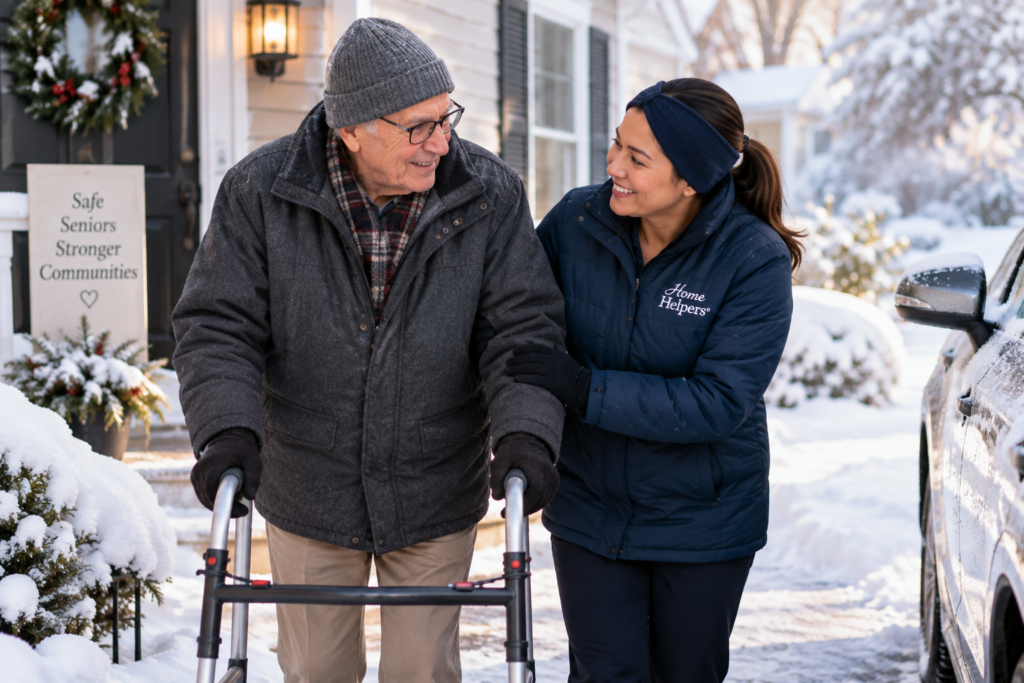
Anyone who has lived through a Michigan winter knows that the season asks something of you. The ice comes early and stays late. The sun sets before dinner. The stretch between January and March can feel considerably longer than eight weeks.
For an older adult living alone, that season asks quite a bit more.
Every year, from roughly November through March, the calls I take change character. More falls. More families discovering that Mom hasn’t left the house in eleven days. More adult children calling from out of state because they can’t get anyone on the phone and the roads are bad. Winter compresses everything that was already hard about aging at home.
The good news is that most of what makes winter dangerous for older adults is predictable, which means it’s preparable. Below is what I’d want every Ann Arbor family thinking about before the first hard freeze.
The ice, and why it’s worse than the cold
The cold itself is manageable. The ice is what sends people to the hospital.
Michigan’s freeze-thaw cycle creates a specific hazard that colder, drier climates don’t have as much of. Snow melts in the afternoon, refreezes overnight, and by morning there’s a thin sheet of ice on the walkway that looks exactly like wet pavement. Black ice on a front step is nearly invisible, and it’s the first thing your parent’s foot lands on when they step out for the mail.
An older adult who slips on ice is not falling the way you would. Slower reflexes mean less chance of catching themselves. Reduced bone density means what would bruise you can fracture them. And a fall on ice happens outdoors, sometimes with nobody nearby, sometimes in temperatures where lying on the ground for twenty minutes becomes its own emergency.
What actually helps:
- Someone other than your parent needs to be responsible for clearing the walk and the steps. A neighbor, a hired service, a family member with a standing arrangement. This is the single most important winter change most families can make. Snow removal services in Washtenaw County are not expensive relative to a hip fracture.
- Ice melt applied preemptively, not after the ice forms. Keep a covered container by the door with a scoop.
- Handrails on every exterior step, checked for stability before winter.
- Ice cleats that slip over regular shoes. Inexpensive, effective, and most older adults will actually wear them once they’ve had one bad experience.
- A boot tray inside the door so melting snow doesn’t create an indoor hazard on tile or hardwood.
- Reconsider the mailbox trip. If the mailbox is at the end of a driveway that ices over, arrange for someone else to bring the mail in, or ask about mail hold options during bad stretches.
Isolation is the danger nobody plans for
The falls get the attention. In my experience, isolation does more cumulative damage.
The pattern I see constantly goes like this. It gets cold, and driving becomes unpleasant, then intimidating, then something your parent quietly stops doing. The friends they used to see are also staying in. Church attendance drops off. The senior center feels like too much effort in the dark. Family visits become less frequent because the roads are bad and everyone is busy.
By February, an older adult who was reasonably social in September may have spoken to almost nobody in weeks.
Isolation in older adults is associated with meaningful declines in both physical and cognitive health. It accelerates memory issues. It contributes to depression. It causes people to eat less, move less, and take worse care of themselves. And it’s largely invisible from a distance, because the twice-weekly phone call sounds exactly the same as it always did.
What actually helps:
- Schedule contact rather than leaving it to chance. A standing weekly call at a set time, a neighbor who checks in on a specific day, a grandchild assigned to Sunday phone duty.
- Find one thing that gets them out of the house each week. A church service, a senior center lunch, a standing coffee with a friend, a hair appointment. One reliable outing does more for winter mood than several sporadic ones.
- Arrange transportation in advance. If driving in winter is off the table, the alternative needs to exist before the day they need it. Washtenaw County has senior transportation options worth researching in the fall, not in January.
- Consider whether a caregiver a few hours a week makes sense specifically for winter. Some of our families use us seasonally — more hours from December through March, less the rest of the year. Companionship, transportation, meals, and a set of eyes on the situation during the hardest stretch.
Heating safety
Heating is where the most serious winter emergencies come from, and older adults are at higher risk for several reasons at once.
Space heaters cause a meaningful share of home fires. If your parent uses one, it needs to be a newer model with automatic tip-over shutoff, placed at least three feet from anything flammable, plugged directly into a wall outlet rather than an extension cord, and never left running overnight or when they leave the room.
Carbon monoxide is the invisible one. Furnaces, water heaters, gas stoves, and fireplaces all produce it. Older adults may be less likely to notice or correctly interpret early symptoms, which resemble ordinary tiredness or flu. Working carbon monoxide detectors on every level of the house are non-negotiable, and batteries should be replaced at the same time as smoke detector batteries.
The furnace should be serviced in the fall, before the first hard cold snap. This is easy to skip and hard to recover from when the furnace fails at eleven at night in February.
Watch for a thermostat set unusually low. Older adults on fixed incomes sometimes reduce heat to save money, and they may not perceive cold as acutely as they used to. Hypothermia can occur indoors at temperatures that don’t feel dangerous — 60 to 65 degrees over an extended period is enough for someone with reduced circulation, low body weight, or certain medications. If you find the house cold, ask directly about heating costs. Michigan has energy assistance programs, and this is a solvable problem.
Fireplaces and wood stoves need a chimney inspection and a clear surround.
Food, medication, and the logistics of a bad week
Winter makes ordinary errands difficult, and difficulty compounds.
Groceries. A stretch of bad weather can mean a week or more without a grocery run. Talk with your parent about keeping a reasonable stock of shelf-stable food. Grocery delivery is available in the Ann Arbor area and is worth setting up in the fall, including walking through how to use it, rather than trying to figure it out during an ice storm.
Medications. This is the one that concerns me most. Running out of a heart medication or blood thinner during a bad weather stretch is a genuine emergency. Ask your parent’s pharmacy about ninety-day supplies and about mail-order or delivery options. Do this in October.
A backup plan for utilities. Power outages happen in Michigan winters, sometimes for days. Flashlights with fresh batteries in known locations, a battery-powered radio, warm blankets accessible without going to the basement, and a charged backup battery for a cell phone all matter. If your parent relies on any powered medical equipment, oxygen concentrator, CPAP, powered medical bed, the family needs a specific plan for an extended outage, including where they would go.
A “who to call” list posted somewhere visible. Family numbers, doctor, pharmacy, utility company, a nearby neighbor. Large print, on the refrigerator.
If you’d like help thinking through what your parent’s winter actually looks like and where the gaps are, you can schedule a free in-home assessment. We do a lot of these in the fall specifically because families want to be ready. There’s no cost and no pressure to decide that day.
Seasonal depression is a real medical issue
Michigan winters are dark. Ann Arbor sees relatively few clear days between November and February, and the sun sets before five for months.
Seasonal affective disorder and general winter mood decline are real, well-documented, and treatable. In older adults, they can be harder to recognize because the symptoms overlap with things families have started attributing to age — low energy, withdrawal, sleeping more, less interest in things they used to enjoy, changes in appetite.
If your parent seems noticeably different in January than they were in September, please don’t write it off as normal winter blues. Depression in older adults is common, frequently undiagnosed, and responds well to treatment.
Things that help: getting outside during daylight hours even briefly, light therapy boxes (worth asking their doctor about), maintaining social contact, keeping a consistent sleep schedule, and treating the depression itself when it’s present.
Dressing for Michigan cold
This sounds basic but it’s worth saying because older adults are at higher hypothermia risk than most people realize.
Older bodies regulate temperature less efficiently. Certain medications, thyroid conditions, and reduced circulation all make cold harder to tolerate. And crucially, some older adults simply don’t feel cold as acutely, which means they may not dress warmly enough for how cold they actually are.
Layers matter more than one heavy coat. Hats matter more than people think. Warm socks and properly fitting boots with good tread matter for both warmth and traction. Keeping a warm blanket in the living room and the bedroom is a small thing that helps.
If your parent is on a fixed income and needs better winter clothing, this is exactly the kind of practical gift that’s worth giving in November.
What a winter check-in should cover
If you’re calling from out of state and can’t see the house, here are the questions that actually surface problems:
- Who cleared the walk after the last snow?
- When was the last time you left the house? Where did you go?
- Who have you talked to this week besides me?
- How’s the furnace running?
- Are you keeping the house warm enough? What’s the thermostat set at?
- When do you next need to refill your prescriptions?
- What did you eat yesterday?
- Have you slipped or almost slipped on anything?
That last question deserves a specific note. Ask it directly, and then wait. Older adults routinely don’t volunteer near-falls because they don’t want to worry anyone or trigger a conversation about independence.
Frequently asked questions
At what indoor temperature does hypothermia become a risk for older adults?
Prolonged exposure to indoor temperatures of 60 to 65 degrees can cause hypothermia in older adults, particularly those with low body weight, circulation problems, thyroid conditions, or certain medications. That’s much warmer than most people assume. If you find your parent’s house cold, treat it as a real concern rather than a preference.
What senior transportation options exist in the Ann Arbor area for winter?
Washtenaw County has several options worth researching before you need them, including services through the regional transit authority and programs coordinated through senior centers and aging services organizations. AgeWays Non-Profit Senior Services (248-357-2255) can point families toward current local transportation resources. The important thing is to sort this out in the fall rather than during an ice storm.
Should we consider a temporary increase in care hours just for winter?
Quite a few of our families do exactly this. Winter is when isolation, weather-related risk, and the practical difficulty of errands all peak at once. Some families use more hours from December through March and scale back in the spring. There’s no requirement to keep a schedule you don’t need year-round.
What are the signs of carbon monoxide poisoning in an older adult?
Headache, dizziness, weakness, nausea, confusion, and shortness of breath. The difficulty is that these resemble flu, fatigue, or in an older adult, symptoms families may attribute to aging. Any situation where multiple people in the home feel unwell, or where symptoms improve when someone leaves the house, warrants immediate attention. Working carbon monoxide detectors are the real answer here.
My parent refuses to consider moving somewhere with less winter. What can we do?
That’s their call to make, and most people want to stay in their own home. The practical response is to make the home as winter-safe as possible: solve snow removal, address isolation deliberately, get the furnace serviced, arrange medication and grocery logistics in advance, and consider seasonal support. Most Michigan winters are survivable at home with the right preparation.
Getting ready before the first freeze
If you want a short list to work from, here’s what I’d do in October:
- Arrange snow and ice removal with someone who is not your parent
- Get the furnace serviced and test every carbon monoxide and smoke detector
- Set up medication delivery or a ninety-day supply
- Set up and practice grocery delivery
- Put one weekly out-of-the-house activity on the calendar
- Confirm the winter transportation plan
- Check exterior handrails and add ice cleats to the shoe closet
- Post an emergency contact list on the refrigerator
That’s a Saturday afternoon and a few phone calls, and it addresses most of what makes Michigan winters dangerous.
If you’d like a second set of eyes on your parent’s situation before winter, you can schedule a free in-home assessment. We do a lot of these in the fall. There’s no cost and no pressure to decide that day, and even if you decide you don’t need help this year, you’ll leave the conversation with a clear picture of where the gaps are.
Michigan winters are long. They’re a lot more manageable when somebody has thought them through in advance.
About the author
Elizabeth Snyder Corman is the owner of Home Helpers Home Care of Ann Arbor, serving families in Ann Arbor, Saline, Dexter, Chelsea, Pinckney, and Whitmore Lake. Before opening the agency, she served as a hospital chaplain through the COVID-19 pandemic and as a hospice chaplain. She holds an M.Div. and has spent many Michigan winters helping families keep older adults safe at home.
The Most Comprehensive Care In The Industry

Physical Wellness
We make daily life easier as needs change, with support for personal care, mobility, medication reminders, and recovery after a hospital stay.
Learn More
Mental Well-Being
Staying active and connected matters. Our caregivers provide companionship and meaningful engagement to support emotional health and independence.
Learn More
Nutrition & Hydration
Healthy meals and proper hydration are essential. We help with planning, shopping, and preparation to support daily wellness and energy.
Learn More
Active Connections
Strong relationships bring comfort and purpose. We help seniors stay connected through social engagement, technology, and regular check-ins.
Learn More