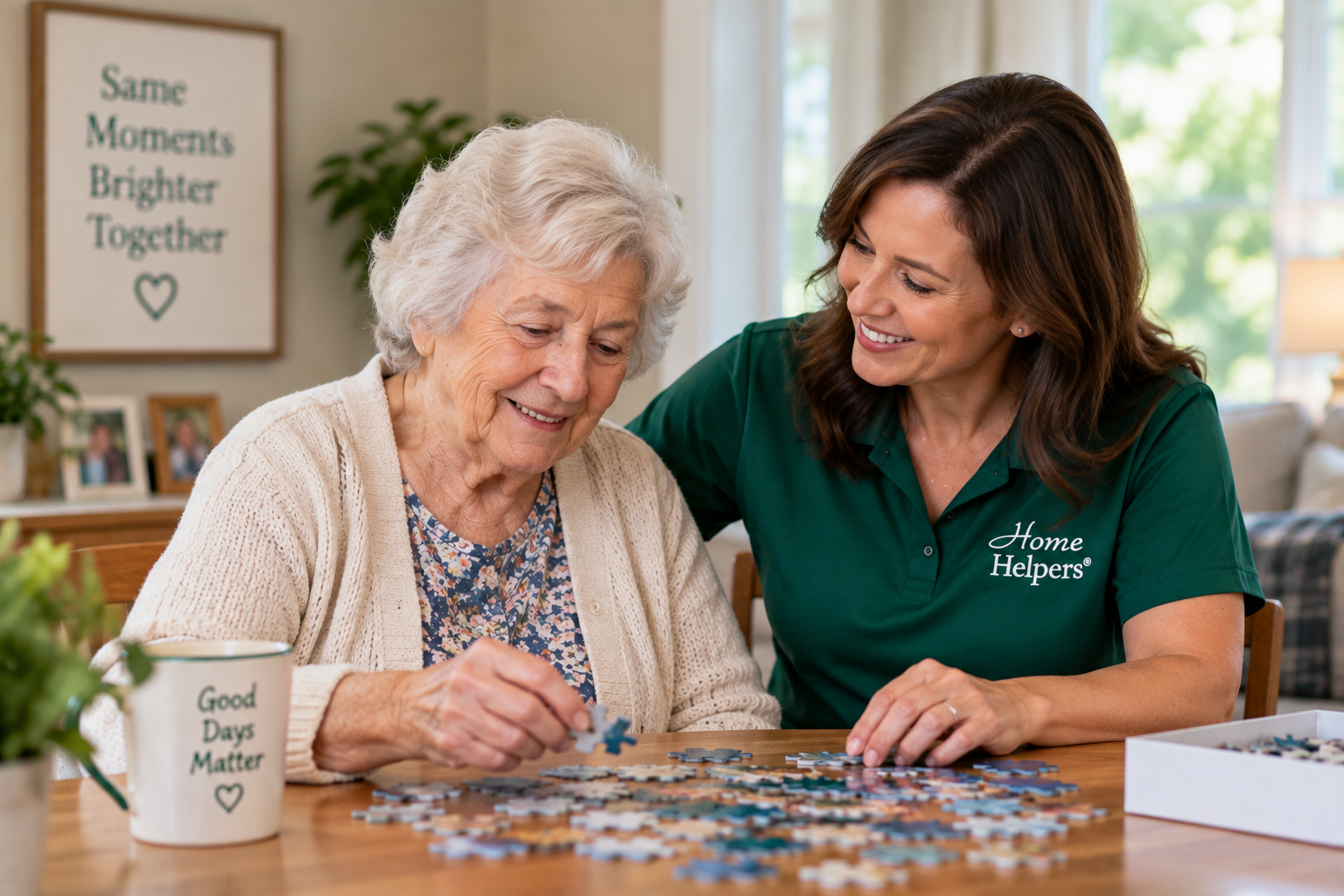
Dementia Care at Home in Ann Arbor: What to Expect, How to Prepare, and When to Ask for Help
Need Home Care?
Contact Us Today
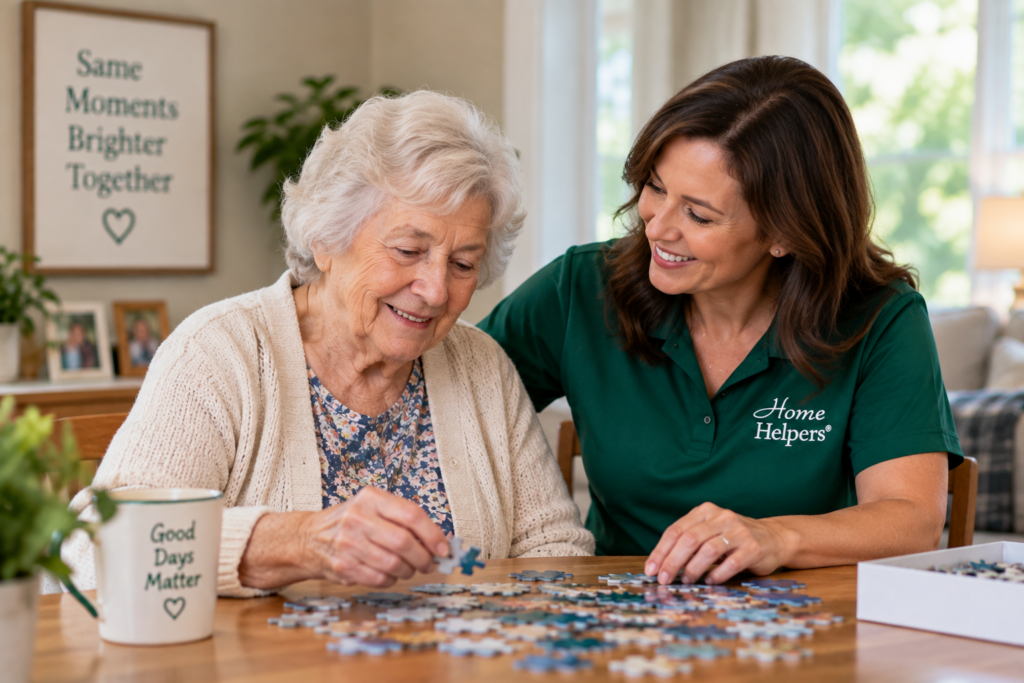
There’s a particular kind of exhaustion I see in families caring for a parent with dementia, and it doesn’t look like ordinary tiredness. It looks like something quieter and more layered. It’s the exhaustion of loving someone who is slowly becoming less recognizable, while also holding the grocery list, the medication schedule, the doctor appointments, the safety concerns, and your own life — all at once, without a clear end in sight.
If that’s where your family is right now, or where you can see yourselves heading, this is for you.
I’ve worked with dementia patients and their families for years, first as a chaplain and now as the owner of a home care agency in Ann Arbor. Dementia care at home is one of the most complex and most rewarding kinds of care we do, and it is also the kind that families most often try to handle alone for too long. Below is an honest picture of what dementia care at home actually looks like: the stages, what helps, when family caregiving stops being enough, and where to find real local support in Washtenaw County.
What “Dementia Care at Home” Actually Means
The phrase covers a wide range of situations. In the early stages, a parent with mild cognitive impairment or an early Alzheimer’s diagnosis may need only occasional support — someone to check in a few times a week, help with medication reminders, and provide company during the parts of the day that feel hardest. In the middle stages, they may need someone with them for most of the day, help with bathing and dressing, help with meals, and consistent supervision to keep them safe. In the later stages, they may need around-the-clock care and specialized techniques to manage the physical and behavioral realities of advanced dementia.
Home is almost always the goal. Familiar surroundings, familiar smells, familiar routines, and familiar faces all help a person with dementia feel more oriented and safer for longer than an unfamiliar environment would. That’s a real benefit, and it’s the reason so many families work hard to keep their parent at home.
Home is also, at some point in the disease, harder to sustain than families expect. Understanding what each stage tends to require can help you plan ahead instead of reacting to each new development.
The Stages, and What Each One Tends to Require
Dementia doesn’t move through neat phases the way a textbook suggests. Each person is different, and each type of dementia (Alzheimer’s, vascular dementia, Lewy body, frontotemporal, and others) has its own pattern. But a rough map of what tends to happen at each stage can help you prepare for what’s coming.
Early Stage
In the early stage, your parent is still mostly independent. They may forget appointments, repeat questions, misplace items, or get anxious in unfamiliar situations. They may still drive, still cook, still handle their own finances, but you’re starting to notice small shifts.
What tends to help in this stage: consistent daily routines, a shared calendar system, simplified medication management (a pill organizer filled weekly by a family member or a caregiver), and a home environment with fewer trip hazards and clearer visual cues. Some families benefit from a caregiver coming in a few times a week to help with specific tasks — grocery shopping, meal preparation, transportation to appointments, which also gives your parent a familiar face to build a relationship with before things get harder.
This is also the stage to have the harder conversations while your parent can fully participate in them. Advance care planning, medical power of attorney, wishes about future care — all of this is much easier to sort out now than it will be later.
Middle Stage
The middle stage is where most families first call an agency like ours. Your parent needs help with more of daily life. Getting dressed takes longer and often requires guidance. Meals need to be prepared for them, not just left for them. Medication needs to be given at the right times, not just organized. They may wander, become anxious in the afternoon and evening (a pattern often called “sundowning”), or have periods of confusion about where they are or who is with them.
Safety becomes a bigger concern. Cooking on the stove is often no longer safe. Bathing without assistance risks falls. Driving becomes off the table if it hasn’t already. The home environment usually needs modifications: grab bars, better lighting, secured medications, sometimes door alarms if wandering is a concern.
Family caregivers often try to handle the middle stage alone for as long as possible, and this is the stage where caregiver burnout most reliably arrives. If that’s where you are, our companion piece on caregiver burnout in Washtenaw County walks through what that actually looks like and where to find help.
In-home care in this stage is typically eight to twelve hours a day, or full daytime coverage with family covering nights, depending on your parent’s specific pattern.
Late Stage
In the late stage, your parent needs around-the-clock support. They may not recognize familiar people. They may lose the ability to walk or to speak clearly. Eating and swallowing may become difficult. Continence is usually a concern.
The care at this stage is intensive but not impossible at home, and many families do keep their parent home through the entire disease. What it requires is 24-hour caregiving (either through an in-home care agency, a rotating family schedule, or some combination), significant home modifications, and often coordination with hospice services when the qualifying conditions are met. If you’d like to understand how hospice, home health, and in-home care work together, our piece on the three buckets of senior care covers that in detail.
Some families reach a point where memory care in a facility becomes the right choice, and that isn’t a failure. It’s a decision that depends on the specific situation: the layout of the home, the family’s capacity, the parent’s specific behaviors, and the availability of trained caregivers.
What Families Don’t Anticipate About Dementia Care
A few things I would want every family to know before the middle stage arrives.
The Behavioral Changes Are Real and Often the Hardest Part
Physical caregiving is challenging but relatively predictable. What tends to catch families off guard is the behavioral side: the anxiety, the personality shifts, the repeated questions, the resistance to bathing, the accusations, the sundowning agitation. These are not intentional and they are not personal, but they can be exhausting and sometimes frightening. Caregivers trained specifically in dementia care use specific techniques, validation therapy, redirection, environmental modifications, that make an enormous practical difference. Families rarely have this training, and they shouldn’t have to.
Continuity of Caregiver Matters More than Usual
For most home care situations, a rotating team of caregivers is fine. For dementia care, it usually isn’t. A person with dementia relies on familiar faces to feel safe, and every new caregiver represents a small anxiety event. A good agency for dementia care will assign a small, consistent team, usually two or three caregivers your parent gets to know well — rather than sending a different person every shift.
The Evenings Will Get Harder Before the Mornings Do
Sundowning — the pattern of increased confusion, anxiety, and agitation in the late afternoon and evening — affects most people with dementia in the middle stages. Families often plan around morning routines because that’s when the day starts, but the harder hours are usually 4 pm to 8 pm. Coverage during those hours is often what tips a family from managing to overwhelmed.
The Care Extends Beyond Your Parent
Dementia care at home is really care of the whole family. The spouse of a person with dementia often carries the heaviest load and is at the highest risk for their own health decline. Adult children carry a different kind of weight: the anticipatory grief of watching a parent become someone different. A good caregiver holds space for all of that, not just for the direct care tasks.
If you’re trying to figure out what level of dementia care your family actually needs, or whether it’s time to bring someone in — you can schedule a free in-home assessment and we’ll walk through your specific situation together. No cost and no pressure to decide that day.
What to Look for in a Dementia-trained Caregiver
Not all caregivers are prepared for dementia care, and choosing an agency that treats dementia as a specialty (rather than a variation on standard care) matters a lot.
Look for:
- Specific dementia certification: programs like the Certified Dementia Practitioner (CDP) credential or the Alzheimer’s Association’s habilitation training
- Ongoing continuing education in dementia-specific techniques
- Experience with the specific challenges you’re describing — a caregiver who has worked with a wanderer, or with a person prone to sundowning, or with a spouse in early-stage dementia will bring skills that generalist experience doesn’t
- Personality fit: dementia care requires enormous patience, gentleness, and a willingness to meet the person where they are in the moment rather than trying to correct them back to reality
- Consistent scheduling so your parent sees the same faces regularly
At our agency, dementia care is one of our specialty areas, and the caregivers I match to dementia cases are chosen specifically for both training and temperament.
Environmental Changes That Help
The home itself can either support or work against dementia care. A few things that tend to help significantly:
- Consistent lighting, especially in the evening. Sundowning is often worse in dim light.
- Reduced clutter to make the environment easier to navigate and to reduce visual overwhelm.
- Familiar objects and photos in visible places to anchor memory.
- Safety modifications: grab bars in the bathroom, secured medications, stove safety devices, door alarms if wandering is a concern.
- Clear paths from the bedroom to the bathroom to the kitchen with no rugs to trip on.
- A quiet “soft space”: a comfortable chair in a quiet spot where your parent can retreat when overwhelmed.
A home health occupational therapist (available through Medicare after a hospital stay or a doctor’s order) can do a full home safety walkthrough and recommend specific modifications. Some in-home care agencies, including ours, will do a version of this as part of the free in-home assessment.
Local Resources for Dementia Families in Washtenaw County
You don’t have to do this alone. Ann Arbor and Washtenaw County have real resources for families navigating dementia:
- The Alzheimer’s Association Greater Michigan Chapter has a Washtenaw office and runs support groups, education programs, and a 24/7 helpline (1-800-272-3900).
- The U-M Health Memory and Mood Clinic is one of the top memory clinics in the country and can provide diagnostic and management support.
- AgeWays Non-Profit Senior Services (formerly the Area Agency on Aging 1-B) coordinates resources for Washtenaw County families.
- JFS WISE provides aging services including social work support for families dealing with dementia.
- Adult day programs in Washtenaw County offer daytime engagement and respite for family caregivers.
- Memory cafes and support groups meet regularly through the Alzheimer’s Association and through some local senior centers.
If you’d like a personal recommendation for any of these based on your specific situation, that’s something I can help with directly — I’ve referred many families to specific resources over the years and I keep an updated list.
When to Consider Memory Care Instead of Home
Memory care, a specialized residential facility designed for people with dementia, is the right choice for some families and the wrong choice for others. There’s no universal answer.
Signs that memory care might be the right conversation to have:
- The home cannot be made safe enough, even with modifications, for your parent’s specific behaviors
- Wandering has become a serious safety risk and cannot be reliably prevented at home
- The primary family caregiver’s own health is declining because of the caregiving load
- Around-the-clock in-home care is financially unsustainable and family cannot cover the gaps
- Your parent’s needs have progressed beyond what home care can safely provide
- The isolation of home is doing more harm than the community of a memory care facility would
Signs that staying home may still be the right choice:
- Your parent is more calm and oriented at home than they are in unfamiliar settings
- Home modifications and consistent caregivers are keeping things safe and manageable
- The family has capacity to sustain the coordination it requires
- Hospice services can be layered in if the medical picture warrants it
This is one of the conversations I have with families most often, and I’ll say the same thing here that I say in person: there is no right answer that fits everyone. Some families keep their parent home through the entire disease and are grateful they did. Some families move their parent to memory care and are grateful for the community, structure, and specialized support the facility provides. Neither choice is a failure of love.
Frequently Asked Questions
How much does dementia care at home cost in Ann Arbor?
Dementia-specialized in-home care in Ann Arbor typically runs $35 to $42 per hour in 2026, slightly higher than standard care because of the specialized training and continuity requirements. Monthly costs depend on the level of coverage. Daytime-only coverage typically runs $5,000 to $7,000 per month, and 24-hour care can run $15,000 to $22,000 per month. Our companion piece on home care cost walks through the payment options in detail, including VA benefits, long-term care insurance, and MI Choice Waiver eligibility.
Does Medicare cover dementia care at home?
Original Medicare does not cover non-medical dementia care at home. Medicare does cover short-term home health (nursing visits, physical therapy) when doctor-ordered after a hospital stay or new diagnosis, and it covers hospice completely for those who qualify. The extended daily care that most dementia families need is not covered by Medicare. Some Medicare Advantage plans now offer very limited in-home care benefits, but not enough to cover a real dementia care plan.
When should we consider adding a caregiver for dementia care?
I would suggest most families start bringing in help sooner than they think they need to, ideally in the transition from early to middle stage. Waiting until the family caregiver is completely overwhelmed is common but not ideal. Even a few hours a week early on builds the caregiver relationship, makes future changes easier, and gives the family caregiver breathing room. If you’re already exhausted, it’s not too late, but it’s also a sign it’s time.
How do we handle it when Mom refuses to let a caregiver in the house?
This is one of the most common challenges in dementia care, and it doesn’t usually get resolved with a direct conversation. A few things that tend to help: start with very small visits (one hour, one specific task, one warm and patient caregiver), frame the caregiver as a friend or helper rather than a caregiver, and let the relationship build slowly over several visits before increasing hours. Sometimes it takes a specific approach — a caregiver who cooks a favorite meal, or who shares a hobby, or who is simply the right personality for your parent. A good agency will work with you on this, not around it.
What’s the difference between dementia care and memory care?
Dementia care at home is exactly what it sounds like — specialized in-home care for someone with dementia, provided in their own house. Memory care is a specific type of residential facility designed for people with dementia, typically featuring secured environments to prevent wandering, staff trained specifically in dementia care, and structured daily programming. Both can be excellent choices depending on the family’s situation. Neither is inherently better than the other.
A Word About the Harder Truth
I want to say one more thing before I close, because it’s the thing families most often need someone to say out loud.
Dementia is not a disease anyone can love their way out of. Doing more, sleeping less, refusing to accept help. None of these change the trajectory of the disease. What they do change is the toll it takes on the family caregiver.
The most consistent pattern I’ve seen over years of this work is that the families who bring in help earlier, who set up structure and support before the crisis point, are the ones who make it through with their own health intact and with their relationship with their parent still recognizable. The families who wait until they can’t do it anymore often lose two people to the disease instead of one.
If you’re carrying this right now, please know: asking for help isn’t failing at love. It’s making space for love to keep going.
If you’d like to talk through your specific situation, you can schedule a free in-home assessment with me. There’s no cost and no pressure to decide that day. If in-home care isn’t the right answer for where you are, I’ll tell you what I think would help instead.
About the Author
Elizabeth Snyder Corman is the owner of Home Helpers Home Care of Ann Arbor, serving families in Ann Arbor, Saline, Dexter, Chelsea, Pinckney, and Whitmore Lake. Before opening the agency, she served as a hospital chaplain through the COVID-19 pandemic and as a hospice chaplain, walking with families through some of the hardest transitions of their lives. She holds an M.Div. and specializes in supporting families navigating dementia, hospice-appropriate home care, and post-hospitalization transitions.
Want the full picture? Read our companion piece on caregiver burnout in Washtenaw County, or schedule a free in-home assessment to talk through your specific situation.
The Most Comprehensive Care In The Industry

Physical Wellness
We make daily life easier as needs change, with support for personal care, mobility, medication reminders, and recovery after a hospital stay.
Learn More
Mental Well-Being
Staying active and connected matters. Our caregivers provide companionship and meaningful engagement to support emotional health and independence.
Learn More
Nutrition & Hydration
Healthy meals and proper hydration are essential. We help with planning, shopping, and preparation to support daily wellness and energy.
Learn More
Active Connections
Strong relationships bring comfort and purpose. We help seniors stay connected through social engagement, technology, and regular check-ins.
Learn More