VA Aid and Attendance: How Michigan Veterans and Their Spouses Can Get Help Paying for Home Care
Need Home Care?
Contact Us Today
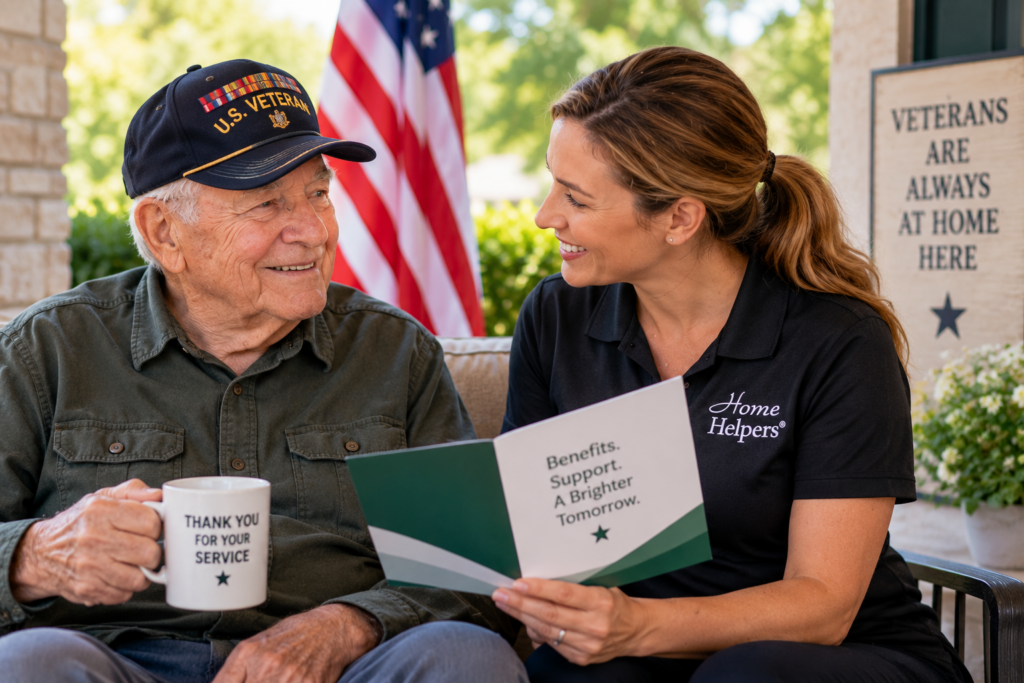
There’s a conversation I’ve had more times than I can count, and it goes almost exactly the same way every time.
A family calls about home care for their father. We talk through what he needs and what it would cost. There’s a pause while they do the math in their head, and then someone says quietly that they’re not sure how they’ll manage it. And then, usually as an aside, someone mentions that Dad was in the service.
That aside changes everything. And most families have no idea it does.
The Department of Veterans Affairs administers a benefit called Aid and Attendance that pays qualifying veterans and their surviving spouses a monthly, tax-free amount that can be used to pay for in-home care. As of this writing the maximum for a married veteran is roughly $2,795 a month, though the VA adjusts these rates every year, so check the current figure at va.gov or with the Michigan Veterans Affairs Agency before you count on a number. It is one of the most consequential benefits available to older Americans, and it is dramatically underused.
Michigan has a large population of Vietnam-era veterans who are now in their late seventies and eighties, which is exactly the population that needs this benefit most. If your parent served, please read this before you pay for a single month of care out of pocket.
What Aid and Attendance Is
Aid and Attendance is not a standalone program. It’s an increased monthly payment added on top of a VA pension for veterans and surviving spouses who need help with daily living.
The underlying benefit is the VA Pension, sometimes called the Improved Pension or the Non-Service-Connected Pension. It’s a needs-based benefit for wartime veterans with limited income and assets. Aid and Attendance is an enhancement to that pension for people who require the aid and attendance of another person.
Two things make this benefit unusually valuable for families paying for home care.
First, it does not require a service-connected disability. This is the piece most families get wrong. Your father does not need to have been injured in service. He does not need an existing VA disability rating. The qualifying condition is his current need for help, not something that happened to him decades ago.
Second, the money is paid directly to the veteran or surviving spouse and can be spent on care. The VA doesn’t dictate which agency you use or how the care is structured. It’s a monthly deposit that you can put toward whatever care arrangement fits.
What the Monthly Amounts Look Like
The maximum annual pension rates adjust every year, usually each December. The approximate monthly maximums with Aid and Attendance at the time of writing are:
- Married veteran: up to about $2,795 per month
- Single veteran: up to about $2,358 per month
- Surviving spouse of a veteran: up to about $1,515 per month
- Two veterans married to each other: a higher combined rate
Please look up the current year’s figures before planning around them. The VA publishes them at va.gov, and the Michigan Veterans Affairs Agency (1-800-642-4838) will confirm what applies to your situation. Numbers in any article age, including this one.
These are maximums. The actual amount is calculated based on the difference between the maximum rate and your countable income, so a veteran with more income receives less. There is one detail in that calculation that families often do not know about: unreimbursed medical expenses, including the cost of in-home care, get subtracted from your countable income.
That means paying for home care can be what makes you eligible, or what increases the amount you receive. I have watched families assume they made too much to qualify, only to find out that once their monthly care costs were factored in, they qualified comfortably.
Who Qualifies
There are three sets of criteria: service, medical need, and financial.
Service Requirements
The veteran must have served at least 90 days of active duty, with at least one of those days during a recognized wartime period, and must have been discharged under conditions other than dishonorable.
The wartime periods most relevant to families reading this:
- World War II: December 7, 1941 – December 31, 1946
- Korean War: June 27, 1950 – January 31, 1955
- Vietnam War: February 28, 1961 – May 7, 1975 (for those who served in Vietnam), or August 5, 1964 – May 7, 1975 (for all other veterans)
- Gulf War: August 2, 1990 – present (as of this writing, still open)
Note what this does and does not require. Your parent did not need to serve in combat. They did not need to be deployed overseas. They needed to be on active duty during one of those date ranges. A veteran who spent his entire service at a base in Texas during 1968 meets the service requirement.
For veterans who entered service after September 7, 1980, there are additional minimum-duty requirements, but that’s rarely relevant to the age group we’re discussing.
Medical Need Requirements
The veteran or surviving spouse must need the regular aid and attendance of another person. The VA looks for at least one of the following:
- Needing help with activities of daily living such as bathing, dressing, eating, toileting, or transferring
- Being bedridden due to disability
- Being a patient in a nursing home due to physical or mental incapacity
- Having eyesight limited to 5/200 or less in both eyes with corrective lenses, or a concentric contraction of the visual field to 5 degrees or less
The most common qualifying path is simply needing help with daily activities. A physician documents this on VA Form 21-2680, the Examination for Housebound Status or Permanent Need for Regular Aid and Attendance.
Financial Requirements
This is where families get discouraged, sometimes unnecessarily.
At the time of writing the net worth limit is approximately $159,240, and that figure includes both assets and annual income. It also adjusts annually, so confirm the current limit before ruling yourself in or out. A few important exclusions:
- The primary residence is not counted, along with a reasonable lot area
- A vehicle is not counted
- Personal belongings and household goods are not counted
And again, the income calculation subtracts unreimbursed medical expenses, including ongoing home care costs, insurance premiums, and other medical spending.
There is also a three-year look-back period on asset transfers. The VA will review whether assets were given away or transferred below fair market value in the three years before the application, and may impose a penalty period. This is why families who are considering this benefit should talk to someone before restructuring finances.
If you’re trying to figure out what care would cost and whether VA benefits could cover part of it, you can schedule a free in-home assessment and we’ll walk through both together. There’s no cost and no pressure to decide that day.
What Families Most Often Get Wrong
A few misconceptions I run into constantly.
“He wasn’t injured, so he doesn’t qualify.” This is the single most common reason families never apply. Aid and Attendance is not a disability benefit. It does not require any service connection to the current health condition.
“We make too much money.” Possibly, but run the numbers with care costs subtracted before deciding. A veteran with $4,000 a month in income and $3,500 a month in home care expenses looks very different to the VA than a veteran with $4,000 a month in income and no medical expenses.
“We have too much in savings.” Check the actual limit, and remember the house and car don’t count. Families frequently assume they’re over when they aren’t.
“My mother can’t apply because my father was the veteran and he passed away.” Surviving spouses of wartime veterans can qualify, as long as they were married at the time of the veteran’s death and did not remarry. The benefit amount is lower but still meaningful.
“He was never in combat.” Irrelevant to eligibility. Service during a wartime period is what matters, not where.
“We’d have to spend down everything first.” The net worth limit is real, but it isn’t zero, and the primary residence is excluded. This is not Medicaid.
How to Apply
The application process is paperwork-heavy, which is the main reason so few eligible families complete it. The practical shape of it looks like this.
The main form is VA Form 21P-527EZ (Application for Veterans Pension) for a living veteran, or VA Form 21P-534EZ for a surviving spouse.
You will also need VA Form 21-2680, the medical examination form, completed by your parent’s physician documenting the need for aid and attendance.
Supporting documents typically include:
- DD-214 or other discharge paperwork (this is the one families most often can’t find — start looking early)
- Marriage certificate, and death certificate if applying as a surviving spouse
- Documentation of all income sources
- Documentation of assets
- Documentation of ongoing medical and care expenses, including a care agreement or invoices from your home care agency
- Bank account information for direct deposit
Where to get help with the application. This is important, because doing it alone is difficult and doing it wrong causes months of delay.
- Michigan Veterans Affairs Agency: 1-800-MICH-VET (1-800-642-4838). They provide free assistance and are a good first call.
- County Veteran Service Officers: Washtenaw County has accredited service officers who help with VA claims at no charge. This is often the most practical route.
- Accredited Veterans Service Organizations: the VFW, American Legion, DAV, and others have accredited representatives who can file on your behalf for free.
- VA-accredited attorneys or claims agents: these can be helpful for complex financial situations, but be aware that anyone charging you a fee to prepare an initial claim is violating VA rules. Accredited representatives may charge for appeals, not for initial applications.
Be cautious of anyone who charges to help you apply. There is an entire industry of people who charge fees to file Aid and Attendance claims, sometimes bundled with financial products designed to restructure assets. Free accredited help is available. Use it.
How Long It Takes
Realistically, expect several months. Processing times vary considerably, and incomplete applications are the main cause of delay.
Two things worth knowing:
Benefits are generally paid retroactive to the date the VA received your intent to file. If you submit VA Form 21-0966 (Intent to File) first, that starts the clock while you gather the rest of the paperwork. This is worth doing on day one.
There is an expedited process for applicants over 90 years old and in certain hardship circumstances.
Because of the timeline, the practical advice is simple: start the application before you desperately need the money. Families who apply while care is still manageable are in a much better position than families who apply during a crisis.
Using Aid and Attendance for In-home Care Specifically
Once approved, the monthly benefit is deposited like any other income and you decide how to use it. Most families we work with put it directly toward their care bill.
A few practical notes from the home care side:
Keep good documentation of care costs. The VA needs to see ongoing unreimbursed medical expenses to maintain your award, and they periodically request updated information. A home care agency that provides clear monthly invoices makes this much easier.
A written care agreement helps. Having a formal agreement documenting the care being provided, the schedule, and the rate strengthens both the initial application and any subsequent review.
In-home care generally counts as a medical expense for VA purposes when the person receiving care requires assistance with activities of daily living, which is the same standard used to qualify for Aid and Attendance in the first place.
At our agency we’re familiar with the documentation VA families need and can provide it as a matter of course. If you’re working with a different agency, ask them directly whether they’ve handled VA situations before.
Frequently Asked Questions
Does the VA pay for home care in Michigan?
Not directly through Aid and Attendance, but effectively yes. Aid and Attendance is a monthly cash benefit paid to the veteran or surviving spouse, and it can be used to pay for in-home care from any agency you choose. Separately, the VA does operate some direct care programs, including Homemaker and Home Health Aide services and the Veteran-Directed Care program, which are administered through VA medical centers and have their own eligibility rules. Those are worth asking your parent’s VA provider about as well.
My father has a service-connected disability rating. Does that affect this?
It can. Veterans receiving VA disability compensation cannot receive VA pension at the same time — you receive whichever is greater. If your father has a significant disability rating, his compensation may already exceed what pension with Aid and Attendance would pay. A County Veteran Service Officer can compare the two for your specific situation.
How far back will the VA pay?
Generally back to the date they received your Intent to File form, or your application if you didn’t file an intent first. This is why submitting VA Form 21-0966 early matters — it preserves your effective date while you gather documentation.
Can my mother qualify if my father died years ago?
Yes, if she was married to him at the time of his death, has not remarried, and meets the medical and financial criteria herself. The surviving spouse rate is lower than the veteran rate but can still be a meaningful contribution toward care costs.
What if we get denied?
Denials are common and appealable, and many are the result of incomplete documentation rather than actual ineligibility. If you’re denied, work with an accredited representative on the appeal. This is one situation where a VA-accredited attorney may be appropriate, since they can charge for appeal representation.
Where do I find my father’s DD-214?
If you can’t locate it, you can request it from the National Archives through the National Personnel Records Center. Requests can be made online, and next of kin can request records for a deceased veteran. Start this early — it’s the document that most often holds families up.
What I’d Want Every Michigan Veteran Family to Know
If your parent served during a wartime period and now needs help at home, please look into this before you assume you can’t afford care.
I’ve watched families spend down savings for a year, then discover they’d been eligible the entire time for a benefit that would have covered a meaningful share of the cost. The money doesn’t come back. The only remedy is applying earlier than you think you need to.
Start with a call to the Michigan Veterans Affairs Agency at 1-800-MICH-VET or to a Washtenaw County Veteran Service Officer. Both are free. Both do this every day.
And if you’d like help thinking through what level of care your family needs, and what the monthly cost would look like with or without a VA benefit in the picture, you can schedule a free in-home assessment. There’s no cost and no pressure to decide that day. I’ll give you a straight answer about what I think would help, and I’ll tell you if I think you should be talking to someone else instead.
About the author
Elizabeth Snyder Corman is the owner of Home Helpers Home Care of Ann Arbor, serving families in Ann Arbor, Saline, Dexter, Chelsea, Pinckney, and Whitmore Lake. She holds an M.Div. and served as a hospital chaplain through the COVID-19 pandemic and as a hospice chaplain before opening the agency. She works regularly with veteran families navigating VA benefits alongside their care decisions.
This article is general information, not legal or benefits advice. Eligibility rules and benefit amounts change. Confirm your specific situation with the Michigan Veterans Affairs Agency, a County Veteran Service Officer, or a VA-accredited representative.
The Most Comprehensive Care In The Industry

Physical Wellness
We make daily life easier as needs change, with support for personal care, mobility, medication reminders, and recovery after a hospital stay.
Learn More
Mental Well-Being
Staying active and connected matters. Our caregivers provide companionship and meaningful engagement to support emotional health and independence.
Learn More
Nutrition & Hydration
Healthy meals and proper hydration are essential. We help with planning, shopping, and preparation to support daily wellness and energy.
Learn More
Active Connections
Strong relationships bring comfort and purpose. We help seniors stay connected through social engagement, technology, and regular check-ins.
Learn More